Education is a fundamental right, yet not every child experiences learning in the same way. Some children grasp concepts quickly, while others need visual support, repeated practice, additional time, or a different way of engaging with material.
For children with learning, developmental, communication, attention, memory, or motor-related difficulties, the challenge is often not a lack of ability — it’s that the way learning is presented becomes a barrier.
Reducing learning barriers means creating more accessible and flexible opportunities for children to participate, understand, practise, and progress according to their individual needs. VergeTAB supports this by providing interactive, structured learning experiences that give children different ways to engage with educational content.
Understanding Learning Barriers
Learning barriers look different for every child. A child may:
Find it difficult to maintain attention during an activity
Need repeated practice to understand and remember a concept
Struggle to follow lengthy verbal instructions
Require additional time to complete tasks
Find traditional worksheets difficult or unengaging
Lose interest when learning doesn’t match their level or needs
These challenges shouldn’t be viewed as limits on a child’s potential. Instead, they point to a more useful question: What is making learning difficult for this child, and what support could help reduce that barrier?
Sometimes a small change in how a concept is presented creates a much greater opportunity for participation and learning.
Every Child Learns Differently
Learning barriers don’t define a child’s ability. The right combination of visual support, interaction, repetition, time, and encouragement can create more opportunities for meaningful participation.
Different Barriers Need Different Approaches
There’s no single teaching method that works for every learner:
Attention challenges → Interactive, engaging activities encourage active participation where traditional formats fall short.
Memory and retention difficulties → Children may understand a concept in one session but struggle to recall it later. They benefit from repeated opportunities to revisit what they’ve learned.
Trouble following verbal instructions → Visual materials, demonstrations, and interactive activities make instructions easier to understand.
Coordination difficulties → Repeated, low-pressure opportunities to interact with materials help build controlled movement over time.
Different learning speeds → Being able to revisit activities at an appropriate pace reduces unnecessary pressure.
The goal isn’t to make every child learn the same way; it’s to give every child a meaningful path to learning.
How VergeTAB Helps Reduce Learning Barriers
Technology can’t remove every barrier on its own. But alongside appropriate teaching and support, it gives children more ways to access and engage with learning through:
Visual learning materials
Audio support
Touch-based activities
Interactive exercises
Matching and identification activities
Structured digital learning activities
Repeated practice
These features let children see, hear, touch, practise, and actively participate rather than simply listen or complete a static worksheet. Because activities can be revisited freely, children get structured opportunities to reinforce learning at their own pace, without pressure.
Different Ways to Engage with Learning
Learning Need
VergeTAB Support
Attention
Interactive activities
Memory and retention
Repeated practice
Verbal instruction
Visual and audio support
Hand-eye coordination
Touch-based activities
Different learning pace
Activities that can be revisited
Active participation
Interactive exercises
How VergeTAB supports different learning needs through flexible, interactive activities.
A Real Experience from the Classroom
While working with children in a school environment, I observed some meaningful changes through VergeTAB.
Two children initially experienced significant difficulties with hand-eye coordination. Touching the correct option on the tablet and completing touch-based activities was challenging, so they required additional time and support.
Over weeks, they grew more comfortable with touch-based activities and showed gradual improvement in coordination. More encouraging was their increased willingness to participate. Activities that once felt difficult gradually became familiar, and the children showed greater interest and confidence during learning sessions.
This supported an important point: when a child gets repeated, engaging opportunities to practise, a barrier that once limited participation can gradually become manageable.
Teachers also noticed positive changes in:
Participation
Interest in learning activities
Engagement during sessions
Willingness to interact with materials
Overall learning progress
A Small Achievement That Made a Big Difference
One experience stood out in particular: a child learning to identify colours.
It took almost two months of consistent practice, but the child eventually learned to identify two or three colours. From the outside, that might look like a small step. For that child, it was a meaningful milestone.
Learning progress can’t always be measured through conventional academic benchmarks. Sometimes progress means identifying a new colour, remembering something learned earlier, completing an activity independently, or simply participating more actively in a session. Every small step can represent significant progress in a child’s individual journey.
Small Steps Are Meaningful Progress
Learning progress isn’t always measured by academic milestones. Identifying a colour, completing an activity independently, remembering a previously learned concept, or participating more actively can all represent meaningful progress.
Supporting Teachers, Not Replacing Them
Technology doesn’t replace teachers — it supports their efforts by offering different ways to present concepts, encourage participation, and provide repeated practice. VergeTAB provides teachers with opportunities to observe how children respond to different learning approaches, helping them understand individual needs and plan appropriate next steps. The tools are additional; the teacher’s guidance and encouragement remain essential.
Reducing barriers creates more opportunities for children to experience success. When a child completes or participates in an activity with less support than before, even a small win builds confidence and motivates them to attempt the next challenge.
Conclusion
Every child faces different barriers to learning, and meaningful support starts with understanding those barriers rather than focusing on limitations. VergeTAB gives children additional ways to access, practise, and engage with learning according to their individual needs. It works best when combined with skilled teaching, appropriate content, and consistent support at home.
When technology, teachers, and families work together, small steps become meaningful progress. Every child’s progress deserves to be recognised and celebrated.
Want to see how VergeTAB can support the learners in your classroom or at home?
Explore how interactive, structured activities can give children more opportunities to access, practise, and engage with learning at their own pace.
Every special educator walks into the classroom with one goal: to help each learner grow and reach their potential. But no two learners are the same. In a single classroom, one child may need visual support, another needs repeated practice, and a third needs extra prompts or a different pace entirely.
Alongside teaching, educators are also responsible for lesson planning, creating individualised materials, tracking progress, documenting achievements, and staying in sync with parents and therapists. Balancing all of that while making sure every learner gets the right support is genuinely hard, and it’s where the right digital tools can make a real difference in day to day classrooms.
The Everyday Reality of a Special Education Classroom
Special education teachers navigate a moving target every day. One student may be working on identifying basic concepts while another is building communication skills or working towards greater independence, often in the same room, during the same hour.
That means constant adaptation: different activities, varying levels of support, repeated instructions, and individual progress monitored over time, all without losing the rest of the class. Preparing separate materials for each learner, keeping everyone engaged, managing behaviour, and maintaining accurate records take real time and effort, time that often gets pulled away from direct teaching and one to one interaction.
In practice, this can mean preparing multiple versions of the same activity, checking where each learner left off, and adjusting the next task before the lesson even begins.
Every Learner Has Different Needs
Different learning speeds, support levels, communication abilities, and learning goals require educators to adapt activities and instruction.
Making Personalised Learning Practical
Personalised learning means recognising that each learner needs a different approach, pace, and level of support, and putting that into practice every day, not just in theory.
This is easier when teachers have the right tools to organise and deliver instruction. The XceptionalLEARNING (XL) Platform is designed to help educators build learning experiences around each student’s individual goals, abilities, and pace. Teachers can organise resources, assign activities, and manage content from one place — making it more practical to offer repeated practice, choose suitable materials, and plan around individual needs, rather than building every resource from scratch.
Creating More Engaging Learning Experiences
Keeping every learner engaged is its own challenge. Children respond differently to traditional teaching methods, and many do better with visual, interactive, activity-based learning.
Through VergeTAB, students can access the activities their teacher has assigned in a structured, distraction-free environment. Interactive pictures, videos, animations, and activity based lessons are designed to encourage participation and support understanding, and because the content is selected and assigned by the teacher, it stays focused on what that learner actually needs, without the pull of unrelated apps.
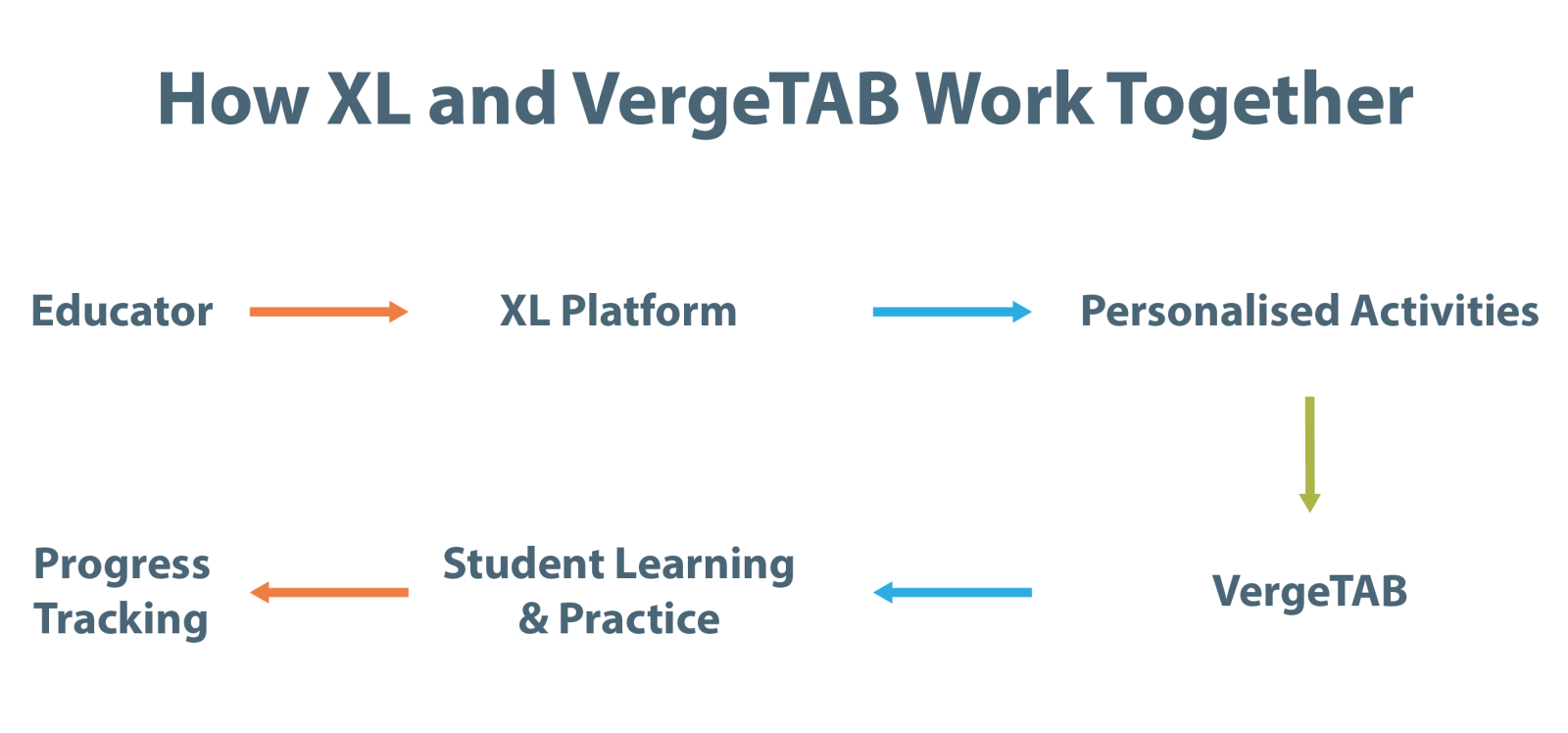
XL helps educators personalise and track learning, while VergeTAB delivers those assigned activities in a focused learning environment.
Supporting Better Educational Decisions Through Progress Tracking
In special education, progress often shows up in small, easy-to-miss changes: a learner needing fewer prompts, staying engaged longer, completing a task more independently, or applying a learned skill in a new situation.
Keeping track of these changes is what makes it possible to know what’s working and what needs to shift. The XL Platform helps teachers keep organised progress records, making it easier to review achievements, spot learning gaps, and plan next steps. Clear, well-organised documentation can also be a useful input into Individualised Education Planning (IEP) discussions, alongside the educator’s own clinical and professional judgement.
Building Stronger Partnerships with Parents and Therapists
A learner’s development doesn’t rest on one person. Teachers, parents, and therapists all play a role, and consistency across those environments strengthens learning.
When progress information lives in one organised place, conversations between school, home, and therapy become more concrete and productive. Clear documentation helps everyone stay aligned on a learner’s strengths, current challenges, and next goals.
Technology as a Support for Educators
Technology cannot replace the knowledge, patience, and compassion of a special educator. Its role is to support them, simplifying routine tasks and freeing up more time for teaching and direct student interaction.
Together, the XL Platform and VergeTAB offer practical tools for lesson management, engagement, progress tracking, and collaboration. The goal isn’t to make teaching dependent on technology — it’s to make personalised education a little easier to organise and deliver, every day.
Conclusion
Each learner deserves an education built around their unique abilities and potential. That’s easiest to deliver when educators have tools that simplify planning, support engagement, and offer real insight into student progress, without adding to their workload.
By reducing administrative load and making personalisation more manageable, the XL Platform and VergeTAB give educators more room to do what matters most: help students build confidence, independence, and the foundation for lifelong success.
Ready to Make Personalised Learning More Manageable?
If you’re a special educator, school leader, or therapist looking to make personalised learning easier to plan, deliver, and track, connect with the XceptionalLEARNING team.
Building Foundational Learning Through Digital Colour Concept Instruction
Colour recognition is one of the earliest cognitive and visual discrimination skills that children develop. For children with special educational needs (SEN), understanding colour concepts is not simply about identifying different colours — it is a critical developmental milestone that supports communication, cognitive growth, environmental awareness, academic readiness, and independent living skills.
Children with developmental disabilities, intellectual disabilities, autism spectrum disorder (ASD), and other learning differences often require structured, individualised, and repetitive instruction to acquire foundational concepts. Digital assistive technology can provide an engaging medium for delivering structured, evidence-informed learning activities and supporting meaningful practice.
At XceptionalLEARNING, VergeTAB — our purpose-built learning tablet — serves as an innovative educational tool that combines technology with individualised teaching strategies. By integrating interactive digital content, educators can create highly engaging learning environments that motivate children while supporting their unique learning needs.
Why Colour Concepts Matter in Special Education
Colour concepts form the basis of numerous functional and academic skills. Before children can classify objects, follow classroom instructions, organise materials, or describe their surroundings, they must first understand and apply colour concepts in meaningful contexts.
For children with special educational needs, learning colours supports the development of visual discrimination, receptive and expressive language, cognitive processing, and concept formation. It also strengthens attention and concentration, functional communication, object classification, pre-academic readiness, and everyday environmental awareness — skills that show up well beyond the classroom, from sorting laundry by colour at home to identifying a favourite toy on a cluttered shelf.
Because every learner progresses at a different pace, colour instruction should be individualised, systematic, and reinforced through repeated practice across multiple learning environments.
What Colour Learning Supports
Visual discrimination
Concept formation
Receptive and expressive language
Attention and concentration
Object classification
Functional communication
Pre-academic readiness
Everyday independence
From Matching to Meaning: A Step-by-Step Approach to Colour Learning
Colour learning often develops progressively. Depending on the learner’s abilities and goals, educators may begin with simple matching before moving towards identification, naming, classification, and generalisation:
Matching — Match objects or pictures with the same colour.
Identification — Select a requested colour from several choices.
Labelling — Name or communicate the colour.
Sorting — Group objects according to colour.
Following instructions — Respond to directions such as “Give me the blue ball.”
Generalisation — Identify colours across different objects, pictures, and everyday environments.
This staged progression allows educators to meet each learner at their current level and build systematically towards more complex, functional use of colour concepts.
Colour Recognition Activities for Children with Special Needs
To support colour concept acquisition, a structured set of digital learning activities was developed using the XceptionalLEARNING platform and delivered through VergeTAB. The instructional resources were carefully designed to address different learning styles while supporting learner engagement through activities such as:
Interactive colour activities
Colour matching tasks
Picture-based learning tasks
Digital worksheets
Short educational videos
Reinforcement activities
Digital assessments
Repeated practice sessions
Together, these activities allow each learner to progress through material at a pace suited to their own developmental needs, moving through the matching-to-generalisation stages outlined above.
How VergeTAB Supports Digital Colour Learning
The gamified nature of VergeTAB’s learning activities can make instruction more engaging and enjoyable. Instead of passively receiving information, learners actively participate in interactive tasks that encourage exploration, problem-solving, and independent responses. This learner-centred approach increases motivation and helps sustain attention throughout each session.
VergeTAB also enables educators to design personalised interventions that align with each learner’s Individualised Education Programme (IEP) goals while maintaining high levels of engagement. Interactive digital resources support data-driven instruction by allowing educators to monitor progress and adapt learning activities according to each learner’s developmental needs.
How VergeTAB Supports Colour Learning
Interactive digital activities
Visual matching tasks
Picture-based learning
Digital worksheets
Short educational videos
Reinforcement activities
Repeated practice
Digital assessment activities
Digital activities can complement hands-on teaching by providing additional opportunities for structured practice and reinforcement.
The Importance of Repetition in Concept Development
Children with special educational needs often benefit from explicit instruction combined with consistent repetition. Repeated exposure allows learners to strengthen memory, improve processing speed, and gradually generalise newly acquired concepts across different environments.
Using VergeTAB, educators provided repeated opportunities for learners to engage with colour-based activities through videos, digital worksheets, visual prompts, interactive games, and picture-based exercises. Each learning experience reinforced previously introduced concepts while gradually increasing the learner’s confidence and independence. The structured progression of activities also allowed learners to build understanding at their own pace without unnecessary cognitive overload.
From Recognition to Meaningful Understanding
With consistent instruction and repeated practice, learners were observed progressing from simple colour recognition towards more meaningful use of colour concepts, responding appropriately during structured activities and using colour names more confidently in functional communication.
For example, some learners who initially matched colours only within a fixed activity began, over time, to apply the same concept to new and unfamiliar objects — recognising “red” on a jumper, a fruit, or a toy car, rather than only within the original app or worksheet. This kind of generalisation across contexts is an important indicator of meaningful concept acquisition, and it is a primary goal in special education instruction.
The engaging nature of the activities provided through VergeTAB supported regular participation and additional opportunities for practice over time.
Recognition vs understanding
Recognition
Understanding
Identifies a familiar colour
Identifies colour across different objects
Matches identical colours
Sorts objects by colour
Responds correctly in one activity
Applies the concept in new activities
Recognises colour in a picture
Recognises colour in everyday environments
The goal is not simply to recognise a colour, but to understand and use the concept across different situations.
The Role of Technology in Inclusive Education
Technology can complement traditional teaching by giving educators additional ways to present concepts, provide repeated practice, offer visual and multisensory learning experiences, and adapt activities to individual learning goals. When integrated with evidence-based instructional practices, digital tools can support more flexible and inclusive learning environments.
Conclusion
Teaching colour concepts is far more than helping children identify different colours. It is about developing foundational cognitive abilities that support communication, learning, problem-solving, and everyday independence.
The integration of VergeTAB with the XceptionalLEARNING platform demonstrates how thoughtfully designed digital resources can make concept learning engaging, meaningful, and accessible for children with special educational needs. Through individualised instruction, gamified learning experiences, consistent reinforcement, and repeated practice, educators can help learners move beyond simple recognition toward a deeper understanding of colour concepts.
As special education continues to embrace innovative digital solutions, technology-driven interventions such as VergeTAB are creating more inclusive classrooms where every child has the opportunity to learn, participate, and achieve success according to their unique abilities. By combining structured teaching strategies with engaging digital content, educators can build strong conceptual foundations that support lifelong learning and greater independence for children with diverse learning needs.
See How VergeTAB Can Support Foundational Learning
Explore how VergeTAB can help educators and therapists deliver structured digital activities, repeated practice, and engaging learning experiences for children with special educational needs.
When Learning Feels Confusing, Participation Stops Before Learning Does
For many children with special needs, learning does not stop because they are unwilling. It pauses because participation feels uncertain in unfamiliar environments.
Spend a few minutes observing a child during a new activity, and you will often notice something interesting. Before participating, many children spend time watching. They look at what others are doing, listen to instructions, and try to understand what is expected of them.
For some children, this observation period is brief. For others, it takes longer. That doesn’t necessarily mean they are unwilling to participate. In many cases, they are simply trying to make sense of an unfamiliar situation before stepping into it.
Many therapists and educators now use structured visual supports and digital learning tools such as VergeTAB to help children understand activities before participating. When children know what to expect, they often feel more comfortable engaging with new experiences both at home and in group settings.
When activities feel predictable and expectations are clear, participation often becomes much easier. The child hasn’t changed overnight. What has changed is their understanding of the environment around them.
If you’ve ever watched your child stand on the sidelines while other children participate, you are not alone. Many parents worry when their child prefers to observe rather than join in. However, observation is often an important part of how children learn, process information, and prepare themselves for participation.
Quick Summary
Structured activities help children understand expectations and participate more confidently.
Real-life learning experiences support communication, independence, and social interaction.
Learn how a simple cake-mixing activity encouraged engagement, participation, and confidence building.
The Day Started Like Any Other Group Activity
During a recent cake-mixing activity, the room was filled with ingredients, bowls, spoons, and plenty of excitement. While the adults were ready to begin, the children approached the activity in very different ways.
Some walked straight to the table and were eager to see what was happening. Others stayed close to their parents or teachers. A few preferred to stand back and watch for a while before getting involved.
What was interesting was how much observation was happening during those first few minutes. The children were watching the ingredients being arranged, noticing what their peers were doing, and trying to understand the flow of the activity before stepping into it themselves.
As the session progressed, participation started to happen naturally. One child offered to stir the mixture. Another helped pass the ingredients across the table. A child who had spent several minutes observing moved closer and began following the steps alongside the group.
None of these moments felt extraordinary on their own. They were small actions that could easily have gone unnoticed. But together, they showed something important. As the activity became more familiar, many of the children seemed more comfortable taking part. The focus was no longer on figuring out what was happening around them. Instead, they were becoming active participants in the experience.
Concerned About Participation or Independence?
Many children simply need clearer expectations and structured opportunities to participate successfully. Chat with our team on WhatsApp to discuss practical strategies you can start using at home or in school.
Watching the activity unfold, it was hard not to notice how differently children responded as the session progressed.
Some who had been observing from a distance started moving closer to the table. Others became more willing to try a step once they had seen someone else do it first. By the end of the activity, a few children who seemed hesitant at the beginning were participating comfortably alongside the group.
Experiences like this are a good reminder that confidence does not always appear before participation. More often, it develops through participation.
A child stirs the mixture successfully and realizes they can do it. A child follows a simple instruction and receives positive feedback. Another child watches a peer complete a task and decides to give it a try as well.
None of these moments seems particularly significant on their own. Yet they are often the experiences that help children become more comfortable, more willing to engage, and more confident in their own abilities over time.
That is why small opportunities to participate matter so much. They give children a chance to experience success for themselves rather than simply being told they are capable.
Why Everyday Activities Often Teach More Than We Expect
One of the interesting things about the cake-mixing activity was that the children were focused on the experience itself rather than on learning a specific skill.
They wanted to see what ingredients were being added. They wanted to stir the mixture, pass a bowl, or watch what their friends were doing. The activity gave them a reason to stay engaged because it felt meaningful and enjoyable.
At the same time, a lot of learning was happening in the background.
Children were listening to instructions, waiting for opportunities to take part, observing how others completed a step, and making decisions about when and how they wanted to participate. These were not separate lessons being taught one by one. They were naturally woven into the experience.
That is often what makes everyday activities so valuable. Learning happens within a real situation rather than as an isolated task.
By the end of the session, there was more than just a cake mixture in the bowl. There were moments of communication, cooperation, patience, and participation that had developed throughout the activity.
Those experiences may seem simple, but they often leave a lasting impression because children are actively involved in them rather than simply being told what to do.
Watch How One Simple Festival Activity Encouraged Participation
During this cake-mixing activity, children explored ingredients, followed simple steps, interacted with peers, and participated at their own pace. Watch how a familiar, structured activity helped create opportunities for engagement and confidence building.
Watch Dwitheeya’s Cake Mixing Experience and see how children engage, interact, and build confidence through a real-life group activity.
Experiences like this remind us that learning does not always happen through formal instruction. Sometimes it happens while children are sharing an activity, following a routine, interacting with others, and becoming comfortable enough to participate in their own way.
See how therapists, educators, and families use VergeTAB to support communication, participation, structured routines, and independence. Chat with Our Team on WhatsApp to Book a Free Personalized VergeTAB Demo
The Real Issue Is Often Understanding, Not Ability
One thing that becomes clear during activities like this is that children do not all approach new situations in the same way.
While some are ready to join immediately, others prefer to spend time observing first. They watch what their peers are doing, listen to instructions, and try to understand how the activity works before becoming involved themselves.
This can sometimes be misunderstood as a lack of interest or ability. However, many children are fully capable of participating once they feel comfortable with what is happening around them.
During the cake-mixing session, it was easy to see how participation increased as the activity became more familiar. Children who initially stayed on the sidelines gradually moved closer, watched others complete a step, and eventually joined in when they felt ready.
Experiences like this are a useful reminder that participation is influenced by more than skill alone. Factors such as familiarity, communication style, visual support, routine, and processing time can all affect how comfortably a child engages in an activity.
Understanding what to expect is often the first step toward meaningful participation. This is one reason why structured introductions and predictable routines are emphasized when implementing tools like VergeTAB. In our guide, “Your First 90 Days with VergeTAB: A Step-by-Step Guide for Parents and Educators,” we explore practical ways families and professionals can help children become comfortable with new learning experiences.
When these factors are considered, children are often able to show abilities that may not be immediately visible at the beginning of a new experience.
Other Structured Activities That Support Learning and Independence
The cake-mixing activity is just one example of how structured experiences can support learning.
What makes activities like these effective is not the activity itself, but the predictability they provide. Children know what they are doing, what comes next, and how they can participate. That sense of structure often makes it easier for them to stay engaged and build confidence over time.
The good news is that opportunities for this kind of learning exist in everyday life.
A simple cooking activity at home can encourage children to follow steps, make choices, and communicate their needs. Art and craft projects often provide a clear beginning, middle, and end, helping children understand sequences while giving them freedom to be creative.
Even routine activities can become valuable learning experiences. Helping pack a school bag, setting the table, organizing materials, or following a morning routine all require children to practice planning, responsibility, and independence in small but meaningful ways.
Outdoor activities can offer similar opportunities. Whether it is watering plants, helping in a garden, or taking part in a group game, children learn to follow routines, cooperate with others, and become more comfortable participating in shared experiences.
Many occupational therapy goals are built around these everyday moments because they help children develop skills that extend beyond a single activity. The focus is not simply on completing a task. It is on helping children become more confident and independent in situations they encounter regularly.
Over time, these experiences often lead to something bigger than the activity itself. Children become more willing to make decisions, solve problems, and take ownership of their learning. We explore this further in our article on cultivating self-directed learning in therapy with VergeTAB.
Why Waiting for Readiness Can Sometimes Slow Progress
It is completely natural for parents and educators to wonder whether a child is ready for a new experience.
Sometimes there is a tendency to wait for more confidence, better communication, or stronger participation before introducing something unfamiliar. The intention is usually to avoid creating stress for the child.
However, many skills develop through experience rather than before it.
During activities like the cake-mixing session, it was easy to see how children became more comfortable as they spent time in the environment. Some children who were hesitant at the beginning gradually became more involved as they watched others, understood the routine, and realized what was expected.
The activity itself helped build familiarity. This is often why structured participation can be so valuable. Children are given opportunities to observe, explore, and engage at their own pace. Over time, experiences that once felt unfamiliar begin to feel manageable.
In many cases, confidence grows from these repeated opportunities rather than appearing beforehand.
Where Digital Support Fits Into Real-Life Learning
While real-world experiences remain an important part of learning, preparation can often make those experiences feel more comfortable and predictable.
Many children respond well when they have some idea of what to expect before entering a new activity. Seeing the steps in advance, becoming familiar with routines, or understanding the sequence of events can reduce uncertainty and make participation easier.
Similar structured learning approaches are used on VergeTAB, where children can explore routines, sequences, and activities in a predictable environment before applying those skills in real-world situations.
This is where digital tools such as VergeTAB can play a supportive role.
Rather than replacing hands-on experiences, they can help children become familiar with activities before encountering them in real life. For some children, that extra preparation can make a meaningful difference in how confidently they approach a situation.
The same principle applies to structured routines. When children encounter familiar patterns regularly, they often spend less time trying to understand what is happening around them and more time engaging with the activity itself.
One of the interesting things about structured activities is that the impact is not always obvious right away. Most of the changes happen gradually.
Parents might notice that a child who once needed a lot of encouragement starts approaching an activity more willingly. Teachers may see a child remain engaged for longer than before or require fewer reminders to complete a task. Sometimes the changes are as simple as a child choosing to participate rather than staying on the sidelines and observing.
Individually, these moments can seem quite small. In fact, they are easy to overlook when focusing on larger goals or milestones.
However, when viewed over weeks or months, those small changes often tell a different story.
Children become more familiar with routines. They begin understanding expectations more quickly. Activities that once felt overwhelming start to feel manageable. As participation becomes more comfortable, children are often willing to try new experiences and take greater ownership of what they are doing.
These are the kinds of changes that parents, educators, and therapists frequently talk about—not because they happen overnight, but because they build steadily over time and often extend far beyond a single activity or learning environment.
Frequently Asked Questions
What are structured activities for children with special needs?
Structured activities are planned tasks with clear steps and predictable outcomes that help children understand what to do, reducing confusion and improving participation.
Why is real-life learning important for children?
Real-life learning helps children practice communication, independence, and problem-solving in meaningful situations, making skills easier to apply in daily life.
My child prefers to only observe activities. Is this normal?
Yes. Many children observe first to understand the environment. Participation often increases once they feel familiar and comfortable.
How can I encourage participation in group activities?
Start with simple, predictable tasks, allow observation time, and gradually encourage small steps of involvement without pressure.
Can structured learning be done at home?
Yes. Daily routines like cooking, packing a bag, or organizing items can be turned into structured learning opportunities.
How does VergeTAB support structured learning?
VergeTAB helps by visually breaking down activities into steps, making routines more predictable and supporting better engagement and understanding.
Final Thought: Confidence Often Starts With Participation
Looking back at the cake-mixing activity, what stands out most is not the finished task itself. It is the way children gradually became part of the experience.
Some started by observing from a distance. Others joined after watching their peers. A few became more involved as they grew familiar with the routine and understood what was expected of them.
These moments may not seem significant at first, but they often mark the beginning of something important.
For many children, progress is not defined by how quickly a skill is mastered. It is reflected in a willingness to engage, try something new, or participate a little more comfortably than before.
Activities that provide structure, predictability, and support create opportunities for those experiences to happen naturally. Over time, repeated opportunities to participate can help children become more independent, more comfortable in group settings, and more confident in their own abilities.
The cake-mixing activity was just one example, but it served as a simple reminder that meaningful progress often begins with small steps and everyday experiences.
Ready to Support More Confident Participation?
Reading about structured activities can be helpful, but seeing children participate in them often provides a much clearer picture of how they work in practice.
For many families and educators, the most valuable insights come from observing how children respond when activities are designed to be predictable, engaging, and easy to follow.
If you would like to explore how structured, activity-based learning can be introduced in classrooms, therapy sessions, or home environments, our team would be happy to guide you through the process.
A Parent’s Guide to Visual Support, Daily Stress, and Calmer Routines
Quick Summary
Why do some children struggle to process verbal instructions even when they are trying to listen
How visual learning can reduce confusion, stress, and repeated reminders
Signs your child may naturally process information better visually
Why children with ADHD, autism, language delays, or executive functioning difficulties often benefit from visual structure
Simple ways parents can make routines easier at home and school
How structured learning systems like VergeTAB support more independent participation
“Why Does My Child Understand Better When I Show Them?”
Many parents ask this question every day.
You explain something clearly. Your child looks at you. Sometimes they even repeat the instructions correctly. Yet a few minutes later, the task is forgotten, the routine stops halfway, emotions begin rising, and everyone feels exhausted.
Then something surprising happens.
Someone demonstrates the same activity visually just once, and your child suddenly completes it without repeated reminders.
In many homes, that moment feels confusing.
It can look like a child is ignoring instructions, refusing to cooperate, or not paying attention. But in many cases, the real challenge is something very different:
The information disappears faster than the child can mentally organize it.
Children with difficulties in verbal processing, working memory, receptive language, task organization, or handling transitions often understand visual information more easily than spoken instructions.
Once parents understand this difference, everyday routines often begin to feel calmer, clearer, and less stressful for everyone involved.
Feeling Exhausted From Repeating Instructions All Day?
In many homes, unfinished routines, repeated reminders, transition stress, and constant prompting slowly become emotionally exhausting for everyone involved.
Many parents say the hardest part is not the routine itself — it is the pressure that comes from repeating the same reminders throughout the day.
Sometimes the issue is not motivation. Some children simply process information differently.
Structured visual support may help routines feel more predictable, easier to follow, and less mentally exhausting for families. Children often participate more confidently when expectations are presented clearly and consistently.
Some families use structured visual systems, such as VergeTAB, to help make daily routines feel calmer, smoother, and easier to manage consistently.
Some children are not refusing to listen. They may simply be trying to process too much verbal information at once.
Think about being asked to follow several instructions quickly while routines change, distractions compete for attention, and multiple steps must be remembered. For some children, this is what everyday situations can feel like.
Children with attention, communication, sensory, or executive functioning differences often find spoken information harder to process and retain. As a result, they may lose track of steps, forget what comes next, or need frequent reminders to complete routines.
What appears to be inattention is often a child working hard to keep up with the information being presented.
In these situations, repeating instructions louder or more often may not be the answer. Children often benefit more when information is presented in a way that is easier to understand, remember, and follow.
Sometimes, the challenge is not listening. It is processing.
A Morning Routine Many Parents Will Recognize
A parent says:
“Brush your teeth, wear your socks, pack your lunchbox, keep your notebook ready, and come downstairs quickly.”
A few minutes later, the shoes are missing, homework is forgotten, the child is distracted by something else, and stress levels start rising across the home.
Now imagine the same routine presented as a simple visual checklist:
The routine has not changed. Only the way it is presented has changed.
For many children, this small adjustment can make tasks easier to understand, remember, and complete independently. Instead of trying to hold several spoken instructions in mind at once, they can refer back to the information whenever needed.
Parents often notice that some children can complete puzzles, copy actions, or follow visual activities with ease, yet struggle with multi-step verbal instructions during busy parts of the day.
This can be an important clue. The challenge may not be motivation or attention. The child may simply process visual information more efficiently than spoken language, especially when routines involve multiple steps.
Why Small Visual Changes Often Make Daily Routines Easier
For many families, visual structure offers benefits beyond learning and skill development. It can make everyday routines feel calmer and more manageable.
Parents often notice smoother transitions, fewer repeated reminders, and greater independence during daily activities. When expectations are presented clearly and consistently, children may feel more confident about what comes next.
Simple supports such as picture schedules, visual labels, countdown timers, and step-by-step routine checklists can help bring more predictability to the day. Tasks often feel easier to follow when children can see the information rather than relying only on spoken instructions.
Over time, these small changes can make a meaningful difference. Many families report that mornings become less rushed, routines run more smoothly, and children move from one activity to the next with less prompting.
The result is not just improved participation. It is often a calmer home environment with less stress for both children and parents.
For many families, that sense of everyday ease becomes one of the most valuable outcomes of all.
Why Predictable Structure Helps at Home and School
Classrooms and home routines move quickly. Throughout the day, teachers and parents give instructions, explain activity changes, guide transitions, and remind children about what comes next.
While some children manage this easily, others may struggle to process and organize verbal information quickly enough to keep up.
A child may do well academically but still miss spoken directions, lose track of routines, or rely heavily on reminders during transitions. This is not always a matter of attention or effort. Sometimes, the information is simply difficult to process in real time.
As a result, adults often increase the number of reminders:
“Come quickly.”
“I already explained this.”
“Why are you not listening?”
“Hurry up.”
Although well-intentioned, more reminders do not always make things easier. For children who are already trying to organize multiple instructions mentally, additional verbal information can increase frustration and stress.
Many therapists and educators observe that children participate more comfortably when routines are predictable and visually organized. Clear visual supports can reduce the need to remember every instruction at once and make transitions easier to manage.
Simple strategies such as picture schedules, visual routine checklists, transition countdowns, or demonstrating an activity before expecting participation can often be more effective than repeated verbal reminders.
Sometimes, a small change in how information is presented can make a big difference in how confidently a child navigates the day.
Real Stories Often Help Parents See What Progress Can Look Like
Every child’s journey looks different, but many families begin noticing small changes when learning becomes more visually structured and easier to process.
One example is Antony’s journey, where visually structured digital learning gradually improved participation, confidence, and engagement during everyday activities.
Visual Learning Is Very Different From Passive Screen Time
When parents hear the word “screen,” they often think of videos, scrolling, or entertainment. However, structured visual learning is very different from passive screen time.
Passive screen use typically involves consuming content with little interaction or participation. In contrast, structured visual learning encourages children to engage, respond, follow sequences, and actively take part in activities.
Tools like VergeTAB are designed around guided participation, visual routines, sequencing activities, and skill-building tasks that support active learning. The focus is not on keeping children occupied but on helping them understand, participate, and become more independent in everyday activities.
Some families use structured VergeTAB activities before homework, therapy sessions, bedtime routines, or other transition-heavy parts of the day. These visual supports can help reduce the need for constant verbal reminders and make routines easier to follow.
Small Changes Often Create the Biggest Relief
Many parents assume that significant challenges always require major interventions. In reality, meaningful progress often starts with simple adjustments that reduce the amount of information a child has to process at once.
These small strategies can make daily routines easier to understand and manage. Children who struggle with remembering sequences or completing multi-step tasks may particularly benefit from visual supports that present information in a clear and organized way.
Sometimes, the biggest improvement comes not from asking children to work harder, but from making information easier for them to process.
My child learns better visually. Should I be worried?
Not necessarily. Many children naturally process information visually. Visual support simply helps instructions feel clearer and easier to organize.
Can visual routines help emotional regulation too?
Often, yes. Children usually feel calmer when routines become predictable and easier to understand.
Do visual supports replace communication?
No. Visual support strengthens communication by reducing confusion and improving understanding.
At what age can visual support help?
Visual routines and structured learning approaches can support children across different developmental stages depending on their learning needs.
Do visual schedules help children with ADHD or autism?
Many therapists and educators use visual schedules because they often improve transitions, participation, and independent task completion for children with ADHD, autism, sensory processing challenges, and language delays.
What Therapists and Schools Are Recognizing More Often
Many therapists, educators, and schools are increasingly using visual supports to help children participate more comfortably in daily activities. When learning environments are visually organized and predictable, children often find it easier to understand expectations and follow routines.
Visual strategies are commonly used during:
• Classroom transitions • Therapy activities • Communication routines • Daily living skills training • Independent learning tasks
The goal is simple: present information in a way that is easier for children to process and use successfully throughout the day.
Final Thought
Sometimes the challenge is not that a child is unwilling to learn or participate.
The challenge may be that spoken information disappears before the child has enough time to organize and act on it.
When routines become more visual, predictable, and easier to follow, many children participate with greater confidence, require fewer reminders, and manage transitions more successfully. Over time, daily routines can feel less stressful for both children and the adults supporting them.
Some families use structured visual learning systems like VergeTAB to create clearer routines, support independent learning, and make everyday activities easier to navigate at home and school.
Sometimes children do not need more instructions.
They simply need information presented in a way that is easier for them to understand.
Looking for Calmer and More Structured Learning Support?
VergeTAB Powered by XceptionalLEARNING helps many families create calmer routines, smoother transitions, and more visually guided learning experiences at home, school, and therapy settings.
Structured visual support may help children participate more independently during activities, reduce repeated prompting, and feel more confident during everyday routines.
Many parents also find that visually guided activities make transitions easier to manage and reduce frustration during busy parts of the day.
Watch how structured visual activities help children participate more confidently and independently during guided learning routines.
Whether your child struggles with transitions, verbal instructions, or managing routines independently, visually guided support may help daily activities feel calmer and more manageable.
Introduction: Special Education in a Changing World
Special schools today are no longer limited to traditional teaching methods. With rising therapy needs and increasing parental expectations, digital transformation in special education is becoming essential for delivering structured and measurable outcomes.
For both educators and parents, the goal remains the same—ensuring that every child receives meaningful, structured, and effective learning opportunities.
Today, special schools are evolving by integrating digital therapy platforms and special education technology to support not just academic growth, but also independence, communication, and life skills.
Changing Social Needs and Educational Expectations
There has been a significant shift in how society understands disability and education. Increased awareness of inclusion and disability rights has raised expectations from both schools and parents.
Modern special education schools now focus on:
Life skills development
Social interaction
Communication abilities
Vocational readiness
This shift requires individualized special education programs that adapt to each child’s unique needs.
Digital Transformation in Special Education: Why It Matters for Special Schools
Technology is no longer optional—it is becoming essential.
Digital tools in special education help:
Simplify complex concepts through visual learning
Provide structured and repeated practice
Support multiple learning styles (visual, auditory, activity-based)
For educators, special education software and digital systems improve lesson planning and progress tracking. For parents, these platforms offer better visibility into their child’s learning journey.
Traditional vs Digital Special Education: What’s Changing?
Traditional Approach
Digital Approach
Manual progress tracking
Real-time tracking and reports
Limited engagement
Interactive, activity-based learning
One-size-fits-all teaching
Individualized learning programs
Paper-based materials
Digital activity-based content
How Digital Transformation Improves Therapy Outcomes
How Digital Learning Improves Engagement in Special Education
Children with special needs respond better to learning that is interactive, structured, and engaging.
Digital methods such as:
Animated lessons
Interactive exercises
Activity-based digital learning
help improve:
Attention span
Participation
Confidence
This leads to more consistent and meaningful learning outcomes.
See Real Classroom Impact: How Digital Learning Improves Engagement
Watch how digital learning is transforming special education classrooms in real-life settings:
DESS introduces a hybrid learning model, combining traditional teaching with digital solutions to create a balanced and effective learning experience.
At the core of this model is VergeTAB, a digital activity book designed to enhance structured learning.
Within this approach:
Each student uses an individual device for focused engagement
Lessons are delivered through structured, interactive content
Teachers can guide, monitor, and manage activities in real time
For educators, this enables better classroom management and personalized instruction. For parents, it ensures that learning is structured, monitored, and meaningful.
By combining teacher-led instruction with digital support, DESS creates a more inclusive and adaptive learning environment.
Despite rapid technological advancement, teachers remain central to a child’s learning journey.
Today, educators are:
Facilitators of interactive learning
Guides for individualized learning paths
Users of digital tools to enhance understanding
Ongoing training and professional development are essential to help teachers effectively integrate technology into their teaching practices.
Challenges in the Transition
While digital transformation offers many benefits, schools may face challenges such as:
Limited infrastructure
Need for training and technical support
Adjustment to new teaching methods
With proper planning and collaboration between educators and parents, these challenges can be effectively managed.
The Future of Special Schools
The future of special education lies in combining traditional teaching strengths with digital innovation.
Special schools will continue to focus on:
Building independence and life skills
Enhancing social and communication abilities
Preparing children for real-world participation
With advancements in assistive and digital technologies, the potential to support children will continue to grow.
Conclusion
Special schools are evolving by integrating traditional teaching approaches with digital innovation to create more structured and effective learning environments.
Initiatives like DESS highlight how combining teacher-led instruction with tools like VergeTAB can significantly improve engagement, consistency, and learning outcomes.
By working together—educators, parents, and organizations—special schools can create empowering environments that support independence, confidence, and long-term development for children with special needs.
Frequently Asked Questions
What is a digital therapy tablet in special education?
A digital therapy tablet is a specialized device designed to deliver structured, goal-based learning and therapy activities for children with special needs. It supports engagement, tracks progress, and enables personalized learning within a controlled environment.
How does digital therapy work with VergeTAB?
VergeTAB works exclusively with the XceptionalLEARNING platform, where therapy activities, lesson plans, and progress tracking are managed. Teachers and therapists can assign structured activities, monitor performance, and guide students in real time.
Can digital therapy replace traditional teaching?
No. Digital therapy supports teachers and therapists by enhancing engagement and consistency. The best results come from a hybrid therapy approach.
How does digital therapy improve learning outcomes in special education?
Digital therapy improves learning by providing consistent practice, visual and interactive activities, and real-time progress tracking. When combined with teacher-led instruction, it creates a hybrid learning model that enhances engagement, skill development, and overall outcomes.
Need help choosing the right digital solution for your school or child?