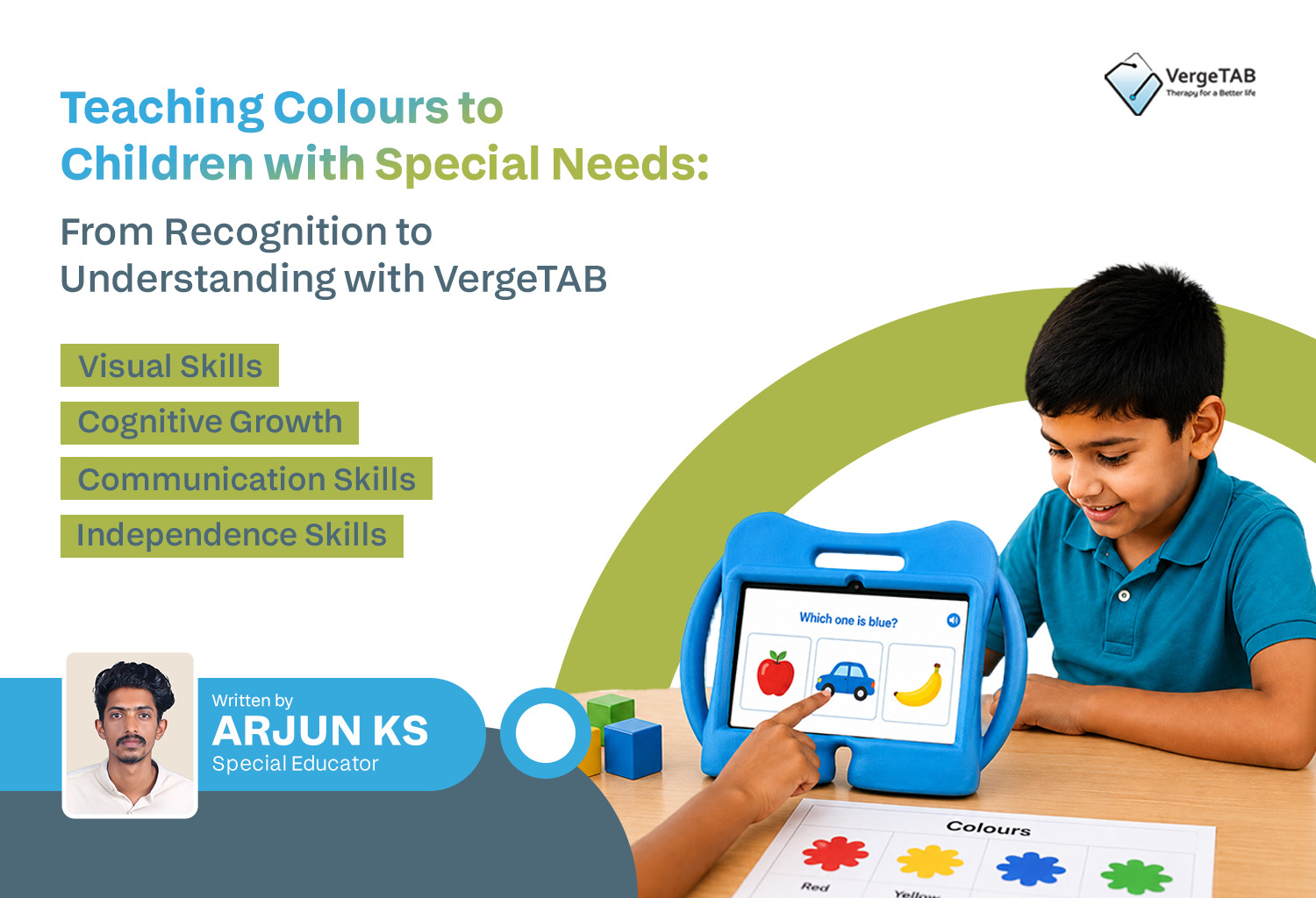
Teaching Colours to Children with Special Needs: From Recognition to Understanding with VergeTAB
11 Aug 2026

Written By
Arjun K S
Special Educator
Building Foundational Learning Through Digital Colour Concept Instruction
Colour recognition is one of the earliest cognitive and visual discrimination skills that children develop. For children with special educational needs (SEN), understanding colour concepts is not simply about identifying different colours — it is a critical developmental milestone that supports communication, cognitive growth, environmental awareness, academic readiness, and independent living skills.
Children with developmental disabilities, intellectual disabilities, autism spectrum disorder (ASD), and other learning differences often require structured, individualised, and repetitive instruction to acquire foundational concepts. Digital assistive technology can provide an engaging medium for delivering structured, evidence-informed learning activities and supporting meaningful practice.
At XceptionalLEARNING, VergeTAB — our purpose-built learning tablet — serves as an innovative educational tool that combines technology with individualised teaching strategies. By integrating interactive digital content, educators can create highly engaging learning environments that motivate children while supporting their unique learning needs.
Why Colour Concepts Matter in Special Education
Colour concepts form the basis of numerous functional and academic skills. Before children can classify objects, follow classroom instructions, organise materials, or describe their surroundings, they must first understand and apply colour concepts in meaningful contexts.
For children with special educational needs, learning colours supports the development of visual discrimination, receptive and expressive language, cognitive processing, and concept formation. It also strengthens attention and concentration, functional communication, object classification, pre-academic readiness, and everyday environmental awareness — skills that show up well beyond the classroom, from sorting laundry by colour at home to identifying a favourite toy on a cluttered shelf.
Because every learner progresses at a different pace, colour instruction should be individualised, systematic, and reinforced through repeated practice across multiple learning environments.
What Colour Learning Supports
- Visual discrimination
- Concept formation
- Receptive and expressive language
- Attention and concentration
- Object classification
- Functional communication
- Pre-academic readiness
- Everyday independence
From Matching to Meaning: A Step-by-Step Approach to Colour Learning
Colour learning often develops progressively. Depending on the learner’s abilities and goals, educators may begin with simple matching before moving towards identification, naming, classification, and generalisation:
- Matching — Match objects or pictures with the same colour.
- Identification — Select a requested colour from several choices.
- Labelling — Name or communicate the colour.
- Sorting — Group objects according to colour.
- Following instructions — Respond to directions such as “Give me the blue ball.”
- Generalisation — Identify colours across different objects, pictures, and everyday environments.
This staged progression allows educators to meet each learner at their current level and build systematically towards more complex, functional use of colour concepts.
Colour Recognition Activities for Children with Special Needs
To support colour concept acquisition, a structured set of digital learning activities was developed using the XceptionalLEARNING platform and delivered through VergeTAB. The instructional resources were carefully designed to address different learning styles while supporting learner engagement through activities such as:
- Interactive colour activities
- Colour matching tasks
- Picture-based learning tasks
- Digital worksheets
- Short educational videos
- Reinforcement activities
- Digital assessments
- Repeated practice sessions
Together, these activities allow each learner to progress through material at a pace suited to their own developmental needs, moving through the matching-to-generalisation stages outlined above.
How VergeTAB Supports Digital Colour Learning
The gamified nature of VergeTAB’s learning activities can make instruction more engaging and enjoyable. Instead of passively receiving information, learners actively participate in interactive tasks that encourage exploration, problem-solving, and independent responses. This learner-centred approach increases motivation and helps sustain attention throughout each session.
VergeTAB also enables educators to design personalised interventions that align with each learner’s Individualised Education Programme (IEP) goals while maintaining high levels of engagement. Interactive digital resources support data-driven instruction by allowing educators to monitor progress and adapt learning activities according to each learner’s developmental needs.
How VergeTAB Supports Colour Learning
- Interactive digital activities
- Visual matching tasks
- Picture-based learning
- Digital worksheets
- Short educational videos
- Reinforcement activities
- Repeated practice
- Digital assessment activities
Digital activities can complement hands-on teaching by providing additional opportunities for structured practice and reinforcement.
The Importance of Repetition in Concept Development
Children with special educational needs often benefit from explicit instruction combined with consistent repetition. Repeated exposure allows learners to strengthen memory, improve processing speed, and gradually generalise newly acquired concepts across different environments.
Using VergeTAB, educators provided repeated opportunities for learners to engage with colour-based activities through videos, digital worksheets, visual prompts, interactive games, and picture-based exercises. Each learning experience reinforced previously introduced concepts while gradually increasing the learner’s confidence and independence. The structured progression of activities also allowed learners to build understanding at their own pace without unnecessary cognitive overload.
From Recognition to Meaningful Understanding
With consistent instruction and repeated practice, learners were observed progressing from simple colour recognition towards more meaningful use of colour concepts, responding appropriately during structured activities and using colour names more confidently in functional communication.
For example, some learners who initially matched colours only within a fixed activity began, over time, to apply the same concept to new and unfamiliar objects — recognising “red” on a jumper, a fruit, or a toy car, rather than only within the original app or worksheet. This kind of generalisation across contexts is an important indicator of meaningful concept acquisition, and it is a primary goal in special education instruction.
The engaging nature of the activities provided through VergeTAB supported regular participation and additional opportunities for practice over time.
Recognition vs understanding
| Recognition | Understanding |
|---|---|
| Identifies a familiar colour | Identifies colour across different objects |
| Matches identical colours | Sorts objects by colour |
| Responds correctly in one activity | Applies the concept in new activities |
| Recognises colour in a picture | Recognises colour in everyday environments |
The goal is not simply to recognise a colour, but to understand and use the concept across different situations.
The Role of Technology in Inclusive Education
Technology can complement traditional teaching by giving educators additional ways to present concepts, provide repeated practice, offer visual and multisensory learning experiences, and adapt activities to individual learning goals. When integrated with evidence-based instructional practices, digital tools can support more flexible and inclusive learning environments.
Conclusion
Teaching colour concepts is far more than helping children identify different colours. It is about developing foundational cognitive abilities that support communication, learning, problem-solving, and everyday independence.
The integration of VergeTAB with the XceptionalLEARNING platform demonstrates how thoughtfully designed digital resources can make concept learning engaging, meaningful, and accessible for children with special educational needs. Through individualised instruction, gamified learning experiences, consistent reinforcement, and repeated practice, educators can help learners move beyond simple recognition toward a deeper understanding of colour concepts.
As special education continues to embrace innovative digital solutions, technology-driven interventions such as VergeTAB are creating more inclusive classrooms where every child has the opportunity to learn, participate, and achieve success according to their unique abilities. By combining structured teaching strategies with engaging digital content, educators can build strong conceptual foundations that support lifelong learning and greater independence for children with diverse learning needs.
See How VergeTAB Can Support Foundational Learning
Explore how VergeTAB can help educators and therapists deliver structured digital activities, repeated practice, and engaging learning experiences for children with special educational needs.