Empowering Every Learner to Become More Independent with VergeTAB

Reading Time: 5 minutes
Written by Anjuna.M

Special Educator

Every child deserves the chance to learn, grow, make choices, and become as independent as possible. For children with developmental, intellectual, communication, or learning disabilities, independence usually develops gradually, through structured teaching, repeated practice, appropriate support, and the steady reduction of adult assistance.

Technology can play an important role in this journey, but only when it’s used purposefully. It shouldn’t simply make learning more digital or entertaining. It should help children participate more actively and do more for themselves.

VergeTAB, an educational technology solution from XceptionalLEARNING, is a locked digital learning device powered by the XceptionalLEARNING (XL) Platform. When integrated with XL, it can be used for structured digital activities, visual supports, interactive learning experiences, and customised tasks alongside teaching and therapy to support children with diverse learning needs.

From Adult Support to Independence

Independence doesn’t happen suddenly. A child may initially need support to understand instructions, begin a task, complete each step, or make a choice. The goal isn’t to remove that support immediately; it’s to reduce it gradually as the child’s skills, understanding, and confidence grow.

This journey can be understood in four stages:

Adult Support → Guided Practice → Reduced Prompts → Independent Task Completion
1. Adult Support

At the start, a child may need an adult to explain the activity, demonstrate what to do, provide verbal prompts, or guide them through each step. For example, a teacher might show a child how to complete a matching activity on VergeTAB and offer prompts when the child is unsure what to do next. The adult’s role here is simply to provide whatever support the child needs to understand and participate.

2. Guided Practice

Once the child understands the activity, the adult can step back and let the child complete more of the task independently — offering guidance only when necessary. Instead of physically guiding the child’s hand, for instance, the adult might give a simple instruction like, “Look at the pictures and choose the matching one.” Repeated opportunities help the child become familiar with the task and its sequence.

3. Reduced Prompts

As confidence builds, prompts can be gradually scaled back. A detailed verbal instruction may shrink to a short reminder. A verbal prompt may eventually give way to a visual cue. Over time, the child may start to recognise the activity itself as the cue to begin. This matters because the goal isn’t to create dependence on adult prompts; it’s to help the child complete familiar tasks with less and less assistance.

4. Independent Task Completion

Over time, some children may begin to start and complete familiar tasks with minimal adult prompting. Independence at this stage might look like:

  • Following visual instructions independently
  • Starting an assigned activity with less adult support
  • Completing a task step by step
  • Making choices between available activities or responses
  • Practising familiar activities without repeated prompting
  • Attempting a task independently before asking for help

These may look like small achievements, but each one marks real progress toward greater independence.

How VergeTAB Supports This Journey

When used with the XL Platform, VergeTAB can give children repeated opportunities to practise skills while educators and therapists gradually adjust the level of support.

  • Following visual instructions. Lengthy verbal instructions can be hard for some children to process. Pictures, symbols, and structured activities offer another way to understand what’s expected — and with practice, children can learn to follow visual cues without waiting for an adult to explain every step.
  • Starting tasks independently. Rather than waiting for repeated prompts to begin, children can learn to recognise an assigned activity and start it on their own. Clear routines and consistent visual or digital cues help build this habit.
  • Completing tasks step by step. Many activities involve several steps, and a child may need support at each one at first. Structured, repeatable activities let children practise the sequence until adult assistance can be reduced.
  • Making independent choices. Depending on the activity and learning goal, children can choose between available activities or responses, select an answer, or indicate what they want to do next — giving them real opportunities to practise decision-making.
  • Practising without repeated prompting. When children have access to familiar, structured activities, they can be given time to attempt a task before an adult steps in, with prompts reduced as familiarity grows.

The Role of Teachers and Therapists

Technology alone doesn’t create independence. How it’s introduced and used matters just as much. Teachers and therapists can support this growth by:

  • Demonstrating a task before expecting independent performance
  • Giving clear, simple instructions
  • Providing prompts only when necessary
  • Allowing enough time for the child to respond
  • Gradually reducing verbal, visual, or physical prompts
  • Encouraging the child to try before stepping in
  • Recognising effort as well as successful completion
  • Using progress information to recognise when support can be reduced
  • Choosing activities that match the child’s current abilities while still offering room to grow

The objective is to support without over-supporting: enough assistance for the child to succeed, but enough room for them to discover what they can do on their own.

The Goal: Support Without Over-Supporting

Provide enough assistance for the child to succeed, while creating opportunities for the child to attempt, practise, and complete tasks with gradually less support.

The Role of Parents

Independence shouldn’t stop at the classroom door. Parents can reinforce the same approach at home by giving children chances to practise familiar activities with gradually reduced assistance. Instead of immediately stepping in on a familiar task, parents can give the child time to try first, offering simple instructions, visual cues, and encouragement only when needed, and avoiding unnecessary prompting.

When home and school take a consistent approach, children get more chances to practise independence across different environments.

Small Steps, Lasting Confidence

Independence is built through small, repeated successes. A child who once needed an adult to start an activity may eventually begin it alone. A child who needed step-by-step guidance may complete the sequence with less help over time. A child who waited for an adult to make a choice may start making choices independently.

Repeated successful experiences can help build confidence. When children feel “I can do it myself,” they become more willing to attempt new tasks, work through challenges, and take an active role in their own learning.

Independence doesn’t mean expecting children to do everything alone. It means providing the right support at the right time, and gradually helping them need less of it. Through thoughtful teaching strategies and the purposeful use of technology like VergeTAB, educators, therapists, and parents can help every child practise familiar skills, make choices, follow instructions, and take greater ownership of their learning.

The goal was never just to make learning digital or engaging. It’s to help every child discover what they can do for themselves, and give them the support, opportunities, and confidence to do more.

Explore VergeTAB for Structured Learning

VergeTAB works exclusively with the XceptionalLEARNING (XL) Platform to support structured digital learning and therapy activities under educator and therapist guidance.
Want to see how VergeTAB can fit into a child’s learning or therapy programme?

Beyond the Device: Why VergeTAB Is More Than Just an Educational Tablet

Reading Time: 6 minutes
Written By 

Anjana VS
Special Educator

Learning Needs More Than Just a Screen

Technology becomes meaningful when it creates engaging, personalized, and inclusive learning experiences—not simply when it adds another screen to the classroom.

Education has entered an era where technology is no longer a luxury—it is an essential part of the learning journey. Yet, not every digital device is designed to support meaningful learning outcomes. While tablets and laptops provide access to information, they often fall short when it comes to creating meaningful, engaging, and personalized learning experiences.

This is where VergeTAB stands apart.

VergeTAB is more than an educational tablet. Functioning as a structured Digital Activity Book, it has been purposefully developed to create engaging, structured, and learner-centred educational experiences that support diverse learning needs across classrooms, therapy settings, and home environments.

More importantly, when integrated with XceptionalLEARNING, VergeTAB becomes part of a complete hybrid learning ecosystem—one that extends learning beyond classrooms and empowers every learner, regardless of ability.

VergeTAB: More Than a Tablet, A Complete Learning Ecosystem

Many digital devices focus only on delivering content. VergeTAB focuses on delivering learning experiences.

Instead of functioning as just another screen, VergeTAB becomes an interactive educational environment where students can learn, practice, revise, and explore concepts independently.

It provides a structured learning space where education becomes:

  • Interactive instead of passive
  • Personalized instead of generalized
  • Accessible instead of restrictive
  • Continuous instead of classroom-dependent
VergeTAB transforms learning by making it

Interactive
Personalized
Accessible
Continuous

Every feature is designed with one purpose—to make learning simpler, smarter, and more enjoyable.

VergeTAB Makes Learning Interactive, Not Monotonous

Students understand concepts better when they actively participate in the learning process. VergeTAB encourages this through interactive educational experiences rather than one-way information delivery.

Interactive learning features include:

  • Digital flashcards
  • Educational games
  • Animated lessons
  • Visual storytelling
  • Audio-supported learning
  • Practice activities
  • Interactive quizzes
  • Skill-based exercises

These engaging resources stimulate curiosity, improve concentration, and encourage students to explore concepts at their own pace. Instead of memorizing facts, learners begin understanding ideas through experience.

Personalized Learning with VergeTAB

Every learner has a unique pace. Some students grasp concepts quickly, while others require additional practice and visual support. Traditional classrooms often struggle to accommodate these differences.

VergeTAB addresses this challenge through personalized learning experiences.

Students can:

  • Learn at their own speed
  • Repeat lessons whenever needed
  • Revisit difficult topics
  • Practice independently
  • Strengthen weak areas
  • Build confidence before moving ahead

This flexibility reduces the pressure of “keeping up” and encourages confident, continuous learning. Learning becomes student-centered rather than syllabus-centered.

VergeTAB Brings Learning Beyond Classroom Walls

Education should never stop when the school bell rings.

VergeTAB enables students to continue learning wherever they are.

Whether at:

  • Home
  • School
  • Therapy centres
  • Libraries
  • Learning support centres
  • During travel

This continuity helps reinforce concepts, reduce learning gaps, and encourage daily learning habits. Parents also become active participants by supporting children’s learning beyond school hours.

For example, a teacher can introduce a concept in the classroom using VergeTAB, assign related activities for home practice, and review the student’s progress during the next class. This continuous learning approach helps reinforce concepts while keeping parents actively involved in the learning journey.

Creating Inclusive Education Through VergeTAB

Modern education must be inclusive. Students learn differently, communicate differently, and require different kinds of support.

VergeTAB promotes inclusive learning by offering educational experiences suitable for diverse learners, including children with special educational needs.

Its learning environment supports:

  • Visual learners
  • Auditory learners
  • Kinaesthetic learners
  • Early learners
  • Students requiring repeated instruction
  • Learners who benefit from structured routines

Interactive multimedia resources make lessons easier to understand while reducing anxiety often associated with traditional learning methods. This creates opportunities for every learner to participate confidently.

Empowering Teachers with Smarter Digital Teaching

Technology should simplify teaching—not complicate it.

VergeTAB provides teachers with digital resources that help them create engaging classroom experiences without increasing their workload.

Teachers can:

  • Deliver multimedia lessons
  • Conduct interactive classroom activities
  • Demonstrate concepts visually
  • Monitor student participation
  • Encourage independent practice
  • Reinforce classroom learning using digital resources

Instead of spending valuable time preparing repetitive materials, educators can focus on what matters most—teaching and mentoring students. VergeTAB becomes an extension of the teacher rather than a replacement.

Technology should simplify teaching, not complicate it.

How VergeTAB Encourages Independent Learning

One of the greatest strengths of VergeTAB is its ability to promote self-directed learning. Students gradually become independent learners by exploring educational content on their own.

Benefits include:

  • Better problem-solving skills
  • Increased confidence
  • Improved decision-making
  • Stronger digital literacy
  • Greater responsibility for learning
  • Consistent practice habits

This independence prepares students not only for examinations but also for lifelong learning.

The Power of Hybrid Learning: How XceptionalLEARNING Completes the VergeTAB Experience

While VergeTAB provides the device and learning environment, XceptionalLEARNING transforms it into a comprehensive hybrid education ecosystem.

Hybrid learning combines the strengths of classroom teaching with the flexibility of digital learning, ensuring students receive continuous educational support regardless of where they are.

Through the integration of VergeTAB with XceptionalLEARNING, students experience learning that is:

Continuous

Learning no longer ends when school hours finish. Students can revise lessons, complete activities, and reinforce concepts at home using VergeTAB while staying connected to their educational journey.

Connected

Teachers, therapists, parents, and students remain connected through a shared learning ecosystem. Everyone involved can contribute to the student’s progress, creating a collaborative support system.

Personalized

XceptionalLEARNING provides structured digital content that complements classroom instruction. Combined with VergeTAB, learners receive activities suited to their pace, strengths, and individual learning needs.

Inclusive

The hybrid model is especially valuable for children with developmental disabilities and diverse learning requirements. Multimedia lessons, interactive activities, visual supports, and structured learning pathways help ensure every learner has equal opportunities to succeed.

Consistent

Whether students are learning from school, home, therapy sessions, or remote locations, VergeTAB ensures they have uninterrupted access to the same educational resources available through XceptionalLEARNING.

Together, VergeTAB and XceptionalLEARNING remove geographical barriers, reduce learning interruptions, and create a flexible educational environment where learning continues anytime and anywhere.

This partnership represents the future of education—where technology enhances human teaching rather than replacing it.

VergeTAB + XceptionalLEARNING create one continuous learning ecosystem connecting school, home, therapy, teachers, parents, and students.

Why VergeTAB Is Shaping the Future of Education

The future of education will not be defined by the number of devices in classrooms. It will be defined by how effectively those devices improve learning.

VergeTAB succeeds because it focuses on educational outcomes rather than technology alone. By integrating the intelligence and adaptability of the XceptionalLEARNING platform, VergeTAB transcends the limitations of conventional tablets to become a dynamic, responsive learning ecosystem.

Its strengths include:

  • Personalized Student-Centred Learning: Activities adapt to each learner’s abilities, pace, and goals for meaningful progress.
  • Interactive Educational Experiences: Gamified exercises and visual simulations transform abstract concepts into tangible experiences.
  • Hybrid Learning Support: Seamless continuity between classroom, home, and therapy sessions.
  • Inclusive Education: Built-in supports for children with developmental disabilities, speech delays, and cognitive differences.
  • Teacher Empowerment: Powerful tools for engaging lessons and progress monitoring without increasing workload.
  • Home-School Connectivity: Parents access activities, track progress, and reinforce learning at home.
  • Continuous Skill Development: Regular practice and reinforcement help learners build confidence and essential life skills.
  • Digital Accessibility: Offline functionality and durable, child-safe design for diverse settings.

By integrating modern technology with meaningful pedagogy through the XceptionalLEARNING platform, VergeTAB creates learning environments where students remain engaged, teachers feel empowered, and parents become active learning partners. It is not just shaping the future of education—it is redefining what is possible for every learner.

Conclusion: Beyond the Device Lies the Experience

Technology alone cannot transform education. What truly changes learning is how technology is designed, integrated, and used to support students, teachers, and families.

VergeTAB goes beyond being a digital learning device. It serves as a bridge between traditional education and the future of learning—making education interactive, inclusive, personalized, and accessible.

When combined with the hybrid learning ecosystem of XceptionalLEARNING, VergeTAB evolves into far more than a tablet. It becomes a powerful educational companion that supports learning across classrooms, homes, and therapy environments, ensuring that every learner has the opportunity to grow, explore, and succeed.

As education continues to evolve, the question is no longer whether technology belongs in learning. The real question is whether that technology can truly create meaningful educational experiences.

VergeTAB answers that question with confidence—not by offering another device, but by delivering a smarter, more connected, and more inclusive way to learn

Experience Learning Beyond the Device

VergeTAB is more than an educational tablet. When integrated with the XceptionalLEARNING platform, it creates a connected learning ecosystem that supports interactive, personalized, and inclusive education across classrooms, homes, and therapy environments.

Whether you’re a school, therapist, special educator, or parent, discover how VergeTAB can help create meaningful learning experiences for every learner.

Screen Time in Children With Special Needs: Myths, Facts, and What Parents Should Know

Reading Time: 7 minutes

Written By

Jasna K

Special Educator

What if the very thing many parents fear could also become a powerful tool for learning, communication, and development?  

In today’s world, screens are everywhere. For many families raising children with special needs, screens have become part of everyday life — from online learning and therapy sessions to communication tools, educational activities, and calming routines. Yet, screen time remains one of the most debated and misunderstood topics among parents, educators, and professionals.

Some believe that all screen exposure is harmful and should be avoided completely. Others rely heavily on digital devices without considering the importance of structure, supervision, or purpose. Between these two extremes, many families are left struggling with confusion, guilt, fear, and dependency.

But the truth is far more complex.

Screen time itself is neither completely harmful nor completely beneficial. What truly matters is how screens are used, how long they are used, and whether their use is guided, structured, and purposeful. Research increasingly suggests that while excessive and unstructured screen exposure may negatively affect development, structured, limited, and goal-oriented digital engagement can positively support children with special needs in areas such as communication, learning, participation, and therapy.

This blog aims to separate common myths from scientific facts while exploring how balanced and intentional screen use can become a meaningful support tool rather than just a source of concern.

Why Screen Time Is Different for Children With Special Needs  

Children with Autism Spectrum Disorder (ASD), ADHD, speech delays, learning disabilities, or sensory processing difficulties may interact with screens differently from neurotypical children.

For some children, screens can:

  • support communication
  • improve visual learning
  • increase engagement
  • provide predictable routines
  • assist participation in therapy and learning activities

Simultaneously, excessive and unstructured screen exposure may negatively affect:

  • sleep
  • attention span
  • emotional regulation
  • social interaction
  • physical activity

This is why modern research no longer focuses only on the duration of screen time, but also on the quality, structure, supervision, and purpose behind screen use.

Parents interested in structured visual learning approaches can also explore: How VergeTAB Helps Children Master Visual-Motor, Sensory Engagement, and Daily Living Skills.

Parents looking for structured home-based learning ideas may also find this helpful: How Parents Can Maximize Therapy at Home with VergeTAB

Common Myths and Facts About Screen Time  

Myth 1: “All Screen Time Is Harmful”  

One of the most common misconceptions is that every form of screen exposure damages a child’s development.

In reality, research suggests that not all screen time is the same.

Studies have shown that structured educational technology, communication devices, and therapy-oriented digital tools can support children with special needs when used appropriately. Interactive learning activities often help children who respond better to visual and predictable learning environments.

For example:

  • AAC communication devices help non-verbal children communicate
  • Interactive learning apps may improve participation and engagement
  • Therapy-based digital activities can support attention and cognitive development

The problem is not the screen itself, but passive and excessive use without developmental purpose.

Myth 2: “Children With Special Needs Should Avoid Screens Completely”  

Complete screen avoidance is unrealistic in today’s world and may not always be beneficial.

Technology has become an important support system in:

  • special education
  • therapy sessions
  • communication training
  • visual learning
  • home-based intervention

Organizations like the World Health Organization (WHO) and the American Academy of Pediatrics (AAP) do not recommend eliminating screens completely. Instead, they emphasize:

  • age-appropriate use
  • parental involvement
  • quality content
  • balanced routines

This shows that the focus should not be on fear-based restriction, but on responsible and guided usage.

Myth 3: “More Educational Videos Automatically Mean Better Learning”  

Many parents believe that educational videos alone can improve development.

However, children — especially those with special needs — learn best through interaction, repetition, real-world experiences, and human connection.

Watching educational content passively for long hours does not guarantee meaningful learning. Research suggests that children benefit more when:

  • adults participate during screen use
  • activities are interactive
  • digital learning is connected to real-life practice

For example, a child learning colours through a video should also be encouraged to identify colours in toys, clothes, and daily surroundings.

The effectiveness of screen use depends on engagement, not simply exposure.

Myth 4: “Screens Cause Autism”  

This is one of the most harmful and scientifically inaccurate myths.

Autism Spectrum Disorder is a neurodevelopmental condition influenced by genetic and biological factors. No scientific evidence proves that screens cause autism.

Some studies have found associations between excessive screen exposure and difficulties in language, attention, or social interaction. However, association does not mean causation.

Researchers continue to emphasize that excessive and unstructured screen exposure may affect development, but screens themselves do not cause autism.

Spreading misinformation around this topic often creates unnecessary fear and guilt among parents.

Myth 5: “Children Become Addicted to Screens Only Because of Poor Parenting”  

Screen dependency is far more complex than simple parenting failure.

Children with special needs may naturally prefer screens because screens provide:

  • predictability
  • repetition
  • immediate rewards
  • reduced social pressure
  • sensory comfort

Often, screens become calming tools because they offer structured stimulation that feels easier to process.

Instead of blaming parents, experts encourage:

  • structured routines
  • transition support
  • visual schedules
  • time limits
  • alternative sensory activities

Families need guidance and balance, not judgment.

Myth 6: “If a Child Is Quiet While Using a Screen, It Means the Screen Is Helping”  

A child being quiet during screen use does not always mean healthy engagement.

Sometimes screens capture attention so strongly that children become disconnected from:

  • social interaction
  • movement
  • communication
  • environmental awareness

This is why experts recommend observing:

  • behaviour after screen use
  • emotional reactions during transitions
  • sleep quality
  • interest in offline activities

Healthy screen use should support development, not replace real-world experiences.

What Research Actually Suggests  

Positive Findings From Structured Digital Learning  

Modern research presents a balanced perspective on screen time in children with special needs. Rather than completely supporting or completely opposing screen use, most studies emphasize the importance of how screens are used, how much they are used, and whether they serve a meaningful developmental purpose.

Several studies support the use of structured and educational technology for children with developmental and communication difficulties. Research on interactive digital learning tools, therapy-based applications, and communication technologies has shown positive outcomes in areas such as:

  • engagement
  • participation
  • communication
  • attention
  • skill development

Research conducted in the field of assistive technology and special education has shown that structured digital interventions can improve participation and accessibility for children with developmental disabilities, speech and language disorders, ADHD, and learning difficulties.

Studies involving children with Autism Spectrum Disorder (ASD) have also found that many children respond positively to visually structured and predictable digital learning environments. Guided educational applications and communication technologies may improve participation, motivation, and communication when used appropriately and under supervision.

Research on assistive technology and therapy-based digital interventions further suggests that structured screen use can improve motivation, learning participation, and therapy engagement, especially when combined with parental or therapist involvement.

Risks of Excessive and Unstructured Screen Exposure  

At the same time, research also warns against excessive and unstructured screen exposure.

A longitudinal study published in JAMA Pediatrics involving more than 2,400 children found associations between excessive early screen exposure and later difficulties in:

  • language development
  • attention
  • problem-solving
  • social interaction

Similarly, studies on children with developmental disabilities have linked prolonged passive screen exposure with:

  • sleep disturbances
  • reduced physical activity
  • emotional dysregulation
  • decreased social engagement

A systematic review published in BMC Pediatrics and other developmental health journals also reported that excessive and unsupervised screen exposure may negatively influence communication, behaviour, and attention in children with developmental challenges.

However, researchers consistently emphasize an important point:

Association does not mean causation.

For example, while some studies found links between excessive screen exposure and autism-related behaviours, there is no scientific evidence proving that screens cause autism.

What WHO and AAP Recommend  

Major health organizations such as the World Health Organization (WHO) and the American Academy of Pediatrics (AAP) recommend:

  • moderation
  • parental involvement
  • quality content
  • structured routines
  • purposeful screen use

The WHO guidelines emphasize limiting passive screen exposure while encouraging interactive activities, movement, sleep, and caregiver involvement.

Similarly, the AAP recommends high-quality and age-appropriate content with active parental participation rather than unrestricted or unsupervised screen use.

These organizations no longer focus only on the duration of screen exposure, but also on:

  • the quality of content
  • the level of interaction
  • adult supervision
  • whether screen use supports or replaces real-world experiences

This highlights an important truth:

The intention and structure behind screen use matter more than the screen itself.

Quality Over Quantity: The Real Conversation  

Instead of asking whether screens are simply “good” or “bad,” parents and professionals should focus on how screens are being used.

Important questions to consider include:

  • What is the child watching or doing?
  • Is the activity interactive or passive?
  • Is there a developmental or educational goal behind the activity?
  • Is screen time replacing sleep, physical activity, or social interaction?
  • Is the child using screens under adult guidance and supervision?

There is a significant difference between endless passive entertainment and guided therapeutic engagement.

Structured and purposeful screen use can support communication, learning, participation, and skill development, while uncontrolled and excessive usage may contribute to emotional, behavioural, social, and developmental challenges.

The goal, therefore, is not to eliminate screens completely, but to ensure that screen use remains intentional, balanced, and beneficial to the child’s overall development.

Watch: Common Screen Time Concerns Answered by Experts

Many parents feel confused about balancing screen time, learning, therapy, and daily routines for children with special needs. Watch this expert discussion addressing common concerns around structured and purposeful screen use.

Expert insights on healthy screen habits and structured digital learning for children with special needs

Technology as a Therapeutic Support Tool  

When technology is used intentionally and under proper guidance, it can become more than just a source of entertainment — it can function as a meaningful therapeutic and educational support tool.

A good example of this approach is VergeTAB, the specially designed digital activity tab powered by XceptionalLEARNING.

Unlike regular tablets or passive entertainment-based screen exposure, VergeTAB is specifically designed to support children with special needs through structured and guided digital engagement.

The device enables therapists and parents to maintain control over:

  • the duration of screen exposure
  • the purpose of screen use
  • the type of activities provided
  • the developmental goals being targeted

Rather than encouraging unrestricted screen time, VergeTAB promotes limited, supervised, and goal-oriented interaction through therapy-supportive and educational activities that can be adapted based on individual learning and developmental needs.

Such tools demonstrate how technology can become meaningful when screen time is:

  • structured
  • monitored
  • purposeful
  • connected to therapeutic outcomes

This reflects a growing understanding that technology should not replace human interaction, but rather support communication, learning, therapy, and developmental progress in a balanced and controlled manner.

Conclusion  

Screen time itself is not the enemy. The real concern lies in unstructured, excessive, and purposeless screen exposure.

For children with special needs, technology can become either:

  • a harmful distraction
    or
  • a valuable developmental support tool

depending on how it is used.

Modern research increasingly supports the idea that structured, limited, and intentional screen use can positively contribute to learning, communication, participation, and engagement.

However, these benefits are most meaningful when screen use is combined with parental involvement, supervision, and real-world interaction.

Need Help Creating Healthier and More Structured Screen Habits?  

Structured digital learning and guided activities may help children engage more meaningfully while supporting communication, participation, and developmental goals.

From Isolated Therapy to Unified Systems: How Special Schools Implement VergeTAB for Structured Digital Therapy

Reading Time: 7 minutes

Clinically Reviewed by

Jinson Alias

Consultant Psychologist, Special Educator & Digital Therapy Trainer

Special schools carry responsibilities that extend far beyond textbooks and timetables. Every day, they support children in developing communication skills, emotional regulation, motor coordination, independence, and essential life abilities that shape their long-term future.

The work is intensive. It is deeply personal. And it requires extraordinary dedication from educators, therapists, administrators, and families alike.

In many institutions, the commitment is unquestionable. Staff members work tirelessly. Therapists design thoughtful intervention plans. Teachers reinforce goals in the classroom. Parents try to continue practicing at home.

Yet despite all this effort, many special schools quietly face a common challenge:

Everyone is working hard — but not always working together within a unified system.

Speech therapy goals may exist in one place. Classroom reinforcement happens elsewhere. Parent updates depend on occasional meetings. Documentation is scattered across files and reports.

This is where structured digital therapy platforms for special education schools are beginning to transform how therapy and learning are delivered.

At the centre of this transformation is VergeTAB, a purpose-built therapy tablet for special education environments designed to work exclusively within the XceptionalLEARNING ecosystem. Together, they create a coordinated digital infrastructure that connects therapists, teachers, administrators, and parents within a single intervention system.

Why Structured Technology Is No Longer Optional in Special Schools

In many special schools, therapy and classroom activities still operate in partially disconnected workflows.

For example:

  • Speech therapy goals may be stored in isolated files
  • Occupational therapy objectives may not always be reinforced in classrooms
  • Behaviour observations are often recorded manually
  • Parent updates depend on periodic meetings rather than continuous engagement

The challenge is not a lack of dedication.

The challenge is infrastructure.

To deliver consistent developmental outcomes, schools increasingly require structured special education technology systems that support:

  • Cross-disciplinary goal alignment
  • Standardized therapy documentation
  • Measurable intervention tracking
  • Parent participation in home practice
  • Controlled and distraction-free digital learning environments

Modern digital therapy platforms for schools allow these elements to function within one coordinated framework instead of fragmented processes.

What Makes VergeTAB Different

Today, many institutions experiment with general-purpose tablets for educational use. However, consumer devices often introduce distractions, inconsistent applications, and open internet access.

These conditions rarely support structured therapy environments.

VergeTAB was developed specifically as a therapy tablet for autism and special education programs. It is not a consumer device adapted for therapy use.

Instead, it operates entirely within the XceptionalLEARNING digital therapy platform, creating a closed, secure environment where all activities are aligned with therapeutic and educational goals.

In simple terms:

VergeTAB is the hardware.
XceptionalLEARNING is the intelligence layer.

Together, they form a controlled therapy management system for schools where every module, activity, and report supports structured intervention.

There are:

  • No gaming applications
  • No open browsing
  • No unrelated digital distractions

This controlled architecture is critical in special education settings where overstimulation and digital safety must be carefully managed.

But beyond safety, the real advantage lies in system alignment.

VergeTAB becomes more than a device.
It becomes an institutional implementation tool.

Why Special Schools Are Adopting Digital Therapy Tablets

Across many special education institutions, administrators are recognizing that therapy outcomes depend not only on professional expertise but also on consistent reinforcement across environments.

Digital therapy tablets are increasingly adopted because they help schools:

  • Reinforce therapy goals during classroom instruction
  • Improve documentation and progress tracking
  • Enable multidisciplinary collaboration
  • Provide structured home practice modules for parents
  • Reduce administrative workload through digital reporting systems

When integrated into a structured IEP digital platform, these systems help schools monitor student development more effectively and make data-informed decisions about interventions.

Instead of relying solely on periodic reviews, educators and therapists can track daily engagement and progress patterns in real time.

A Child-Level Transformation: What This Looks Like in Practice

In one special school classroom, a child working on expressive communication struggled to generalize vocabulary learned during speech therapy sessions.

Before digital integration:

  • Vocabulary was practised only during therapy
  • Classroom reinforcement was inconsistent
  • Parents were unsure how to practice effectively at home

After VergeTAB implementation:

  • The same vocabulary targets appeared in structured classroom activities.
  • Teachers reinforced communication tasks digitally.
  • Parents accessed guided practice modules at home.
  • Progress became visible across stakeholders.

Within weeks, educators observed more spontaneous responses and improved engagement.

One educator summarized the change simply:

“Earlier, we saw progress during therapy time. Now we see it throughout the day.”

This transformation is not about replacing therapists.

It is about extending therapy impact across environments.

See VergeTAB in a Real Classroom Setting

Watch how structured digital therapy supports engagement and reinforcement during classroom learning.

Watch the classroom video

From Touch to Transformation: A Special Child’s Journey with Digital Learning

Project DESS: Structured Institutional Implementation

Technology adoption in special schools must go beyond distributing devices.

That is why the Project DESS (Digitalizing Education in Special Schools) framework focuses on system-level transformation.

The model includes:

  • Institutional needs assessment
  • Staff onboarding and workflow training
  • Phased deployment across departments
  • Performance monitoring and evaluation
  • Parent integration models
  • Scalable expansion planning

Schools implementing VergeTAB through Project DESS move from isolated therapy processes to coordinated intervention systems.

Transformation becomes measurable rather than theoretical.

See How Special Schools Are Implementing VergeTAB

Many institutions are adopting structured digital therapy platforms and assistive technology for autism to align therapy, classroom learning, and home practice.

Watch how real special schools are integrating VergeTAB into their daily intervention systems.

Watch VergeTAB in Action

Measurable Outcomes Observed in Participating Special Schools

Within one academic cycle, institutions implementing VergeTAB under structured models have reported:

  • Significant increases in structured task engagement
  • Reduced administrative documentation workload
  • Improved clarity during interdisciplinary review meetings
  • Stronger carryover of therapy goals into classroom routines
  • Increased parent participation in home practice

Interestingly, staff often report that workload does not increase.

Instead, documentation becomes more streamlined because digital systems replace repetitive manual processes.

Efficiency improves because friction within workflows is reduced.

Institutional Impact: Real Special School Transformations

Santwanam Special School

At Santwanam Special School, VergeTAB helped digitize therapy workflows and align intervention goals across departments.

Principal Athira Krishnan reported improved coordination between therapists and educators, along with more structured documentation practices.

Key outcomes included:

  • Streamlined therapy scheduling
  • Stronger classroom reinforcement of therapy goals
  • Increased student engagement
  • Clearer progress visibility

Watch Santwanam Special School Implementation

Santwanam Special School is Digitalised, Claims Principal Athira Krishnan

Asha Nilayam Special School

Asha Nilayam Special School adopted VergeTAB to create a hybrid therapy–classroom model.

Therapists and educators now assign goal-based digital activities, monitor progress in real time, and provide parents with structured updates.

Key outcomes included:

  • Integrated therapy and classroom workflows
  • Real-time multidisciplinary monitoring
  • Improved parent communication
  • Greater institutional transparency

Watch Asha Nilayam Special School Case

Transforming Asha Nilayam: How Digital Learning Empowers Special Needs Education

How VergeTAB Strengthens Multidisciplinary Collaboration

Effective special education relies on coordinated collaboration among professionals.

With VergeTAB integrated into daily workflows:

  • Special educators reinforce therapy goals during classroom sessions
  • Speech-language pathologists assign communication-focused modules
  • Occupational therapists incorporate motor-based digital activities
  • Behaviour therapists monitor engagement patterns
  • Parents access guided home practice activities

Instead of parallel interventions, schools operate within a connected intervention model.

Research consistently shows that coordinated multidisciplinary approaches produce stronger functional outcomes than isolated therapy sessions.

Key Benefits for Special Schools

1. Improved Generalization Across Settings

A child may confidently form sentences during a session, yet remain silent when a teacher asks a simple question in class. At home, parents may still hear one-word answers. The ability is there, but consistency across environments is missing.

When therapy goals, classroom activities, and home practice are aligned, something changes. The child begins seeing the same structure, cues, and expectations everywhere — not just in one room.

Within weeks, participation improves, and confidence grows. Progress becomes visible not only in sessions but in real life. And when families are actively involved, support shifts from occasional encouragement to meaningful partnership in the child’s development.

2. Data-Driven Decision Making

Manual reporting systems are time-intensive and subjective.

Digital dashboards within the XceptionalLEARNING framework allow special schools to:

  • Monitor individual goal progression
  • Track performance patterns
  • Identify stagnation early
  • Make informed intervention adjustments

Administrators also gain visibility into institutional-level outcomes.

3. Stronger Parent Engagement

One of the biggest gaps in special education is what happens after the school day ends. Progress made in structured sessions can slow down when home practice lacks clarity.

With structured, guided modules, parents are no longer given vague advice like “practice at home.” Instead, they receive clear, step-by-step activities aligned with the child’s therapy goals. This transforms the role of parents in therapy — from passive supporters to active partners in progress.

When parents understand what to reinforce and how to do it confidently, consistency improves. Children experience the same expectations across school and home, reducing confusion and strengthening outcomes. As a result, progress feels steady, measurable, and less stressful for families.

4. Operational Efficiency

Special schools often function with limited staffing.

Structured digital systems reduce:

  • Repetitive documentation
  • Manual file management
  • Cross-department communication delays

Staff can focus more on intervention and less on administrative tasks.

5. Scalable Institutional Growth

Digital infrastructure allows special schools to:

  • Pilot implementation in one department
  • Train staff systematically
  • Monitor measurable outcomes
  • Expand gradually

This makes adoption sustainable and financially strategic.

Ethical, Secure, and Child-Centered

Technology in special schools must remain:

  • Professionally supervised
  • Screen-time regulated
  • Data secure
  • Goal oriented

VergeTAB’s controlled architecture ensures digital usage remains structured, safe, and focused on therapeutic outcomes.

Implementation Model for Special Schools

Successful adoption follows five stages:

  1. Institutional assessment
  2. Staff onboarding and training
  3. Pilot classroom deployment
  4. Data monitoring and refinement
  5. Scalable institutional expansion

This phased model ensures sustainable implementation and measurable impact.

The Future of Special Schools

Special schools are gradually evolving from paper-heavy, disconnected systems toward coordinated digital ecosystems.

The future of therapy and special education will be:

  • Collaborative
  • Data-informed
  • Parent-inclusive
  • Secure
  • Scalable

When therapy platforms, classrooms, and home environments are connected through structured technology, intervention becomes more consistent and effective.

VergeTAB, implemented within frameworks like Project DESS, supports this evolution by aligning therapy, education, and family participation into one unified system.

Conclusion: From Fragmentation to Institutional Leadership

When special schools adopt structured digital therapy platforms and therapy tablets for special education, intervention becomes measurable, collaborative, and sustainable.

Institutions that move beyond disconnected processes and build coordinated digital systems are better positioned to support long-term developmental outcomes for children with diverse learning needs.

If your school is exploring structured digital implementation, you can:

  • Watch how other institutions have implemented VergeTAB
  • Schedule a guided demonstration for your leadership team
  • Connect with our team on WhatsApp for quick inquiries and implementation support

The future of special education belongs to institutions that build structured, scalable systems — not disconnected processes.

And that transformation begins with alignment.

Everyday Maths Made Easy for Children with Special Needs on VergeTAB

Reading Time: 5 minutes

Clinically Reviewed by

Meha P Parekh

Special Educator

Maths is everywhere — in the rooms we live in, the floors we walk on, playgrounds where children run, and the boxes we pack daily. Long before children learn numbers, they experience maths through movement, space, distance, and size.

For many children, especially those with special educational needs, traditional maths can feel abstract. Worksheets and formulas often fail to reflect real-life maths. True understanding comes from awareness of space, boundaries, capacity, and object relationships.

This is where functional learning comes in — helping children learn maths through everyday experiences, building independence, confidence, and practical problem-solving.

VergeTAB, integrated with the XceptionalLEARNING platform, turns these experiences into interactive, therapy-aligned learning modules.

Understanding Boundaries: Exploring the Idea of “Around”

Instead of introducing formal mathematical terms, VergeTAB helps children explore the idea of boundaries — the concept of going around something.

Think of tracing a fence in a playground, wrapping a ribbon around a gift, or following a path around a table. These everyday experiences help children understand what it means to follow a boundary.

On VergeTAB, children interact with animated paths and characters that move along the edges of shapes or spaces. They trace outlines, follow routes, and visually observe how boundaries work — all without being burdened by formulas or calculations.

Functional Learning Activities on VergeTAB:
  • Tracing the outline of rooms, objects, or play areas on-screen
  • Comparing which object takes a longer path visually
  • Guiding animated characters along visible paths

Through these interactions, children build spatial awareness, sequencing skills, and visual tracking — essential for daily functioning.

Making Boundaries Relatable Through Everyday Contexts

Functional learning becomes meaningful when children recognise concepts in their own environment.

Using VergeTAB with XceptionalLEARNING, educators and therapists can relate boundary-based activities to familiar settings such as:

  • Classrooms
  • Homes
  • Playgrounds
  • Therapy rooms

For example:

  • Which room takes longer to walk around?
  • Which garden fence feels longer?
  • Which object has a bigger outline?

By grounding learning in real-life contexts, children begin to understand that spatial ideas are not abstract — they are part of their everyday world.

Exploring Space Inside: Understanding “How Much Space Is There?”

While boundaries define the outside, children also need to understand what lies within — the space inside an area.

This concept becomes relevant when children:

  • Sit together on a mat
  • Spread out toys on a table
  • Choose where to play
  • Organize their belongings

With VergeTAB, learners explore the idea of space visually and interactively. Using the XceptionalLEARNING platform, children can:

  • Fill shapes
  • Colour spaces
  • Arrange objects within boundaries on-screen
  • Compare two areas visually
Functional Applications of Space Awareness:
  • How many children can sit comfortably on a mat? (Guided in real life with adult support)
  • Which play area allows more movement? (Visual concept on-screen)
  • Is there enough space for drawing or writing? (Observation-based judgment)

Through digital interaction, children begin to make judgments based on observation rather than calculation, which can then be reinforced in real-life activities.

Understanding Capacity: Learning About “How Much It Can Hold”

Capacity — the idea of how much something can hold — is a key life skill. From pouring water into a glass to packing items into a box, children encounter this concept daily.

With VergeTAB, learners explore capacity through hands-on digital simulations. They can:

  • Fill containers on-screen with blocks or liquids
  • Stack objects visually
  • Compare quantities in a stress-free way
Everyday Functional Examples (hybrid learning):
  • Simulated pouring into different cups
  • Packing virtual toys into containers
  • Stacking objects digitally to see fullness

These activities support motor planning, visual judgement, and practical independence, especially for children with developmental or learning differences.

Learning Through Play and Exploration

What sets VergeTAB apart is its emphasis on learning through interaction rather than instruction. Traditional maths teaching often relies on abstract symbols and written work. VergeTAB replaces this with exploration, movement (digital), and discovery.

Children can:

  • Trace edges
  • Fill spaces
  • Stack objects digitally
  • Compare visually

This multi-sensory, screen-based approach reduces anxiety, improves engagement, and allows children to learn at their own pace, making learning feel natural rather than forced.

Functional Learning Beyond Academics

Spatial concepts support far more than academic learning. They help children:

  • Navigate environments confidently
  • Organise personal spaces
  • Pack bags and belongings
  • Make practical decisions
  • Develop independence in daily routines

For children with special educational needs, these skills are often more meaningful than academic achievement alone. VergeTAB supports these outcomes by aligning learning with functional goals often included in Individualised Education Plans (IEPs).

Designed for Special Educational Needs

Children with special educational needs benefit most when learning is:

  • Visual
  • Interactive
  • Predictable
  • Adaptable

VergeTAB supports this by offering:

  • Visual cues through animation and colour
  • Touch-based interaction
  • Gradual progression without pressure
  • Learning grounded in familiar experiences

This makes VergeTAB a valuable tool for therapists, educators, and inclusive classrooms, supporting concept exposure without academic overload.

Progressive, Child-Centred Learning Levels

VergeTAB structures learning in a way that respects individual readiness:

Level 1: Awareness
Exploring boundaries, spaces, and containers visually.

Level 2: Functional Understanding
Relating concepts to classrooms, homes, playgrounds, and daily routines.

Level 3: Guided Quantities
Counting steps, spaces, or objects visually — only where appropriate.

Level 4: Problem Awareness
Simple decision-making based on real-life situations.

Level 5: Life-Skill Integration
Applying learning to packing, organising, navigating, and planning.

Progression is flexible, ensuring learning remains supportive rather than stressful. Every child progresses differently, and observing real sessions helps educators and therapists understand how VergeTAB adapts to individual needs.
If you’re curious about how these levels translate into structured, real-life learning experiences, you can see how VergeTAB works in real sessions through a guided walkthrough.

The VergeTAB Advantage

VergeTAB offers:

  • Concept exposure without syllabus pressure
  • Visual-first, child-friendly learning
  • Personalised pacing
  • Alignment with therapy and IEP goals
  • Strong focus on independence and life skills

Rather than teaching maths as a subject, VergeTAB helps children experience mathematical ideas as part of life.

If you would like to see how these boundary, space, and capacity concepts are introduced in actual therapy-aligned sessions, you can explore a live demonstration of VergeTAB in action. Seeing children interact with structured digital activities often makes the learning approach much clearer than words alone.
Request a VergeTAB Demo to understand how it can fit into your classroom or therapy setting.

Bringing It All Together

Spatial understanding does not begin with formulas — it begins with experience. Through tracing, filling, stacking, and comparing, children learn how space works in the world around them.

With VergeTAB, learning moves beyond textbooks. It becomes interactive, meaningful, and accessible. Concepts related to boundaries, space, and capacity become visible, touchable, and understandable, supporting each child’s journey toward confidence, independence, and everyday success.

Take the Next Step

Functional learning becomes powerful when school, therapy, and home environments work together. VergeTAB, powered by the XceptionalLEARNING platform, supports this connected hybrid model by helping children experience maths concepts in structured yet meaningful ways.

If your school, therapy centre, or institution would like to explore how VergeTAB can be integrated into your existing programs, our team is available to guide you.

For institutional enquiries or implementation discussions, you may talk to our team on WhatsApp for direct support and clarification.

Teaching Maths Through Prepositions: How Children Learn “In, On and Under” with VergeTAB

Reading Time: 6 minutes

Clinically Reviewed by

Ann Mary Jose

Special Educator

Children don’t first learn maths through numbers — they learn it through space.

Before a child can add or subtract, they must understand where things are, how objects move, and how they relate in space: in, on, under, left, right, before, and between.

For children with autism, developmental delays, ADHD, speech delays, and learning disabilities, these concepts must be taught slowly, visually, and through touch.

This is where VergeTAB, powered by XceptionalLEARNING, becomes more than a device. It becomes a calm, interactive device, helping children understand early maths concepts through experience—not pressure.

How Children Naturally Build Maths Through Prepositions  

Why prepositions matter  

  • They form the base of spatial reasoning.
  • Spatial reasoning becomes early maths.
  • Early maths later becomes number sense, geometry, measurement, and logic.

VergeTAB supports this natural flow by using movement, visual cues, and child-led exploration.

Help Children Learn Spatial Concepts Through Interactive Activities

VergeTAB offers engaging digital learning activities that help children understand foundational concepts such as in, on, under, beside, and between through visual, interactive, and therapist-friendly exercises.

The Journey Begins: Moving From Space to Meaning  

Every session starts simply.

A clean screen. A shape. A gentle instruction:

“Put the circle in the box.”

This small action does more than build language.

When the child moves the circle inside the box, they experience containment—a core spatial concept used later in geometry, measurement, and even reading.

And just like that, the learning journey begins.

1. Number Lines: The Child’s First Exploration of Distance  

As the child becomes comfortable, the therapist introduces early number concepts—not with equations, but with movement.

A number line appears on VergeTAB. Numbers animate from left to right.

Instead of saying “Find the midpoint,” the therapist gently prompts:

“Look at the jump from 2 to 5. Can we make the same jump on the other side?”

The child sees a dotted line appear.

VergeTAB highlights the three-step distance:

2 → 3 → 4 → 5 (3 steps)

They drag a +3 arrow to match it.

This leads them to discover:

  • equal intervals
  • distance on a number line
  • spatial reasoning through numbers

When the arrow lands on 8, a soft glow confirms the answer.

This is Activity 1—transformed into a moment of discovery, not a worksheet.

2. Range Understanding Appears Naturally  

Once the idea of a number line feels comfortable, the therapist expands the exploration:

A glowing section appears between 12 and 20.

The prompt is simple:

“Pick any number between these two.”

This is Activity 2, but presented in a child-led style.

There is no memorization. The child visually experiences ranges.

The glowing band becomes a self-correcting zone.                                                                

A tap on 15, 17, or 13 is all it takes.

The concept of greater than, less than, and in-between starts settling into the child’s mind—not as rules, but as intuitive visual knowledge.

3. Shapes Become Mathematical Actors  

After working with numbers, we shift to shapes—not by teaching formulas, but by placing them in meaningful spaces.

A square appears with 36 cm² written below it. It fills the entire screen so the child can see an area, not imagine it.

Then a triangle fades inside the square.

The instruction doesn’t sound like a maths problem. It sounds like an interactive story:

“This triangle is part of the square. Move the slider to show how much space it uses.”

As the child slides to ½, the triangle highlights 18 cm².

This moment—Activity 3—teaches:

  • fractions,
  • inside–outside,
  • area understanding,
  • proportional reasoning.

But the child only feels like they’re adjusting a slider.

4. Side-by-Side Shapes Strengthen Spatial Logic  

Now shapes appear next to each other.

Rectangle A fills 15 cm².

Rectangle B is empty.

The therapist asks:

“Rectangle B wants to be next to A but bigger. Can you make it double?”

The child types 30 or picks it from options.

Without any memorized formula, they learn:

  • doubling
  • comparing size
  • “next to” spatial language

This experience is Activity 4, but it feels like creative problem-solving.

5. Fractions Strengthen Top/Bottom Concepts  

From the area, the child moves to something more familiar—a chocolate bar.

It appears to be split into 8 blocks.

The top 3 pieces turn gold.

The bottom 5 remain untouched.

A warm prompt asks:

“How much is on the top row?”

This is Activity 5—fraction identification blended with prepositions.

The child picks 3/8, but deeper learning happens:

  • they visualize fractions,
  • understand placement words (top vs. under),
  • develop early comparison skills.

There is no rush, no scoring—just exploration.

6. Between Two Fractions: Visualising Invisible Spaces  

Another scene slowly transitions onto the screen: a measuring cup half-filled with water.

The water line moves slightly—floating between ¼ and ½.

The therapist asks:

“Can you pick a fraction that fits between these two?”

The child scans options like 1/3 or 3/8 and selects one.

This is Activity 6, but instead of a maths exercise, it becomes a sensory-friendly observation task.

Children with autism especially love this because the movement of water feels soothing while teaching comparison.

7. Grids Introduce “Above” and Directionality  

Next, the screen shifts to a grid—clean, structured, predictable. Many special needs children respond well to grids because they reduce visual chaos.

A point appears at (4,2).

A soft arrow rises upward as the therapist narrates:

“Above means up. Can you move Point B three steps above A?”

The child drags a point upward until it rests at (4,5).

This is Activity 7, introducing:

  • coordinate geometry
  • direction (+Y)
  • visual–motor alignment

The child doesn’t feel like they’re solving coordinates. They feel like they’re moving a dot upward.

8. Left–Right Mastery Strengthens Early Maths Orientation  

Now a point appears at (6,3).

This time, the arrow moves left.

A ghost circle shows the expected destination—an OT-inspired visual scaffold.

The therapist asks:

“Move N to the spot that is left of M by four steps.”

The child shifts the point to (2,3).

This is Activity 8, teaching:

  • negative X movement
  • orientation
  • horizontal number sense

It builds the mental mapping skills needed later for number lines, bar models, and geometry.

9. Queue-Based Logic: Everyday Maths Through People  

The scene now shifts away from numbers and graphs to something human and familiar—a queue of children.

Ajay stands 4th.

Meera is placed behind him.

Ravi must stand in front of Meera but not ahead of Ajay.

The child must reason:

  • Meera is somewhere from 5th to 10th
  • Ravi must be before her
  • But it cannot be 4th or earlier

The child chooses any of the first three positions.

This is Activity 9, but it becomes real-world problem-solving:

  • sequencing
  • before/after
  • positional reasoning
  • everyday logic

Children feel like they are arranging students in line, not completing a worksheet.

10. Real-World Maths: Measuring Over and Under  

The final transition is a river scene—calming blue water flowing across the screen.

The river width is labelled 15 m.

A bridge appears over the river.

The therapist asks:

“Make the walkway twice as wide as the river.”

When the child chooses 30 m, the bridge widens gracefully.

This is Activity 10, strengthening:

  • multiplication
  • measurement
  • over/under spatial concepts

And with this, the child completes a seamless learning journey through all core maths-preposition concepts—without ever feeling overwhelmed.

Looking for Digital Tools to Teach Early Language and Maths Concepts?

VergeTAB combines learning, therapy, and interactive activities to support children’s understanding of spatial awareness, language development, and early mathematical thinking in a structured and enjoyable way.

Explore VergeTAB for Schools, Therapists, and Parents

Why This Natural Flow Works for Special Needs Learners  

Activities progress from concrete → visual → abstract

Children begin with simple spatial placements like in, on, and under, and gradually move into comparisons, fractions, and even coordinates.

Each concept blends smoothly into the next.

There are no hard chapters or jumps—every idea transitions naturally, helping the child stay regulated and engaged.

Visual scaffolds support children with motor and cognitive delays

  • dotted guides
  • glowing zones
  • sliding bars
  • ghost positions
  • step-by-step animations

These elements make learning clear, predictable, and stress-free.

Touch interactions build motor planning and praxis

Dragging, tapping, and sliding are purposeful OT-aligned movements that strengthen coordination and planning.

Prepositions become functional, not memorized.

Children perform the actions instead of merely hearing the words—making understanding deeper, practical, and long-lasting.

Make Learning More Interactive

Traditional worksheets have their place, but children often learn faster when they can see, touch, and interact with concepts. VergeTAB provides activity-based digital learning experiences designed to improve engagement and retention.

📞 Talk to Our Team

Conclusion

When maths and prepositions are taught through natural, flowing interactions—as experienced on VergeTAB—children with special needs build foundational reasoning skills that last a lifetime. Each activity, from number lines to shapes, fractions, and coordinates, becomes a meaningful experience rather than a structured lesson. With XceptionalLEARNING powering the Digital Activity Book modules, educators can effortlessly guide children through concepts such as “between,” “under,” “above,” and “next to,” while also strengthening number sense, visual-motor planning, and logical thinking. VergeTAB’s distraction-free, therapy-focused environment ensures that every child learns through exploration, touch, and visual support at their own pace.

Help Children Build Strong Foundations for Learning

Understanding words like in, on, and under is more than a language skill—it supports classroom readiness, mathematical understanding, and everyday communication. With VergeTAB, educators and therapists can make these concepts more engaging, visual, and accessible for every learner.

Why Science Feels Abstract in Special Education — And How VergeTAB Makes It Real and Visual

Reading Time: 6 minutes

Clinically Reviewed by

Meha P Parekh

Special Educator, Digital Practitioner – SPED

In many special education classrooms, science becomes difficult not because children lack interest, but because the concepts feel invisible. Ideas like evaporation, force, magnetism, plant growth, or states of matter are often explained through words or pictures that children cannot directly relate to their own experiences.

As a result, students may memorize facts for a lesson but struggle to truly understand what is happening or why it happens.

This is where VergeTAB becomes part of science learning in therapy and special education environments. Schools and therapists use VergeTAB with the XceptionalLEARNING platform to provide distraction-free, visual, and interactive activities that help children observe cause-and-effect relationships and understand science concepts in a concrete way.

The Importance of Science in Special Education

Understanding science is not just about memorizing facts. It equips children with skills essential for problem-solving, critical thinking, and understanding the world around them. For children in special education:

  • Hands-on learning matters: Physical engagement improves comprehension and memory retention.
  • Visual and interactive tools are critical: Many children benefit from multisensory approaches.
  • Science connects to daily life: Concepts like parts of plants, or simple machines part become more meaningful when experienced practically.

Key benefits for special education learners:

  • Develops curiosity and observation skills
  • Encourages independent exploration and experimentation
  • Strengthens critical thinking and reasoning abilities
  • Enhances language, vocabulary, and communication skills related to scientific concepts

How VergeTAB Makes Science Accessible

VergeTAB is a versatile tool designed to provide personalized, interactive learning experiences for children in special education. Unlike traditional tablets or worksheets, VergeTAB focuses on:

  • Single-child, personalized interaction — Each learner engages with tailored content that matches their abilities and pace.
  • Hands-on simulations with sensory-friendly tools — Combines touch, visuals, and sound to make scientific concepts easy to experience and understand.
  • Integration with the XceptionalLEARNING Platform — Enables monitoring, activity customization, and smooth coordination between therapy and classroom learning.

Core features for science learning:

  • Interactive simulations of real-world science phenomena
  • Visual step-by-step demonstrations of experiments
  • Engaging digital activities for practice and reflection
  • Simple analytics for educators and therapists to track growth
Struggling to help your child connect science concepts to real life?

VergeTAB offers structured visual activities that make science understanding easier and more engaging.
Chat with our team on WhatsApp for guidance

Key Science Topics for Special Education Learners

Science topics need to be presented in ways that emphasize relevance and interaction. VergeTAB enables the teaching of multiple science domains effectively:

1. Human Body & Health  

Key Concepts  
  • Five Senses: Sight, hearing, touch, taste, smell
  • Major Organs: Heart, lungs, brain, stomach, liver
  • Hygiene: Hand washing, dental care, personal cleanliness
  • Nutrition: Balanced diet, importance of fruits, vegetables, and water
Why it Matters  

Understanding the human body and practicing health awareness helps children in special education:

  • Build independence: Children learn to take care of themselves.
  • Enhance safety awareness: Knowing body parts and functions promotes safety.
  • Encourage healthy habits: Awareness of hygiene and nutrition supports long-term well-being.
VergeTAB Activities  

Interactive Body Map:

  • Drag and drop organs to their correct positions in a digital body.
  • Learn organ functions through touch and visual cues.

Five Senses Matching Game:

  • Match each sense to its corresponding stimulus (e.g., eyes → seeing, ears → hearing).
  • Reinforces sensory awareness and vocabulary.

Hygiene Routines Simulation:

  • Choose healthy habits for daily tasks like brushing teeth or washing hands.
  • Practice sequencing steps in routines.

Impact: These activities combine visual, tactile, and auditory learning, making abstract concepts real and visible. Children can observe, interact, and practice healthy routines in a safe digital environment.

2. Plants and Animals  

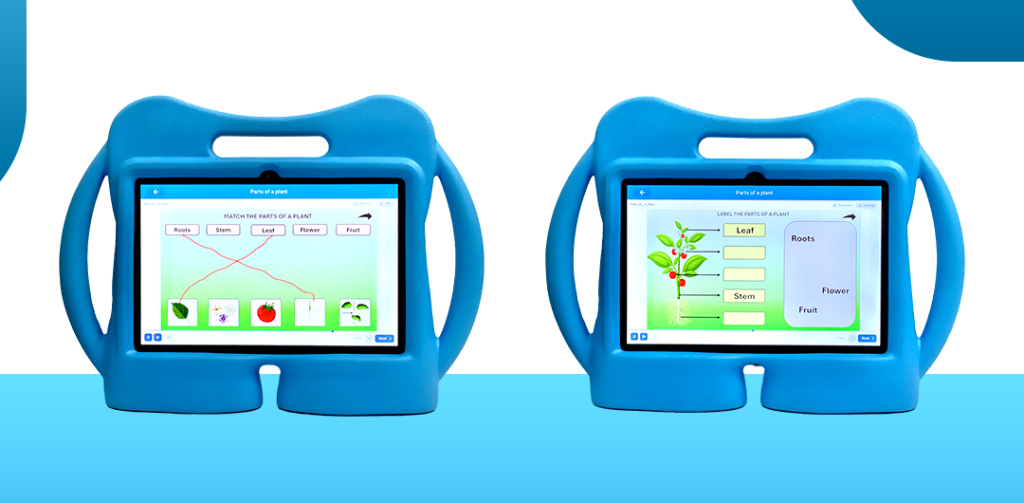
Interactive plant-learning activity on VergeTAB – designed for hands-on, distraction-free learning.
Key Concepts  
  • Life Cycles: Seed → Plant → Flower → Seed
  • Basic Needs: Sunlight, water, air, food
  • Habitats: Forests, deserts, oceans, grasslands
Why it Matters  

Studying plants and animals helps children:

  • Develop responsibility: Caring for plants or observing animals teaches nurturing.
  • Enhance observation skills: Tracking growth and behaviour promotes attention to detail.
  • Understand environmental awareness: Introduces children to ecosystems and conservation.
VergeTAB Activities  

Life Cycle Sequencing:

  • Arrange images of seed → sprout → plant → flower in order.
  • Strengthens understanding of growth and progression.

Habitat Match:

  • Drag animals to their correct habitats (e.g., camel → desert, fish → ocean).
  • Connects animal behaviour with environmental context.

Food Chain Puzzles:

  • Identify connections between plants, herbivores, and predators.
  • Enhances critical thinking and cause-and-effect understanding.

Impact: Children learn the relationships between living things, build vocabulary, and develop observation and analytical skills in a playful, interactive manner.

3. Water & Weather  

Key Concepts  
  • Water Cycle: Evaporation, condensation, precipitation
  • Rain, Clouds, Temperature: Understanding patterns in nature
  • Seasons: Hot, cold, rainy, dry
Why it Matters  

Understanding water and weather concepts helps children:

  • Comprehend daily life: Recognize how the weather affects routines.
  • Promote water conservation: Learn the importance of protecting natural resources.
  • Develop observation skills: Encourage noticing changes in the environment.
VergeTAB Activities  

Water Cycle Simulation:

  • Interactive digital cycle showing evaporation, condensation, and precipitation.
  • Students observe transformations in real-time.

Weather Matching:

  • Match weather icons (sun, clouds, rain) to real-life situations.
  • Reinforces comprehension and vocabulary.

Temperature Sorting:

  • Sort objects or days into hot vs. cold categories.
  • Develops cause-and-effect reasoning and classification skills.

Impact: These activities make abstract meteorological concepts understandable, promote environmental awareness, and improve cognitive reasoning.

4. Materials and Their Properties  

Key Concepts  
  • Physical Properties: Hard vs soft, rough vs smooth
  • Functional Properties: Waterproof vs absorbent, heavy vs light
Why it Matters  

Exploring materials helps children:

  • Make practical decisions: Recognize which materials are safe or useful.
  • Enhance tactile learning: Hands-on interaction improves sensory processing.
  • Support safety awareness: Understanding properties helps prevent accidents.
VergeTAB Activities  

Material Sorting Game:

  • Classify objects based on texture, hardness, or durability.
  • Encourages categorization and observation skills.

Waterproof Test Simulation:

  • Test objects digitally to see which float, absorb water, or resist moisture.
  • Builds understanding of cause-and-effect and experimentation.

Everyday Object Classification:

  • Relate materials to common household items (e.g., cotton → soft, metal → hard).
  • Encourages real-life application of concepts.

Impact: Children can safely explore materials’ properties and understand practical applications, enhancing both cognitive and sensory development.

5. Forces, Motion, Light, and Sound  

Key Concepts  
  • Forces: Push, pull, gravity
  • Motion: Direction, speed, cause-and-effect relationships
  • Light: Reflection, shadows
  • Sound: Vibrations, pitch, source identification
Why it Matters  

Understanding these concepts helps children:

  • Develop cause-and-effect reasoning: Recognize how actions produce results.
  • Enhance movement understanding: Explore physical interaction with objects.
  • Increase sensory awareness: Engage sight, sound, and touch in learning.
VergeTAB Activities  

Push and Pull Experiments:

  • Drag objects to see effects of force and motion.
  • Observe how mass and surface affect movement.

Light and Shadow Game:

  • Match objects to their shadows or reflect light with mirrors.
  • Teaches basic optics and observation skills.

Sound Identification:

  • Match vibrating sources (e.g., drum, string, bell) to their sounds.
  • Enhances auditory discrimination and attention skills.

Impact: These activities give children opportunities to explore physics concepts in a fun, safe, and interactive environment. They boost analytical thinking, sensory processing, and problem-solving.

In real classroom and therapy environments, science concepts are reinforced using VergeTAB in a controlled, distraction-free setup designed specifically for special education and therapy use. Schools and clinics use VergeTAB along with XceptionalLEARNING to help children repeatedly observe, interact with, and understand scientific ideas through guided visual activities.
See how VergeTAB works in real sessions

Overcoming Challenges in Teaching Science to Special Education Learners  

Teaching science to children with special needs comes with unique challenges:

  • Short Attention Spans: Use brief, engaging activities; alternate hands-on experiments with digital simulations.
  • Abstract Thinking Difficulties: Make concepts concrete and visual using real-life examples and VergeTAB.
  • Limited Fine Motor Skills: Adapt experiments for larger movements; use digital tools to reduce manual handling.
  • Varied Learning Paces: Provide individualized, self-paced activities on VergeTAB for mastery before moving forward.

Tips for Educators and Therapists  

To maximize the benefits of VergeTAB in teaching science:

  • Plan: Prepare a sequence of topics and experiments
  • Start simple: Introduce one concept at a time
  • Incorporate visuals and digital tools: Combine hands-on and VergeTAB simulations
  • Encourage exploration: Allow children to experiment freely within structured guidance
  • Track progress: Use the Platform’s analytics to track progress and skill development

Conclusion

Science is all around us—from the water we drink to the air we breathe and the plants that grow in our gardens. For children in special education, understanding these concepts can feel daunting without the right tools. VergeTAB, a Digital Therapy Activity Device integrated with the interactive platform XceptionalLEARNING, transforms abstract concepts into hands-on, engaging, and meaningful learning experiences.

By combining:

  • Multisensory approaches
  • Personalized digital activities
  • Gamified learning
  • Real-life applications

educators and therapists can make science accessible, enjoyable, and memorable for every child. Science is no longer a distant subject; it has become a part of daily exploration, wonder, and discovery. 

Empower every child in special education to experience science like never before — real, interactive, and uniquely theirs with VergeTAB.

See VergeTAB in Action

If your school or clinic is looking for a practical way to make science concepts easier to understand using a dedicated therapy device, VergeTAB provides a safe, guided, and distraction-free digital environment built specifically for special education and therapy.

Child Easily Distracted and Impulsive? How VergeTAB Helps Build Focus and Self-Control

Reading Time: 5 minutes

Clinically Reviewed by

Aswathy Ponnachan

Medical and Psychiatric Social Worker

In classrooms and therapy sessions, educators and therapists often observe children who are easily distracted, act impulsively, and struggle to stay focused on tasks. These challenges affect learning, behaviour regulation, and overall academic performance, especially for children with attention and executive function difficulties.

Traditional teaching methods, worksheets, or regular apps do not provide the structured, guided practice needed to help children build focus and self-control in a measurable way.

VergeTAB, used together with the XceptionalLEARNING platform, is implemented in schools and therapy clinics to deliver distraction-free, goal-based digital activities specifically designed to improve attention, inhibition, and self-regulation skills in children.

Understanding Executive Function in Children

What Are Executive Functions?

Executive functions enable children to regulate their behaviour, manage emotions, and think strategically. Key components:

  • Inhibition (Self-Control): Resist impulses, ignore distractions, and think before acting.
  • Cognitive Flexibility (Adaptability): Switch between tasks, adjust to new rules, and view problems from different perspectives.
  • Metacognition (Thinking About Thinking): Awareness of one’s own thought processes — planning, self-monitoring, and reflecting.
Why Executive Functions Matter

Strong executive functions support:

  • Focus and attention
  • Problem-solving and reasoning
  • Emotional regulation
  • Academic achievement and independence

Children struggling with these skills may find everyday tasks overwhelming.

How VergeTAB Supports Executive Function Development

A Blank Tab with Purpose

Unlike standard tablets, VergeTAB is a blank tab operating only via XceptionalLEARNING. This ensures:

  • Distraction-free learning
  • Tailored activities by therapists, educators, and parents
  • Structured progress tracking and adaptive learning
Therapist-Guided Cognitive Development

Therapists use the XceptionalLEARNING Platform to:

  • Assign targeted exercises per child’s needs
  • Adjust difficulty based on progress
  • Combine visual, auditory, and motor engagement

VergeTAB becomes a personalized tool for executive function training, not a generic tablet.
Chat with our team on WhatsApp for guidance

1. Enhancing Inhibition: Helping Children Pause and Think

VergeTAB strengthens inhibitory control by combining interactive visuals, precise timing, and real-time feedback. Each activity trains the brain to pause, observe, and respond deliberately.

VergeTAB Activities for Inhibition

a. Find What Doesn’t Belong
Children identify which object in a group doesn’t fit (e.g., apple, banana, shoe, orange).
Skill outcome: Improves impulse control and selective attention.

b. Wait and Tap
Children must tap the screen only when a specific signal appears (e.g., a sound or image).
Skill outcome: Builds patience, focus, and the ability to delay reactions.

c. Emotion Regulation Match
Match facial expressions with correct emotion labels while ignoring distractors.
Skill outcome: Strengthens emotional inhibition and empathy understanding.

d. Focused Filtering Games
Activities that require ignoring background images or sounds while completing a main task.
Skill outcome: Trains the brain to filter irrelevant stimuli and sustain attention.

e. Stop-and-Go Challenge
A digital version of “Red Light, Green Light.” Children must freeze when the red light shows and move only when the green light appears.
Skill outcome: Builds motor inhibition, attention, and self-control — all achievable on VergeTAB’s touch-interactive screen.

Therapist Tip:
On the XceptionalLEARNING platform, therapists can adjust timing intervals, difficulty levels, and feedback frequency, helping children gradually internalize control without stress or frustration.

2. Supporting Cognitive Flexibility: Adapting to Change and Thinking Differently

Cognitive flexibility allows children to adjust to new rules or problem-solving approaches. VergeTAB enhances adaptability through dynamic, rule-changing tasks that promote flexible thinking.

VergeTAB Activities for Cognitive Flexibility

a. Rule Switch Sorting
Children sort items by one simple attribute (e.g., colour first, then shape).
Skill outcome: Trains basic set-shifting and adaptability in a controlled environment.

b. Story Sequencing with Changing Rules
Arrange pictures in order of events; then re-arrange based on emotion, cause-and-effect, or character perspective.
Skill outcome: Strengthens narrative flexibility and higher-order thinking.

c. Multiple Solutions Challenge
Puzzles are designed with several possible correct answers.
Skill outcome: Encourages creative problem-solving and open-minded thinking.

d. Switch-the-Scene Activity
The visual background or scenario changes (e.g., day/night or indoor/outdoor), and children must adjust their response based on new conditions.
Skill outcome: Builds situational awareness and attention flexibility.

e. Category Flip Challenge
Children sort items using multiple attributes at once (e.g., shape + size + category) and flip rules mid-task.
Skill outcome: Strengthens complex set-shifting and multi-dimensional thinking.

Therapist Tip:
Therapists can blend flexibility tasks with inhibition exercises through XceptionalLEARNING — like changing sorting rules mid-task — to stimulate multiple executive processes at once.

3. Strengthening Metacognition: Thinking About Thinking

Metacognition develops when children learn to evaluate their own thinking. VergeTAB integrates guided prompts, performance reviews, and reflection-based exercises to make children aware of how they think and learn.

VergeTAB Activities for Metacognition

a. Plan and Reflect Thinking
Children predict steps before starting a puzzle or task. During the activity, they are prompted to think aloud, explaining their approach and decisions in real-time. After completing the task, they reflect on what worked, what was challenging, and how strategies could improve.
Skill outcome: Builds planning, real-time self-monitoring, and post-task reflection, strengthening overall metacognitive skills.

b. What Did You Learn?
At the end of each session, VergeTAB displays reflection prompts such as:

  • What was easy for you?
  • What was challenging?
  • What strategy worked best?
    Skill outcome: Promotes self-awareness and confidence.

c. Strategy Swap Challenge
Children complete a task using their preferred strategy, then are encouraged to try an alternative approach suggested by the therapist. They compare results and reflect on which strategy was more effective and why.
Skill outcome: Promotes flexible thinking, strategy evaluation, and adaptive learning.

d. Progress Dashboard Review
Using the XceptionalLEARNING dashboard, children visualize their performance trends.
Skill outcome: Builds goal-setting habits and reflective learning.

e. Predict and Reflect Quiz
Before answering, children predict whether they’ll get the question right. Afterwards, they compare the prediction vs. the result.
Skill outcome: Builds realistic self-assessment and reflective accuracy — fully supported through VergeTAB’s quiz templates.

Therapist Tip:
Therapists can use platform session logs to discuss progress with children—helping them set new goals and celebrate small wins, which boosts self-monitoring and motivation.

4. Integrated Activities: Training Multiple Executive Functions Together

Real-life thinking involves the combined use of inhibition, flexibility, and metacognition. VergeTAB provides blended digital activities that mirror these integrated cognitive processes.

VergeTAB Combined Activities

a. Decision Tree Stories
Children choose story outcomes based on character decisions. When the rule changes, they adapt their choices and reflect on the new results.
Skill outcome: Integrates impulse control, adaptability, and reflective thinking.

b. Error Detective
Identify mistakes in stories, number patterns, or sequences and explain why they occurred.
Skill outcome: Combines reasoning, reflection, and error awareness.

c. Goal-Setting Missions
Children set goals (e.g., complete 3 levels without errors). VergeTAB tracks completion and presents feedback.
Skill outcome: Supports self-regulation and long-term focus.

d. Daily Routine Planner
Children plan their therapy or learning sequence using visual icons, predicting the order and reflecting after completion.
Skill outcome: Combines planning, inhibition, and cognitive organization.

e. Consequence Mapper
Children choose an action (e.g., helping a friend or ignoring a task) and see simulated outcomes on VergeTAB.
Skill outcome: Enhances foresight, moral reasoning, and metacognitive judgment — all trackable via XceptionalLEARNING modules.

In real therapy and classroom environments, these skills are practiced using VergeTAB in a controlled, distraction-free setup designed specifically for special education and therapy use. Schools and clinics use VergeTAB along with XceptionalLEARNING to ensure structured skill development and measurable progress.
See how VergeTAB works in real sessions

The Role of the Therapist and Educator

While VergeTAB provides a digital framework, human guidance is the key that brings cognitive growth to life.

Therapist and Educator Roles:

  • Customize Activities: Use XceptionalLEARNING to match tasks with the child’s developmental level.
  • Encourage Reflection: Guide children to think aloud during or after activities.
  • Provide Feedback: Encourages effort, not just accuracy, to boost persistence.
  • Track and Review: Use progress analytics to identify strengths and challenges.
  • Bridge to Real Life: Help children apply digital learning outcomes in classroom or home routines.

Parents can view reports from XceptionalLEARNING for continuous support in learning at home.

Why VergeTAB Works

Core Strengths:

  • Blank and Controlled Interface: Prevents distractions and promotes focus.
  • Adaptive Design: Activities scale with performance.
  • Therapist-Driven Customization: Every task has a developmental purpose.
  • Real-Time Feedback: Strengthen effort and accuracy.
  • Secure Learning Environment: Fully protected within XceptionalLEARNING’s ecosystem.

Measurable Outcomes:

  • Better attention and task persistence.
  • Improved behavioural regulation.
  • Growth in self-evaluation and goal setting.
  • Increased independence and cognitive confidence.

Future of Executive Function Training with VergeTAB

VergeTAB emphasizes guided learning over passive screen use. Future developments may include:

  • Personalized AI-guided learning paths.
  • Advanced analytics on behaviour and emotions tracking via the Platform.
  • Deeper collaboration between therapists, educators, and families.
  • Gamified and multi-modal exercises.
  • Cross-Functional Skill Integration.

Experience VergeTAB in Action

If your school or clinic is looking for a practical way to build these skills using a dedicated therapy device, VergeTAB provides a safe, guided, and distraction-free digital environment built specifically for special education and therapy.

Algebra Is Confusing for Many Students—How VergeTAB Makes It Visual and Easy to Understand

Reading Time: 6 minutes

Clinically Reviewed by

Ann Mary Jose

Special Educator

In classrooms and therapy sessions, many children struggle to understand algebra because it feels abstract, symbolic, and disconnected from real-life meaning. Letters, variables, and equations can easily confuse learners, especially those with learning difficulties.

Traditional teaching methods often rely on memorization rather than helping children see how algebra works, which leads to frustration and low confidence.

VergeTAB, used together with the XceptionalLEARNING platform, is implemented in schools and therapy centers to provide distraction-free, goal-based digital activities that make algebra visual, interactive, and easier to understand through guided practice.
Talk to our team on WhatsApp

Why Algebra Matters 

  • Builds reasoning by helping children understand relationships between numbers.
  • Encourages problem-solving through breaking complex problems into steps.
  • Supports higher learning and real-world applications.
  • Develops abstract thinking beyond counting to working with unknowns.

Below, we explore how algebraic concepts can be taught step by step, moving from traditional problem-solving methods to VergeTAB’s unique visual approach, thus ensuring children not only solve problems but also understand and apply concepts in daily life. 

Why Visualization Matters in Special Education Mathematics

Children with special needs often process information differently. Visualization helps them connect concepts, repeat learning safely, and gain confidence.

Makes abstract concrete

  • Numbers and symbols become stories, objects, and interactive activities.
  • Patterns appear as colourful sequences that children can move, hear, or build.
  • Algebra shifts into balance puzzles rather than intimidating equations.

Reduces mathematical-related anxiety

  • Learning feels like discovery and play instead of pressure.
  • Mistakes are reframed as learning opportunities, not failures.

Supports therapy goals

  • Strengthens attention, sequencing, memory, and problem-solving.
  • Builds confidence in parallel with academic skills.

Skills like attention to detail, conceptual understanding, confidence with abstract ideas, step-by-step reasoning, and growing independence are strengthened through this process.

Why VergeTAB Stands Out 
  • Blank Tablet, Focused Learning: No distractions, only therapy-based activities.
  • Therapy-First Design: Integrates with XceptionalLEARNING platform, aligned with developmental goals.
  • Safe Environment: Children learn at their own pace, gaining confidence with instant visual feedback.

With VergeTAB, children can approach and solve algebraic problems more effectively and independently, supported by visualization and therapy-aligned design.

1. Understanding Algebraic Thinking Through Patterns 

Standard Mathematical Approach (Paper Method)  

Complete the sequence 3, 6, 9, __, 15.

  • Step A — Observe: Difference between terms is +3.
  • Step B — Rule Formation: Each number increases by 3.
  • Step C — Solve: 9 + 3 = 12. The missing term is 12.
How VergeTAB Makes It Visual  

Initial Presentation:

  • Activity “Hop by Three” shows tiles 3, 6, 9, __, 15.
  • Audio prompt: “What number comes next if we keep adding three?”

Scaffolding:

  • Model Rule: Animation highlights +3 hops with voice cues.
  • Guided Attempt: Child drags candidate tiles (10, 12, 13). Wrong choice = gentle feedback.
  • Self-Correction: Correct answer (12) reinforced with sparkle and audio.
Generalization Example:

Problem: Start at 4 and add three—find the next three numbers.

Paper solution: 4, 7, 10, 13.

On VergeTAB:

  • Animation hops +3 from 4 onward.
  • The child fills in the missing tiles step by step.
  • Device logs accuracy and time for therapist review.

Skills Developed: sequencing, pattern recognition, attention, and rule extension

2. Introducing Variables in Simple Algebra  

Standard Mathematical Approach (Paper Method)  

Problem Example: Solve x + 4 = 7.

  • Step A: Unknown + 4 =7.
  • Step B: Subtract 4 from both sides → x = 3.
How VergeTAB Makes It Visual  

Initial Presentation:

  • Blank slot shows equation: □ + 4 = 7.
  • Audio prompt: “What number should go here to make seven?”

Scaffolding:

  • Concrete Visuals: 7 objects shown; 4 highlighted; gap remains.
  • Guided Attempt: Options (2, 3, 5). Wrong = mismatch animation.
  • Self-Correction: Correct choice (3) completes the set with reinforcement.
Generalization Example:

Problem: Solve x + 5 = 9.

Paper method: 9 – 5 =4, so x = 4.

On VergeTAB:

  • The basket shows 9 fruits, 5 highlighted, 4 missing.
  • Child drags 4 into a blank tile.
Complex Problem (10–12 yrs):

Problem: Solve x – 7 =15.

Paper method: Add 7 to both sides → x = 22.

On VergeTAB:

  • Shows 15 objects + missing section labeled “7 more.”
  • Child explores until the total = 22.

Skills Developed: balancing, logical reasoning, and fluency with basic equations

3. Applying Algebra to Real-World Word Problems  

Standard Mathematical Approach (Paper Method)  

Sara has 5 apples. She buys x more. Now she has 8. How many did she buy?

  • Step A: 5 + x = 8.
  • Step B: Solve → x = 3.
How VergeTAB Makes It Visual  

Initial Presentation:

  • Sara’s basket has 5 apples; the target basket shows 8.
  • Blank slot for missing apples.

Scaffolding:

  • Model: Animation adds apples.
  • Guided Attempt: Options 2, 3, 4. Wrong = incomplete basket.
  • Self-Correction: Correct = 3 apples, audio reinforcement.
Generalization Example:

Problem: Tom has 10 balloons, gives away y, now he has 6. How many did he give away?

  • Paper method: 10 – y = 6 → y = 4.
  • On VergeTAB: Balloons disappear one by one until 6 remain; the child fills in the missing value.
Complex Problem (10–12 yrs):

Problem: A toy costs 25. You pay with a 50 note. How much change do you get? Represent with algebra.

Paper method: 50 – x = 25 → x = 25.

On VergeTAB:

  • Coins animate dropping into slots.
  • Child drags “25” as the missing change.

Skills Developed: bridges real-life problem-solving with algebra, strengthens symbolic thinking, and builds practical independence.

4. Building Multi-Step Algebraic Reasoning  

Standard Mathematical Approach (Paper Method)  

Solve 2x + 3 = 9.

  • Step A: Subtract 3 → 2x = 6.
  • Step B: Divide by 2 → x = 3.
How VergeTAB Makes It Visual  

Initial Presentation:

  • Shows two baskets + 3 =9 total.
  • Audio: “What number in each basket makes this true?”

Scaffolding:

  • Model: Visual objects split across two baskets + extras.
  • Guided Attempt: Options for x (2, 3, 4). Wrong = mismatch.
  • Self-Correction: Correct = x = 3, animation confirms.
Generalization Example:

Solve 3x + 2 = 11.

Paper method: 3x = 9 → x = 3.

On VergeTAB:

  • Three baskets + 2 extra = 11.
  • The child distributes objects equally.
Complex Problem (10–12 yrs):

Solve 4x – 5 = 15.

Paper method: 4x = 20 → x = 5.

On VergeTAB:

  • The visual shows 4 groups with 5 removed.
  • Child adjusts until balanced at 15.

Skills Developed: multi-step reasoning, abstract manipulation, and confidence with symbolic equations.

In real therapy and classroom environments, algebra concepts are practiced using VergeTAB in a controlled, distraction-free setup designed specifically for special education and therapy use. Schools and clinics use VergeTAB along with XceptionalLEARNING to ensure structured skill development and measurable progress.
See how VergeTAB works in real sessions

Real-Life Applications of Algebra for Children with Special Needs  

  • Budgeting: Counting how much money is needed if an item costs x and they already have some money.
  • Time Management: Solving “If school starts in 30 minutes and it takes y minutes to get ready, how much time is left?”
  • Social Skills: Predicting outcomes like “If three friends each bring x toys, how many toys are there in total?”
  • Daily Routines: Understanding sequences: “If brushing takes 5 minutes and breakfast takes x minutes, the total is 20. How long is breakfast?”

Makes algebra functional by connecting problem-solving to everyday independence, confidence, and adaptive skills.

Practical Tips for Parents, Educators, and Therapists  

  • Start small, progress gradually. Begin with colours, shapes, or toys before introducing numbers and letters.
  • Use VergeTAB daily in short sessions.10–15 minutes of focused activity every day is more effective than occasional long sessions.
  • Encourage exploration over correctness. Mistakes are valuable learning opportunities. VergeTAB’s feedback is gentle and non-judgmental.
  • Blend offline and digital. Reinforce skills with real-life objects like blocks, fruits, or beads alongside VergeTAB activities.
  • Collaborate with therapists. The XceptionalLEARNING Platform ensures that progress can be shared and tracked by professionals, making therapy more effective.

Why This Matters for Special Needs Learners  

  • Children with developmental delays often need multiple ways to understand the same idea.
  • By solving the problem first with real-life objects or verbal reasoning, and then visualizing it on VergeTAB, they link thinking to doing.
  • This not only makes mathematics easier but also reduces frustration and builds confidence.

A Tool for Therapists, Educators, and Parents  

VergeTAB does not replace human teaching—it enhances it.

  • For Therapists: Activities are therapy-aligned, reinforcing goals in occupational, speech, or developmental sessions.
  • For Educators: Mathematics lessons come alive, making classroom participation easier for children with delays.
  • For Parents: Families can use VergeTAB at home to practice what was learned in therapy, turning daily life into a learning opportunity.

With XceptionalLEARNING integration, everyone stays connected—progress can be tracked, shared, and celebrated across home, school, and therapy sessions.

Conclusion

Algebra is more than solving equations—it is a way of seeing patterns, balancing relationships, and making sense of the world. If your school or clinic is looking for a practical way to help children understand algebra using a dedicated therapy device, VergeTAB provides a safe, guided, and distraction-free digital environment built specifically for special education and therapy.
Request a VergeTAB Demo
Talk to our team on WhatsApp for institutional enquiries

Using Nature to Teach Real-Life Concepts: How Schools Reinforce Learning with VergeTAB

Reading Time: 10 minutes

Clinically Reviewed by

Ann Mary Jose

Special Educator

Outdoor learning excites children. A walk through the garden, observing leaves, insects, shadows, and soil can spark curiosity in ways a classroom sometimes cannot. But for many children—especially those with learning challenges—the experience stays as a moment of enjoyment rather than turning into retained understanding.

The real challenge for schools and therapists is this: How do you convert what a child sees in nature into concepts they can recognize, recall, and apply later inside the classroom?

This is where VergeTAB becomes part of the learning process. After nature-based activities, schools use VergeTAB with XceptionalLEARNING to guide children through structured, visual activities that reconnect those real-life observations to classroom concepts in a focused, distraction-free environment.
Talk to our team on WhatsApp

Nature + VergeTAB: Real-Life Learning

1. Mathematics

Nature is a natural classroom for numeracy. Therapists and educators can use outdoor exploration to introduce mathematical concepts in a meaningful, hands-on way—and then reinforce them digitally using VergeTAB. 

Step 1: Nature Exploration

Children can explore numbers and patterns through the world around them:

  • Counting & Quantities: Count petals on a flower, stones in a collection jar, or the number of steps from one tree to another. These activities also build spatial awareness and early arithmetic skills.
  • Sorting & Grouping: Group leaves or flowers by color, size, or texture. Then compare—Which group has more? Which has less?
  • Patterns & Sequences in Nature: Identify repeating patterns in leaf veins, petal arrangements, or bark textures. Explore sequences, such as ordering stones from smallest to largest or tracking the stages of a plant’s growth (seed → sprout → flower).
  • Measurement & Estimation: Compare the length of sticks or leaves, estimate the distance between two trees, or measure the length of shadows throughout the day. Children can also make predictions—like which plant will grow taller over the week—and record daily growth.
Step 2: Digital Reinforcement on VergeTAB  

VergeTAB allows therapists to extend these real-life experiences into structured learning:

  • Photo-Based Activities: Use the child’s own photos of nature objects to create number-matching games or visual math problems.
  • Interactive Sorting: Drag and drop pictures of leaves or stones collected outdoors into categories (by size, shape, or color).
  • Pattern Recognition: Build digital replicas of patterns seen in nature using interactive tiles or drawing tools.
  • Measurement Logs: Children can record measurements they took outdoors (like plant height or shadow length) and track changes over time using charts or digital journals.

By grounding math concepts in the real world, VergeTAB helps children internalize abstract ideas through concrete experiences—bridging exploration and learning in a way that’s both intuitive and enjoyable.
Chat with our team on WhatsApp for guidance

2. Science

Science begins with curiosity—and nature provides endless opportunities to spark it. Children naturally observe, question, and explore when they’re outdoors. With gentle guidance, these spontaneous discoveries can lead to foundational scientific thinking.

Step 1: Nature Exploration

Outdoor science activities help children develop observation, inquiry, and reasoning skills:

  • Observation & Recording: Watch a caterpillar crawl, follow an ant trail, or notice how leaves change color. Children can take photos or make simple sketches to track changes in size, shape, or position over time.
  • Tracking Changes: Measure plant growth each day, observe shadow movement, or monitor how rain affects soil or puddles. Children begin to notice patterns and cycles in the natural world.
  • Cause & Effect: Compare plant growth in sunlight vs. shade. Water one plant and leave another dry. Talk about why one grows faster—building an early understanding of scientific reasoning.
  • Environmental Awareness: Observe how animals react to sound, how weather affects behavior, or how plants change with the seasons—nurturing awareness of interconnected systems.
Step 2: Digital Reinforcement on VergeTAB

VergeTAB helps turn field observations into structured, meaningful learning:

  • Sequencing with Personal Media: Use photos taken by the child to arrange life cycles (e.g., seed → sprout → plant → flower) or daily changes in a tracked plant.
  • Categorization Activities: Sort leaves, insects, or rocks by type, color, or texture using interactive drag-and-drop tools based on what the child collected or observed.
  • Reflection & Review: Rewatch videos of insect behavior or time-lapse recordings of plant growth. Add voice notes to describe what was seen—encouraging expressive language and reasoning.
  • Scientific Journaling: Children can maintain a digital nature journal—adding photos, short captions, and drawings to document and reflect on their discoveries.
  • Prediction & Hypothesis Practice: Engage in guided activities that ask, “What do you think will happen next?” based on their past outdoor observations.

With VergeTAB, science is not limited to a textbook—it becomes a cycle of seeing, thinking, recording, and reflecting, all grounded in the child’s lived experiences in nature.

3. Language & Communication

Nature is full of language opportunities—if we know how to pause and listen. Outdoor experiences naturally spark conversations, storytelling, and non-verbal communication, making them an ideal environment for building language skills.

Step 1: Nature Exploration

In a natural setting, children are surrounded by rich sensory input that fuels vocabulary development and expressive language:

  • Learning Environmental Words: Identify and name things like birds, trees, clouds, flowers, and textures (“soft leaf,” “smooth rock,” “buzzing bee”).
  • Describing Sensory Experiences: Talk about what they hear, see, and feel—“The bird is chirping,” “The wind is strong,” or “The water is cold.”
  • Labeling & Expressing Preferences: During play or walks, children can label what they collect (“This is a red flower”) and express likes/dislikes (“I like the tall tree”).
  • Asking Questions & Storytelling: Encourage children to ask and answer questions about their surroundings—“Why is the leaf brown?”—or build simple nature-based stories.
  • Non-Verbal & Gestural Communication: Pointing, signing, imitating animal sounds, or using facial expressions to show surprise or joy all contribute to early communication, especially for children with limited verbal skills.
Step 2: Digital Reinforcement on VergeTAB  

VergeTAB builds on these natural language moments by turning them into interactive, personalized learning tools:

  • AAC Support (Augmentative & Alternative Communication): For children with limited verbal skills, VergeTAB supports image-based communication. Children can match symbols to real-life objects they saw outside, or build short phrases like “big red flower” using voice-output tools.
  • Photo-Prompted Vocabulary Practice: Use the child’s own photos from outdoor exploration to label objects, describe settings, and practice new words—making vocabulary learning meaningful and contextual.
  • Story Creation Tools: Build simple digital storybooks using pictures or videos taken during nature walks. Children can narrate or caption their experiences (“First, I found a leaf. Then I saw a butterfly.”).
  • Sentence Building Activities: With therapist-guided prompts, children can practice constructing descriptive or sequential sentences using real-life visuals (“The ant is crawling under the leaf”).
  • Reflective Language Practice: Children can revisit their nature experiences through voice recordings or written reflections, strengthening memory, comprehension, and expressive language.

By anchoring language learning in real-world exploration and reinforcing it digitally, VergeTAB helps children build communication skills that are functional, expressive, and rooted in personal experience—not just rote vocabulary.

4. Life Skills  

Outdoor environments offer the perfect setting for children to practice everyday responsibilities in a low-pressure, engaging way. These real-life tasks help children develop independence, self-regulation, and confidence—especially when reinforced consistently across settings.

Step 1: Practical Outdoor Tasks

Simple daily activities in nature can become powerful learning experiences:

  • Gardening & Plant Care: Watering plants, weeding, or harvesting herbs teaches responsibility and routine.
  • Outdoor Clean-Up: Tidying up after play—returning toys, collecting litter, or putting tools away—builds organization and task completion.
  • Safety Skills: Learning to stay on paths, avoid hazards, or follow directions in a park reinforces safety awareness.
  • Routine Awareness: Activities like taking turns on a swing or waiting during group walks encourage patience and social cooperation.
  • Sorting & Organizing: Grouping collected leaves, stones, or sticks by size or color fosters categorization, planning, and attention to detail.
Step 2: Digital Support on VergeTAB

VergeTAB helps children track and reinforce these real-world life skills through structured, visual tools:

  • Visual Schedules & Checklists: Use customizable visual guides to help children follow multi-step outdoor routines (e.g., “Water plants → Wipe hands → Put away tools”).
  • Task Logging & Reflection: After completing a task, children (or adults with them) can log it using photos or icons—creating a digital record of consistency and effort.
  • Motivational Tools: Award stars, badges, or visual tokens for milestones like completing a full garden routine or following safety rules independently.
  • Therapist & Caregiver Prompts: Professionals can set up reminders, rewards, or step-by-step visual aids to encourage repetition and support mastery over time.
  • Progress Tracking: Over days and weeks, both caregivers and children can look back at completed tasks, reinforcing a sense of achievement and routine.

With VergeTAB, life skills become visible, repeatable, and rewarding—bridging the gap between doing something once outdoors and making it part of a consistent daily habit.

5. Social & Emotional Learning (SEL)  

Nature naturally creates moments that help children understand themselves and others. Whether it’s sharing a discovery, waiting for a turn, or feeling joy at spotting a butterfly—these moments are opportunities to build social and emotional skills that last.

Step 1: Peer Interaction & Emotional Awareness in Nature

Outdoor play provides space for social learning in a relaxed and less structured setting:

  • Sharing & Cooperation: Children can collect leaves or stones together, take turns in nature games, or help each other on uneven ground—fostering teamwork and collaboration.
  • Reading Emotions: In open play, children begin to notice and respond to peers’ facial expressions, body language, and tone of voice—learning social cues naturally.
  • Conflict Resolution: Disagreements over toys or turns offer chances to practice expressing needs, using calming strategies, or asking for help.
  • Self-Awareness & Regulation: Children may recognize their own emotional triggers (e.g., feeling overwhelmed by noise or excited by discovery) and use nature’s calming elements—like listening to birds or watching leaves move—to self-soothe.
  • Empathy & Perspective-Taking: Watching a friend struggle or succeed allows children to practice responding kindly and understand how actions affect others.
Step 2: Digital Reinforcement on VergeTAB

VergeTAB offers gentle, structured ways to reflect on and reinforce these emotional and social experiences:

  • Mood Journals with Visual Aids: Children can log how they felt during specific moments outdoors using emojis, colors, or simple icons. A photo of the moment (e.g., sharing a toy) can be paired with a feeling word (“happy,” “calm,” “frustrated”).
  • Reflective Storytelling: Use videos or photos from outdoor activities to talk about what happened, how it made them feel, and how they responded—encouraging self-awareness and emotional expression.
  • Guided Prompts for Social Skills: Therapists or caregivers can create digital prompts tied to real events—“What did you do when your friend was sad?” or “How did you feel when you had to wait your turn?”
  • Empathy-Building Activities: Role-play scenarios or emotion-matching games using images from actual peer interactions help reinforce understanding of others’ feelings.
  • Calming Strategy Libraries: Build a personalized collection of nature-based strategies (e.g., “look at the sky,” “deep breaths near the tree,” “sit quietly and listen to birds”) that children can access anytime as part of their self-regulation toolkit.

Through this blend of natural exploration and digital reflection, children develop not only the language to talk about their emotions but also the tools to manage them—and connect more meaningfully with others.

6. Creative Arts: Expression Through Nature

Nature fuels imagination. For children with special needs, outdoor play isn’t just a break from routine—it’s a chance to explore creativity through touch, sound, movement, and storytelling.

Step 1: Creative Exploration in Nature

Natural materials and open spaces invite artistic expression in organic, unstructured ways: 

  • Imaginative Play: Children can collect leaves, stones, or flowers to create characters, props, or settings. Mimicking bird calls or the sound of the wind can evolve into stories or dramatic play.
  • Sensory Engagement: Nature offers a rich palette of colors, textures, and sounds. Children can trace leaves in dirt, sort petals by color, or arrange stones into shapes—stimulating fine motor skills and sensory processing.
  • Storytelling through Movement: Children can act out scenes with found objects, perform spontaneous skits, or even use natural elements to inspire movement-based expression like dance or rhythm play.
Step 2: Digital Art & Storytelling on VergeTAB

VergeTAB allows children to capture, reflect on, and expand their creative experiences through multimedia expression: 

  • Nature-Inspired Drawing & Sketching: Using a stylus or finger, children can sketch the leaves or objects they collected outside, or recreate scenes from their imaginative play. Colors and textures from nature become digital art prompts.
  • Digital Storybooks & Comics: Children can build simple storyboards or visual narratives using their own photos from outdoor adventures—adding drawings, captions, or voice recordings to tell their story.
  • Environmental Sound Collages: Record bird songs, rustling leaves, or water dripping from plants. Children can combine these with images or drawings to create sensory-rich digital collages or music clips.
  • Therapist-Guided Creative Prompts: Therapists can assign storytelling themes like “A Day in the Forest” or “My Leaf Collection’s Adventure,” helping children express thoughts, feelings, and ideas in an imaginative context.

Through VergeTAB, creative expression becomes more than a moment of play—it becomes a structured, meaningful part of therapy. Children explore language, emotion, motor coordination, and storytelling in a way that’s uniquely their own, supported by both nature and technology.

Nature + VergeTAB Integration: Daily Plan

This simple daily routine blends outdoor exploration with digital reinforcement, making therapy feel natural, engaging, and continuous.

  • Morning Exploration: Head outdoors to collect leaves, stones, or flowers. This builds sensory tolerance, sparks curiosity, and provides the foundation for later learning.
  • Digital Sorting: Take photos of collected objects and sort them on VergeTAB by size, colour, or type—reinforcing math, organization, and visual discrimination.
  • Language Practice: Encourage the child to record a sentence about what they found (e.g., “This is a big green leaf”)—supporting vocabulary development and sentence building.
  • Creative Expression: Use digital tools to trace, colour, or draw the collected objects—building fine motor skills and creative confidence.
  • Social-Emotional Reflection: Use emojis or simple icons to log how the child felt during the activity—enhancing emotional awareness and self-regulation.

    Nature + VergeTAB Integration: Weekly Plan

    A week-long schedule helps create rhythm and consistency in learning while keeping each day fresh and varied.

    Monday: Math & Counting
    • Count stones or leaves during a nature walk.
    • Practice addition or comparison on VergeTAB using photos.
    Tuesday: Science Observation
    • Watch a caterpillar or plant grow.
    • Log observations and create a digital growth timeline.
    Wednesday: Language Building
    • Look up at the sky and describe what you see.
    • Record voice notes to build descriptive language.
    Thursday: Life Skills
    • Water the garden or clean up after outdoor play.
    • Use a digital checklist to mark completed tasks.
    Friday: Social-Emotional Learning
    • Play with peers or siblings outdoors.
    • Use VergeTAB’s Mood Journal to reflect on feelings and interactions.
    Saturday: Creative Arts
    • Choose a leaf, flower, or stone to sketch.
    • Create a digital art project inspired by nature.

    In a Nutshell

    Children with special needs thrive on meaningful, hands-on experiences—but for progress to last, those experiences need structure, consistency, and reinforcement. This is exactly where the Nature + VergeTAB model excels.

    • Therapy feels natural: Outdoor experiences provide motivation and variety; VergeTAB turns them into guided learning opportunities.
    • Consistency matters: Whether at home, school, or in therapy, the same goals are reinforced across settings.
    • IEP goals stay central: Every digital activity can be tailored to support the child’s individualized learning plan.
    • Engagement stays high: Nature stimulates curiosity; VergeTAB helps channel it into meaningful tasks.
    • Progress is visible: Parents, teachers, and therapists can track development over time—making learning transparent and measurable.

    Instead of separating play from therapy, this approach blends them—turning everyday moments into stepping stones for communication, regulation, cognition, and creativity. With the right support, every day becomes an opportunity—not just to learn, but to grow with confidence.

    Nature creates curiosity. Structured reinforcement creates learning.

    By combining outdoor experiences with VergeTAB’s focused digital activities, schools and therapy centers ensure that children don’t just enjoy real-world exploration—they understand it, remember it, and apply it in academic and daily life skills.

    If you’re looking for a practical way to bridge real-life learning with structured skill development in special education, VergeTAB offers a purpose-built digital therapy environment designed for exactly this need.
    Request a VergeTAB Demo
    Talk to our team on WhatsApp for institutional enquiries