Beyond the Screen: Turning Digital Learning into Functional Skills
22 Sep 2026

Written By Sruthy S Kumar
Special Educator
A child may learn a concept on a screen, but true learning becomes meaningful when that concept can be used in everyday life.
For children with special needs, learning isn’t only about completing an activity correctly. It’s about understanding a skill, applying it in different situations, and gradually using it in meaningful daily activities.
Digital learning can introduce and practise skills in a structured, engaging way. But completing an activity successfully on VergeTAB is only one part of the journey. A child may identify a picture, match objects, select a colour, or answer a question on the screen — the more important question is whether the child can use that same skill once the screen is gone.
This is where generalisation and functional learning come in. Teachers and parents can help children take what they practise digitally and apply it with real objects, different people, different environments, and everyday activities.
The learning journey isn’t simply:
Learn on the screen → Complete the activity → Move to the next activity
It becomes:
Learn → Practise → Apply → Generalise → Use meaningfully in everyday life
VergeTAB: A Starting Point for Learning
VergeTAB, also referred to as the Digital Activity Book, is an interactive digital learning resource for children with special needs, accessed through the XceptionalLEARNING platform. It offers activities selected according to a child’s developmental and educational needs, giving children structured, repeated practice with new concepts such as colours, object identification, sequencing, and communication.
But digital practice isn’t the final destination. The most important question is: what happens after the child completes the activity? That’s where generalisation begins.
From Digital Activity to Real Life Skill
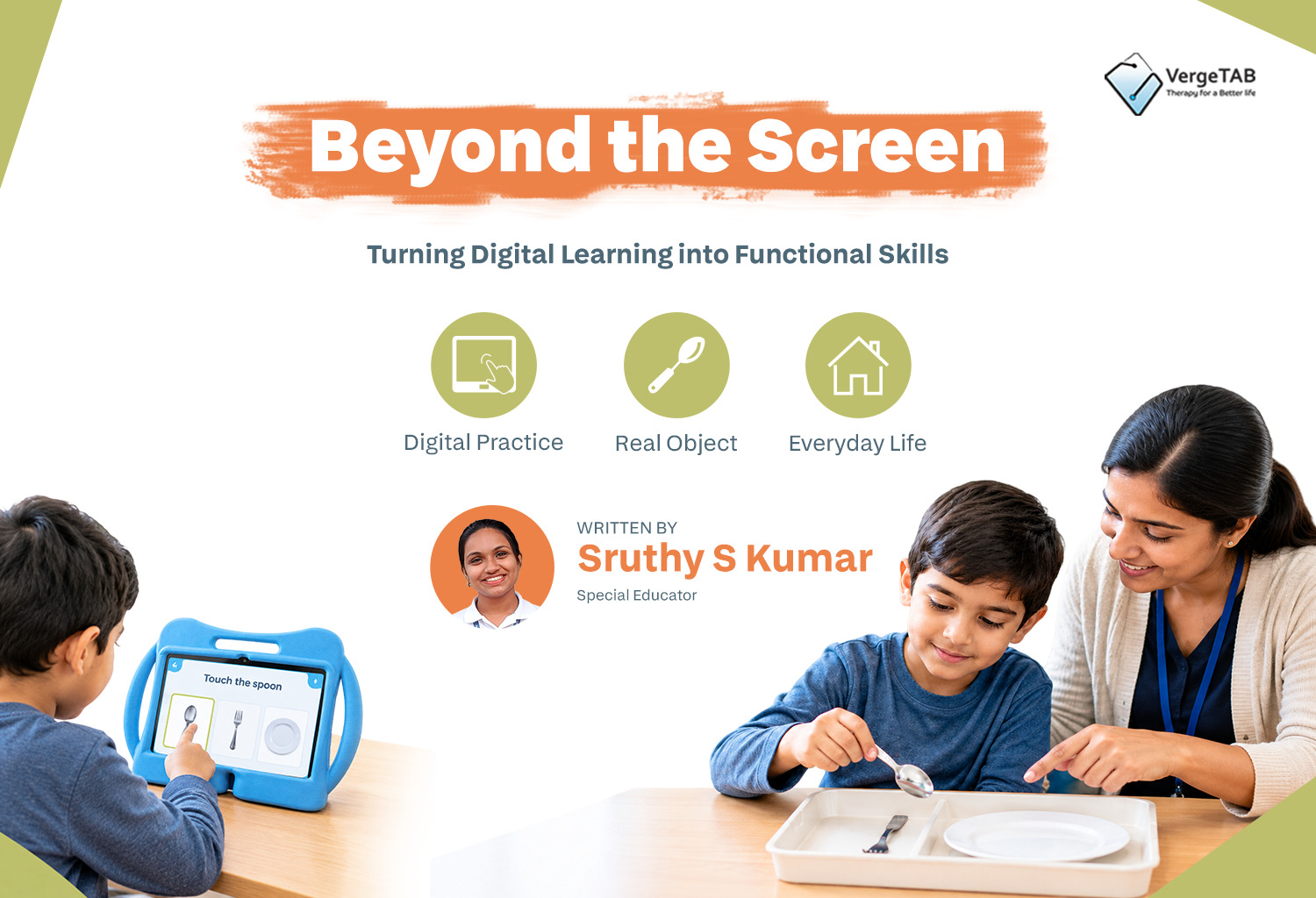
Imagine a child completing a matching activity on VergeTAB, identifying a spoon among a spoon, fork, and plate. Success here shows the child can recognise the spoon digitally. The teacher can extend this:
- Real objects: “Give me the spoon.” The child identifies the real object, not just the picture.
- Daily routine: At snack time, “Can you get your spoon?” Now the concept is used in context.
- Home: The child finds a spoon in the kitchen, a different environment with different people.
The journey becomes:
Digital picture → Real object → Different environment → Daily routine → Independent use
The child isn’t just learning to identify a picture. They’re learning to recognise, understand, and use the concept meaningfully. This is what makes learning functional.
What Is Generalisation?
Generalisation is the ability to use a skill learned in one situation in another. A child may succeed on VergeTAB without automatically applying that same skill in everyday life, and for children with special needs, this transfer doesn’t always happen on its own.
For example, a child may correctly identify red on a tablet but not recognise a red object in the classroom. This isn’t a failure to learn. It simply signals that the child needs more opportunities to transfer and generalise the skill, across:
- Different materials
- Different examples
- Different people
- Different environments
- Real life situations
Teaching should gradually shift the question from “Can the child do the activity?” to “Can the child use what they learned?” and eventually to “Can the child use it independently?”
One Goal, Many Opportunities
Consider a child whose goal is to identify and select everyday objects such as a cup, plate, spoon, and bottle, first practised on VergeTAB. The teacher can extend this goal step by step:
- Digital recognition: “Touch the cup.” (on screen)
- Picture recognition: “Show me the cup.” (printed picture)
- Real object recognition: “Give me the cup.” (among real objects)
- Functional use: “Get your cup for snack.” (during a routine)
- Independence: The child takes the cup unprompted at snack time.
Recognition → Understanding → Application → Independence
The goal isn’t for the child to recognise the word “cup.” It’s for the child to understand what a cup is, identify it when needed, and use it meaningfully. This is the real power of generalisation, and the same five step pattern can be applied to almost any skill introduced digitally: plant parts, money, emotions, hand washing, communication requests, number recognition, and more all follow this same arc from screen to independent, real world use.
From Digital Worksheets to Functional Activities
A digital worksheet can introduce or reinforce a concept, while a real life activity helps the child understand how it’s actually used. A few examples of how that extension might look:
| Digital Activity | Functional Extension |
|---|---|
| Match vegetables | Sort real vegetables |
| Identify money | Play a pretend shop |
| Trace letters | Write their name on a personal item |
| Identify colours | Sort clothes or classroom objects |
| Sequence hand washing | Practise hand washing |
| Identify emotions | Recognise emotions during social interaction |
| Count objects | Count items during classroom routines |
| Match shapes | Find shapes in the environment |
| Identify time | Connect time with daily routines |
The objective isn’t to replace digital learning with traditional activities. It’s to connect the two, so the digital activity becomes a bridge rather than an endpoint.
The VergeTAB Should Open the Door, Not Become the Destination
The purpose of VergeTAB isn’t to keep a child engaged with a screen. It’s to support meaningful learning goals. The device can provide:
Access → Practice → Repetition → Reinforcement
The teacher then provides:
Experience → Interaction → Application → Generalisation → Independence
Together, these form a learning cycle:
Digital Learning (the child practises on VergeTAB) → Guided Practice (the teacher connects the concept to real materials) → Functional Practice (the child uses the skill in an everyday activity) → Generalisation (across people, places, and materials) → Independence (reduced support over time)
The focus shouldn’t be on how much time a child spends on the tablet, but on what they’re learning through that time. A short, goal-oriented activity can be deeply meaningful when it builds a skill that later shows up in everyday life.
The Role of Teachers, Therapists and Parents
Generalisation is strongest when teachers and parents work together. A teacher or therapist introduces a concept digitally, while parents and educators can reinforce the skill in everyday situations. For example: a child learns to identify fruits on VergeTAB → identifies real fruits in the classroom → identifies fruits during meal prep at home.
Practising the same skill across different environments can provide more opportunities for transfer and generalisation, and the child begins to experience learning as something connected across their whole life, not confined to a single lesson.
Measuring Real Progress
Success shouldn’t be measured only by how many digital activities a child completes. That tells us the child performed the task. To understand real progress, we should also ask:
- Can the child perform the skill without the tablet?
- Can they use different materials, or demonstrate it with another person?
- Can they use it in another environment, or during a daily routine?
- Do they need fewer prompts over time?
- Can they eventually do it independently?
A completed activity tells us the child performed the task. Generalisation tells us the child can use the skill. Independence tells us the child can use it meaningfully without constant support. That progression, not activity completion alone, is the more functional way to look at learning.
Connect Digital Practice With Functional Learning
VergeTAB can be used as part of a structured learning approach where digital activities are connected with guided practice, real-world experiences and everyday routines. Explore how VergeTAB can support individual learning goals in home, school and therapy settings.
Beyond the Screen
Technology has changed how children access learning. For children with special needs, tools like VergeTAB offer engaging, visual, individualised opportunities to practise important skills.
But the goal isn’t to raise children who are simply successful at completing digital activities. The goal is to help children use what they learn in the world around them:
- A matching activity can become sorting real objects.
- A money worksheet can become a shopping experience.
- A communication activity can become a real request.
- A colour activity can become a meaningful choice.
VergeTAB provides access to the learning experience. The teacher creates the bridge. Real life provides the opportunity to use the skill.
When a child carries a skill from the screen into the classroom, from the classroom into the home, and from home into the community, digital learning becomes something more than screen based practice. It becomes life learning.
Because the real success of digital learning isn’t what a child can do while looking at the screen. It’s what the child can do after the screen is switched off.
Take the Next Step Beyond the Screen
Explore how VergeTAB can be integrated into structured learning and functional skill development across home, school and therapy settings.