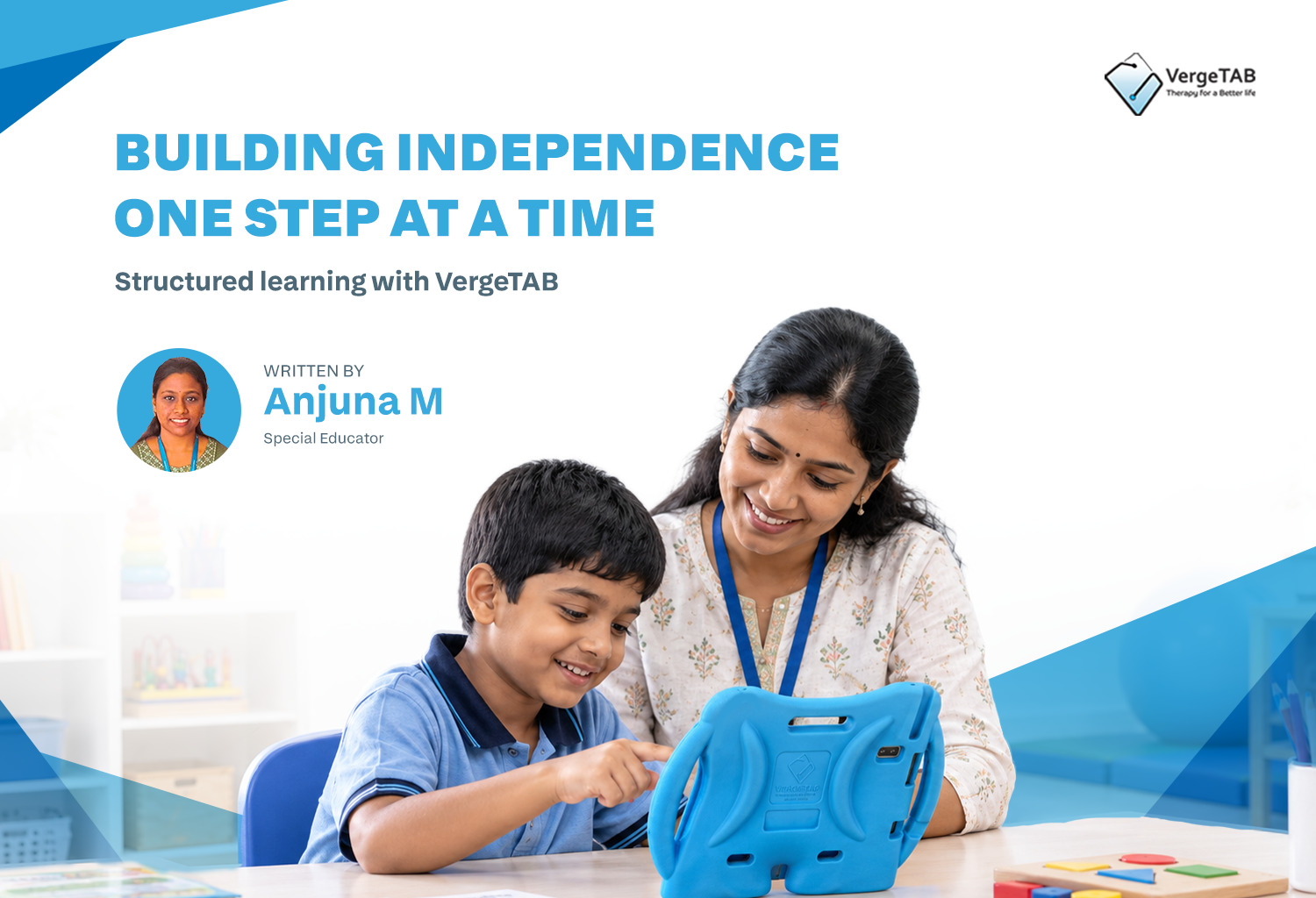
Empowering Every Learner to Become More Independent with VergeTAB
15 Sep 2026

Written by Anjuna.M
Special Educator
Every child deserves the chance to learn, grow, make choices, and become as independent as possible. For children with developmental, intellectual, communication, or learning disabilities, independence usually develops gradually, through structured teaching, repeated practice, appropriate support, and the steady reduction of adult assistance.
Technology can play an important role in this journey, but only when it’s used purposefully. It shouldn’t simply make learning more digital or entertaining. It should help children participate more actively and do more for themselves.
VergeTAB, an educational technology solution from XceptionalLEARNING, is a locked digital learning device powered by the XceptionalLEARNING (XL) Platform. When integrated with XL, it can be used for structured digital activities, visual supports, interactive learning experiences, and customised tasks alongside teaching and therapy to support children with diverse learning needs.
From Adult Support to Independence
Independence doesn’t happen suddenly. A child may initially need support to understand instructions, begin a task, complete each step, or make a choice. The goal isn’t to remove that support immediately; it’s to reduce it gradually as the child’s skills, understanding, and confidence grow.
This journey can be understood in four stages:
Adult Support → Guided Practice → Reduced Prompts → Independent Task Completion
1. Adult Support
At the start, a child may need an adult to explain the activity, demonstrate what to do, provide verbal prompts, or guide them through each step. For example, a teacher might show a child how to complete a matching activity on VergeTAB and offer prompts when the child is unsure what to do next. The adult’s role here is simply to provide whatever support the child needs to understand and participate.
2. Guided Practice
Once the child understands the activity, the adult can step back and let the child complete more of the task independently — offering guidance only when necessary. Instead of physically guiding the child’s hand, for instance, the adult might give a simple instruction like, “Look at the pictures and choose the matching one.” Repeated opportunities help the child become familiar with the task and its sequence.
3. Reduced Prompts
As confidence builds, prompts can be gradually scaled back. A detailed verbal instruction may shrink to a short reminder. A verbal prompt may eventually give way to a visual cue. Over time, the child may start to recognise the activity itself as the cue to begin. This matters because the goal isn’t to create dependence on adult prompts; it’s to help the child complete familiar tasks with less and less assistance.
4. Independent Task Completion
Over time, some children may begin to start and complete familiar tasks with minimal adult prompting. Independence at this stage might look like:
- Following visual instructions independently
- Starting an assigned activity with less adult support
- Completing a task step by step
- Making choices between available activities or responses
- Practising familiar activities without repeated prompting
- Attempting a task independently before asking for help
These may look like small achievements, but each one marks real progress toward greater independence.
How VergeTAB Supports This Journey
When used with the XL Platform, VergeTAB can give children repeated opportunities to practise skills while educators and therapists gradually adjust the level of support.
- Following visual instructions. Lengthy verbal instructions can be hard for some children to process. Pictures, symbols, and structured activities offer another way to understand what’s expected — and with practice, children can learn to follow visual cues without waiting for an adult to explain every step.
- Starting tasks independently. Rather than waiting for repeated prompts to begin, children can learn to recognise an assigned activity and start it on their own. Clear routines and consistent visual or digital cues help build this habit.
- Completing tasks step by step. Many activities involve several steps, and a child may need support at each one at first. Structured, repeatable activities let children practise the sequence until adult assistance can be reduced.
- Making independent choices. Depending on the activity and learning goal, children can choose between available activities or responses, select an answer, or indicate what they want to do next — giving them real opportunities to practise decision-making.
- Practising without repeated prompting. When children have access to familiar, structured activities, they can be given time to attempt a task before an adult steps in, with prompts reduced as familiarity grows.
The Role of Teachers and Therapists
Technology alone doesn’t create independence. How it’s introduced and used matters just as much. Teachers and therapists can support this growth by:
- Demonstrating a task before expecting independent performance
- Giving clear, simple instructions
- Providing prompts only when necessary
- Allowing enough time for the child to respond
- Gradually reducing verbal, visual, or physical prompts
- Encouraging the child to try before stepping in
- Recognising effort as well as successful completion
- Using progress information to recognise when support can be reduced
- Choosing activities that match the child’s current abilities while still offering room to grow
The objective is to support without over-supporting: enough assistance for the child to succeed, but enough room for them to discover what they can do on their own.
The Goal: Support Without Over-Supporting
Provide enough assistance for the child to succeed, while creating opportunities for the child to attempt, practise, and complete tasks with gradually less support.
The Role of Parents
Independence shouldn’t stop at the classroom door. Parents can reinforce the same approach at home by giving children chances to practise familiar activities with gradually reduced assistance. Instead of immediately stepping in on a familiar task, parents can give the child time to try first, offering simple instructions, visual cues, and encouragement only when needed, and avoiding unnecessary prompting.
When home and school take a consistent approach, children get more chances to practise independence across different environments.
Small Steps, Lasting Confidence
Independence is built through small, repeated successes. A child who once needed an adult to start an activity may eventually begin it alone. A child who needed step-by-step guidance may complete the sequence with less help over time. A child who waited for an adult to make a choice may start making choices independently.
Repeated successful experiences can help build confidence. When children feel “I can do it myself,” they become more willing to attempt new tasks, work through challenges, and take an active role in their own learning.
Independence doesn’t mean expecting children to do everything alone. It means providing the right support at the right time, and gradually helping them need less of it. Through thoughtful teaching strategies and the purposeful use of technology like VergeTAB, educators, therapists, and parents can help every child practise familiar skills, make choices, follow instructions, and take greater ownership of their learning.
The goal was never just to make learning digital or engaging. It’s to help every child discover what they can do for themselves, and give them the support, opportunities, and confidence to do more.
Explore VergeTAB for Structured Learning
VergeTAB works exclusively with the XceptionalLEARNING (XL) Platform to support structured digital learning and therapy activities under educator and therapist guidance.
Want to see how VergeTAB can fit into a child’s learning or therapy programme?