How Parents Can Maximize Therapy at Home with VergeTAB

Reading Time: 4 minutes

Clinically Reviewed by

Meha P Parekh

Special Educator

A Practical Guide to Meaningful, Measurable Progress

Therapy doesn’t stop when a session ends.

It continues at the kitchen table during homework.
On the staircase, when balance is tested.
In quiet moments before bedtime, when frustration surfaces again.

And as a parent, you feel it.

You want to help your child progress.
You want to reinforce what the therapist is doing.
But sometimes you’re unsure what to practice — or whether you’re doing it the right way.

That uncertainty can quietly slow progress. Structured clarity changes that.

This is exactly where VergeTAB, a digital therapy tablet, reshapes the home therapy experience — not by adding pressure, but by bringing alignment, consistency, and measurable direction.

Why Home Practice Matters More Than You Think

A therapist may see your child for one or two hours each week.
You are there every day.

Children develop through repetition — especially repetition in environments where they feel safe and emotionally regulated. Research in neuroplasticity consistently shows that the brain strengthens pathways that are activated consistently and meaningfully.

When therapy goals are reinforced at home:

  • Neural pathways consolidate more effectively
  • Motor patterns become smoother
  • Attention stabilizes
  • Emotional regulation improves
  • Skills transfer into real-life situations

Without follow-through, progress can stay inside the clinic. With aligned home reinforcement, skills begin to generalize into classrooms, playgrounds, and daily routines.

That transfer is where real independence develops.

What Makes VergeTAB Different

Many parents worry about increasing screen time — and that concern is valid.

But VergeTAB is not a general-use tablet.

It is a purpose-built therapeutic device that works exclusively within the secure XceptionalLEARNING platform through the protected XL Portal.

There is:

  • No app store
  • No entertainment content
  • No social media
  • No random downloads

Every activity is therapist-assigned. Every program aligns with developmental goals. Every session connects back to measurable outcomes.

Instead of distraction, it provides direction.
Instead of passive consumption, it delivers goal-driven practice.

The Power of Parent Involvement

Therapists design evidence-based intervention plans.
Parents provide consistency and emotional safety.

When therapy is reinforced at home in short, guided sessions:

  • Repetition strengthens adaptive motor control
  • Emotional confidence increases through predictable routines
  • Cognitive flexibility develops through structured sequencing
  • Attention endurance improves gradually

You are not replacing the therapist — you are extending the therapeutic environment.

And when clinic and home operate in alignment, progress becomes more predictable and sustainable.

How the VergeTAB System Works

VergeTAB functions within a connected developmental ecosystem:

  1. Therapists assign structured programs through the XceptionalLEARNING platform.
  2. Activities sync directly to VergeTAB.
  3. Your child completes guided sessions at home.
  4. Performance data is securely tracked.
  5. Therapists review results and adjust programs accordingly.

No guessing. No conflicting strategies. No unstructured repetition.

Just aligned developmental continuity.

See How the VergeTAB System Works

A Step-by-Step Approach for Effective Home Therapy

Step 1: Create a Consistent Routine

Keep sessions:

  • 10–20 minutes
  • At the same time, daily
  • In a calm, distraction-free environment

Consistency builds neural efficiency more effectively than occasional long sessions.

Short, predictable practice builds lasting progress.

Step 2: Follow the Assigned Activity

Activities are intentionally sequenced to support:

  • Adaptive motor coordination
  • Balance and bilateral integration
  • Fine motor precision
  • Attention pacing
  • Speech and communication
  • Emotional regulation

Even if tasks appear simple, they are layered with progression logic.

Trust the developmental sequencing.

Step 3: Encourage Effort Over Perfection

Home therapy should never feel like an exam.

Instead of focusing on mistakes, reinforce effort:

“Good work.”
“Try again, you can do it.”
“Let’s try that together.”

Confidence increases engagement. Engagement accelerates learning.

Step 4: Watch for Subtle Improvements

Progress is often gradual — and powerful.

You may begin noticing:

  • Smoother handwriting
  • Improved posture
  • More stable balance
  • Longer attention span
  • Reduced frustration
  • Faster recovery after small mistakes

Small improvements compound into meaningful transformation.

See How One Family Reinforces Therapy at Home

Every child’s journey is different. Below is an example of how one family integrates structured digital reinforcement into daily routines — supporting therapy goals in small, consistent ways.

Watch Our Child Thrive with Our Digital Activity Book! | ft.VergeTAB

Notice how the focus remains on routine, repetition, and encouragement — not perfection.

Want to explore more therapy demonstrations?
Discover how children engage with guided learning activities on the VergeTAB Therapy Tablet through our video library.

Explore the VergeTAB Video Library

Why a Distraction-Free Device Matters

Many children receiving therapy struggle with attention regulation, pacing, or sensory sensitivity.

General tablets are engineered to stimulate and capture attention continuously.

VergeTAB removes that overstimulation.

Because it operates only within the XceptionalLEARNING ecosystem:

  • Cognitive load is controlled
  • Visual clutter is minimized
  • Task sequencing is intentional
  • Feedback is purposeful

Screen exposure becomes therapeutic — not recreational.

Common Mistakes That Slow Progress

  • Skipping sessions frequently
  • Turning practice into pressure
  • Comparing your child’s journey to others
  • Mixing therapy time with unrelated digital distractions

Consistency and calm reinforcement outperform intensity and urgency.

Progress should feel steady — not stressful.

The Real Goal: Independence

The objective of structured home therapy is not task completion.

It is helping your child:

  • Self-correct naturally
  • Regulate effort and fatigue
  • Transfer skills across environments
  • Adapt confidently to new challenges
  • Build independence without constant prompting

Independence is not built in one session — it is built through aligned repetition over time.

When therapist guidance, VergeTAB sessions, and parent support work together, development becomes measurable and sustainable.

This is not random digital engagement.
It is a connected developmental ecosystem designed for long-term growth.

Frequently Asked Questions

Can home therapy replace clinic sessions?

No. Home reinforcement strengthens clinical therapy — it does not replace professional assessment, planning, or therapist guidance. The most effective progress happens when clinic sessions and home practice work together in alignment.

How much home practice is ideal?

In most cases, short, consistent 10–20 minute sessions are more effective than longer, inconsistent practice. Daily repetition builds neural efficiency and supports steady developmental progress without overwhelming the child.

Is digital therapy safe for children?

When screen exposure is structured, goal-based, and distraction-free — as with VergeTAB — it supports focused learning rather than overstimulation. Purpose-driven digital engagement is very different from passive entertainment screen time.

Moving Forward

If you’re ready to bring clarity, structure, and confidence into your child’s home therapy routine — and strengthen the vital role parents play in accelerating progress — explore how VergeTAB integrates into real therapy sessions.

Contact us or connect with our team on WhatsApp to receive personalized guidance, a suitability assessment, and structured solutions tailored to your child’s developmental needs.

Because when parents are empowered with the right structure, progress doesn’t just continue — it accelerates.


How VergeTAB Strengthens Sensorimotor Processing and Praxis Skills in Children  

Reading Time: 5 minutes

Clinically Reviewed by

Elizabeth Francis

Occupational Therapist

An Occupational Therapist’s Experience With Two Very Different Learners

(Names and details are changed to protect privacy.)

Introduction: Two Personalities, One Underlying Developmental Need

In therapy, children walk in with very different energies.
Some come in quietly, observing the room before taking a single step.
Others rush in with excitement, ready to touch, explore, and start everything at once.

Their behaviours may look opposite, but very often, both groups struggle with the same underlying areas:
Sensorimotor processing and praxis (motor planning).

These skills affect almost everything a child does — from climbing, drawing, and dressing to paying attention and following instructions.

Two children I met six months apart made this clearer than ever: Anjali, the calm observer, and Heera, the energetic adventurer.
Both had very different personalities, yet both benefitted from VergeTAB, which works only through the structured XceptionalLEARNING platform.

Before Their Story: A Simple Explanation of Sensorimotor Processing & Praxis

What Is Sensorimotor Processing?

In simple terms, it’s how a child takes in sensory information and turns it into action.

When this system is working well, children move confidently and stay organised.
When it’s not, you may see:

  • clumsiness or tripping
  • difficulty sitting upright
  • trouble copying shapes or patterns
  • poor coordination
  • slow or inconsistent responses

This explains why some children are overly cautious, while others move too fast.

What Is Praxis (Motor Planning)?

Praxis is the ability to think of an action, plan it, sequence it, and do it smoothly.

Children with weak praxis often:

  • hesitate before starting tasks
  • rush and skip steps
  • struggle with new motor activities
  • get confused with multi-step instructions

Understanding these two areas helps me choose activities that support each child at their level — not faster, not slower.

Why VergeTAB Works Only With XceptionalLEARNING

VergeTAB, on its own, is just a blank tablet.
Every structured therapy activity — from visual–motor tasks to sequencing modules — comes entirely from the XceptionalLEARNING platform.

The platform provides:

  • graded levels of difficulty
  • controlled pacing
  • visual–motor exercises
  • bilateral coordination tasks
  • sequencing and planning modules
  • therapist-guided structure

This structure is what makes the difference for both slow processors and fast movers.

When Anjali First Came Into My Clinic

Anjali was a gentle, quiet child.
She held her mother’s hand tightly and watched everything before participating.

Her parents described concerns such as:

  • long hesitation before starting any new motor activity
  • avoiding climbing, balancing, or fast movements
  • difficulty copying shapes or simple patterns
  • slow processing of multi-step instructions
  • mild posture instability and weak visual–motor coordination
  • extra time needed for planning movements

After assessing her, it was clear that she struggled with sensorimotor processing and praxis, particularly in feedforward planning.
Her strengths were sensitivity and focus — she simply needed predictable input and structured, gradual progression.

To support her, I chose VergeTAB through the XceptionalLEARNING platform because it offers a calm, predictable experience — exactly what Anjali needed.

How VergeTAB Helped Anjali (The Quiet Observer)

1. Gentle Visual–Motor Integration Training

We started with slow, error-free learning tasks:

  • tracing graded paths
  • controlled drag-and-drop
  • dot-to-dot sequencing
  • shape copying with visual cues

These activities strengthened:

  • ocular–motor control
  • hand–eye coordination
  • sustained attention
  • motor accuracy

2. Feedforward Motor Planning & Sequencing

Using modules such as:

  • first → next → last sequences
  • sequential placement tasks
  • “Move only when highlighted” prompts

Anjali began organizing steps more confidently, developing:

  • sequencing skills
  • planning efficiency
  • anticipatory motor control
  • smoother execution

3. Bilateral Coordination & Postural Stability

Activities requiring stable hands, synchronized tapping, and left–right crossing helped improve:

  • core stability
  • interhemispheric integration
  • midline control

Slowly, her handwriting readiness, body awareness, and initiation speed improved.
Anjali became braver — not faster — but more confident, more coordinated, and more willing to try.

Six Months Later… Heera Entered

Half a year after Anjali completed her program, another girl arrived — the complete opposite personality.

Heera rushed into the room with excitement, touching everything, talking nonstop, and ready to start before I even explained the activity.

Her parents listed concerns such as:

  • impulsive movement
  • frequent tripping or bumping into objects
  • difficulty regulating force and speed
  • rushing through tasks and leaving them incomplete
  • inconsistent spatial awareness
  • trouble following sequencing tasks

During my assessment, it was clear:
Heera had challenges with inhibitory control, timing regulation, spatial orientation, and sequencing within praxis.

She did not need “calming down” — she needed organized, paced sensory–motor input.
And once again, the most structured tool for her profile was VergeTAB with XceptionalLEARNING.

How VergeTAB Helped Heera (The Energetic Adventurer)

1. Timing, Rhythm & Impulse Control Activities

Her sessions focused on:

  • tapping only on cue
  • pausing before dragging
  • following rhythmic prompts
  • slow placement tasks

These helped her develop:

  • inhibitory control
  • pacing
  • impulse regulation
  • timing accuracy

2. Sequencing & Working Memory Development

She worked on:

  • multi-step visual sequences
  • pattern imitation
  • controlled drag-and-drop chains

This improved her skills in:

  • planning ahead
  • self-regulation
  • visual sequencing
  • task completion

3. Spatial Orientation & Force Grading

Structured visuals guided her to:

  • apply appropriate pressure
  • judge boundaries
  • avoid overshooting
  • navigate space safely

Her movements became more mindful, organized, and purposeful.
Just as Anjali found courage, Heera found control.

Why VergeTAB Works for Opposite Personalities

Both children improved for the same reasons:

  • no distracting apps
  • therapist-controlled difficulty levels
  • clear visuals that reduce cognitive load
  • structured, graded activity progression
  • measurable progress tracking
  • supports both under-responsive and over-responsive sensory profiles

The system adapts to the child — not the other way around.

Core Sensorimotor & Praxis Skills Strengthened With VergeTAB

1. Praxis / Motor Planning

  • ideation
  • sequencing
  • feedforward planning
  • smooth execution

2. Visual–Motor Integration

Supports handwriting, copying, cutting, drawing, and classroom readiness.

3. Bilateral Coordination

Supports stability, midline crossing, body control, and learning skills.

4. Body Awareness (Proprioception)

Helps children understand their position and movement in space.

5. Timing & Rhythm Regulation

Important for impulse control, speech pacing, and sustained attention.

6. Spatial Orientation

Supports puzzle-solving, navigation, safety, and daily movement planning.

Conclusion: Different Journeys, One Path to Growth

Anjali and Heera show us one truth: no two children learn the same way — but every child learns beautifully when therapy is structured, sensory-aligned, and paced correctly.

Their personalities were opposite, but their developmental needs were similar — and their progress came from structured, consistent, therapist-guided practice.

With VergeTAB powered by XceptionalLEARNING, therapy becomes predictable, measurable, and developmentally aligned — ideal for both cautious and energetic children.

Sensorimotor processing and praxis don’t improve overnight; they grow through repetition, clarity, and the right tools. VergeTAB brings this growth into a child’s everyday learning with precision and child-centered design.

Whether a child is gentle or impulsive… slow or fast… hesitant or adventurous —
VergeTAB helps them move through the world with confidence, coordination, and self-awareness.

Take the next step

Contact us to book a free VergeTAB + XceptionalLEARNING demo, try the Digital Activity Book modules, and learn how our Interactive Learning Device for Children and Digital Therapy Activity Device can support your child’s development.

Disclaimer

The scenarios shared in this article are composite case examples created to illustrate common patterns seen in pediatric therapy. They do not describe any real individual but reflect typical sensorimotor and praxis profiles observed in clinical practice.

Child Lacks Patience and Control? Activities That Build Precision and Self-Regulation Using VergeTAB

Reading Time: 6 minutes

Clinically Reviewed by

Ann Mary Jose

Special Educator

In classrooms and therapy sessions, educators and therapists often notice children who lack patience, rush through tasks, and struggle to control their actions. These difficulties affect precision, learning quality, and the child’s ability to complete activities calmly and accurately.

Traditional worksheets or general learning apps do not provide the structured, guided practice needed to help children slow down, focus, and build self-regulation in a measurable way.

VergeTAB, used together with the XceptionalLEARNING platform, is implemented in schools and therapy clinics to deliver distraction-free, goal-based digital activities specifically designed to improve precision, patience, and self-control in children.
Talk to our team on WhatsApp

Understanding the Core Skills

Before exploring the activities, let’s understand why these three skills matter:

Patience: Helps children wait, observe, and plan their actions instead of reacting immediately.
Control: Encourages careful movement, steady hands, and awareness of body motion.
Precision: Improves accuracy, spatial awareness, and fine motor coordination.

Together, these skills form the foundation for daily routines—from eating and dressing to writing and problem-solving.

Challenges in Developing These Skills

Children with developmental delays often face challenges that make patience, control, and precision harder to cultivate:

  • Short attention span: Maintaining focus can be difficult.
  • Impulsivity: Acting without thinking or rushing tasks.
  • Motor control difficulties: Fine motor skills may be underdeveloped, making precision tasks frustrating.
  • Emotional regulation: Children may become easily irritated or anxious with complex tasks.

Traditional tools may not provide enough engagement for repeated practice, which is why technology-based interventions like VergeTAB can be transformative.

Struggling to help your child develop patience, self-control, or precision?

VergeTAB offers structured activities that strengthen focus and task accuracy.
Chat with our team on WhatsApp for guidance

I. Patience: Learning to Wait, Observe, and Plan

Children often want instant results. But patience is the key to handling frustration, completing multi-step tasks, and following structured routines. VergeTAB includes interactive activities that make waiting rewarding and observation exciting.

1. The Slow Build Challenge

Objective: Teach children how to wait, observe, and act only when it’s time.

How It Works:

  • The screen displays a blank structure, such as a garden or tower.
  • Pieces appear one by one after a few seconds.
  • The child must patiently wait for each new piece before placing it.
  • If they rush, the structure resets or the bonus points decrease.

Therapeutic Focus:
Encourages delayed gratification, attention span, and planning skills.

Why It Works on VergeTAB:
Visual cues, slow-paced animations, and soft sound feedback make the waiting process calm, enjoyable, and engaging — ideal for children who need structured sensory experiences.

Age/Skill-Level Suggestions:
4+
Stepwise Simplification: Reduce the number of pieces and increase wait times for younger children or those with severe delays.

2. Drip Collection Challenge

Objective: Build focus and timing control through anticipation.

How It Works:

  • Droplets fall at irregular intervals into a virtual container.
  • Children must tap only when the droplet reaches a certain height.
  • Early or late taps result in missed points, encouraging accurate timing.

Therapeutic Focus:
Develops patience, rhythm, and hand-eye coordination.

Why It Works on VergeTAB:
The platform adapts droplet speed according to performance, helping children practice timing while receiving immediate feedback, which reduces frustration.

Age/Skill-Level Suggestions:
4–6
Stepwise Simplification: Slower droplet speed and fewer drops for beginners.

3. Story Sequencer Pause

Objective: Teach patience through gradual story completion.

How It Works:

  • A short story appears panel by panel.
  • Each panel opens after a set wait time.
  • The child must arrange each new scene correctly before moving on.

Therapeutic Focus:
Enhances sequencing, attention to order, and comprehension.

Why It Works on VergeTAB:
The slow unfolding of stories allows therapists to observe the child’s reaction to delay, helping reinforce calm responses and anticipation control.

Age/Skill-Level Suggestions:
5+
Stepwise Simplification: Use shorter stories or fewer panels for younger children or severe delays.

II. Control: Building Steadiness and Awareness

Control is not just physical — it’s emotional and mental, too. VergeTAB helps children learn how to manage movement, apply steady pressure, and maintain focus even under gentle challenges.

1. Fine-Motion Labyrinth

Objective: Train steady hand movements and navigation control.

How It Works:

  • The child guides a ball through a digital maze using gentle finger movement.
  • Touching walls restarts the maze, teaching controlled correction.
  • Paths gradually get narrower or include soft-moving barriers.

Therapeutic Focus:
Improves fine motor control, visual tracking, hand stability, and concentration.

Why It Works on VergeTAB:
Children can use their fingers or a stylus for realistic touch feedback, allowing therapists to measure accuracy and improvement over time.

Age/Skill-Level Suggestions:
5+
Stepwise Simplification: Start with wider paths and fewer barriers for beginners.

2. Balance Beam Challenge

Objective: Strengthen coordination and awareness of steady motion.

How It Works:

  • A digital character walks across a narrow bridge while holding items.
  • The child drags the character slowly along the path using touch.
  • Moving too fast or off-path resets the level, teaching controlled movement.

Therapeutic Focus:
Enhances motor planning, hand control, and persistence.

Age/Skill-Level Suggestions:
5+
Stepwise Simplification: Widen the path and reduce items for younger children or severe delays.

Why It Works on VergeTAB:
The screen’s motion sensitivity allows realistic practice of balancing skills in a safe digital environment, perfect for children who need controlled motion tasks.

3. Virtual Clay Sculpting

Objective: Develop precise hand movements and shape recognition.

How It Works:

  • Children drag and position digital shapes to match outlines or templates.
  • Shapes snap into place when correctly aligned, providing immediate visual feedback.

Therapeutic Focus:
Builds hand-eye coordination, spatial awareness, and goal-directed movement.

Why It Works on VergeTAB:
Digital pressure feedback mimics tactile responses, making it effective for children who need to understand hand pressure differences.

Age/Skill-Level Suggestions:
4+
Stepwise Simplification: Use larger shapes and fewer items for beginners or severe delays.

III. Precision: Learning Accuracy and Spatial Awareness

Precision skills help children align, measure, and complete tasks that require focus. VergeTAB uses visual coordination exercises to make accuracy a fun and confidence-building experience.

1. Target Drop Challenge

Objective: Enhance hand-eye coordination and timing.

How It Works:

  • Children drop objects into targets from various heights.
  • Targets move slightly to challenge coordination.
  • Points are awarded for perfect alignment.

Therapeutic Focus:
Reinforces controlled release, visual-motor timing, and spatial judgment.

Why It Works on VergeTAB:
Instant feedback shows whether the object landed correctly, helping children learn through success and gentle correction.

Age/Skill-Level Suggestions:
5+
Stepwise Simplification: Use larger targets and slower objects for beginners.

2. Digital Balance Scale Challenge

Objective: Strengthen logical reasoning and careful movement.

How It Works:

  • Children drag weights onto each side of a digital scale.
  • The goal is to balance it perfectly.
  • The game introduces real-world comparisons, like apples and blocks.

Therapeutic Focus:
Builds analytical thinking, attention to measurement, and fine motor control.

Why It Works on VergeTAB:
The adaptive scale mimics real physics—ideal for combining maths, motor coordination, and critical thinking in a sensory-friendly way.

Age/Skill-Level Suggestions:
6+
Stepwise Simplification: Start with fewer items or smaller numbers for younger children.

3. Rotating Maze Key

Objective: Teach alignment, timing, and problem-solving through motion.

How It Works:

  • A key must pass through a rotating maze without touching the sides.
  • Each turn requires careful timing and movement alignment.
  • Higher levels introduce new paths and speeds.

Therapeutic Focus:
Develops fine precision, reaction control, and spatial orientation.

Why It Works on VergeTAB:
The activity simulates real-life alignment challenges (like unlocking doors) in a digital format, making it relatable and transferable to daily skills.

Age/Skill-Level Suggestions:
6+
Stepwise Simplification: Use slower rotations or simpler paths for younger children or severe delays.

In real therapy and classroom environments, these skills are practiced using VergeTAB in a controlled, distraction-free setup designed specifically for special education and therapy use. Schools and clinics use VergeTAB along with XceptionalLEARNING to ensure structured skill development and measurable progress.
See how VergeTAB works in real sessions

Real-World Applications

VergeTAB activities build essential life skills that extend beyond digital learning:

Patience: Helps children wait calmly, follow daily routines step by step, and take turns in games or class.
Control: Improves careful movement, tool use, and safe handling—like carrying a tray, writing neatly, or pouring drinks.
Precision: Enhances accuracy and focus for real tasks such as stacking toys, organizing items, or threading beads.

Example:
A child who practices patience, control, and precision on VergeTAB may later wait calmly while cooking, carry a lunch tray without spilling, or pour water into a cup with steady hands.

Expected Outcomes

With regular use of VergeTAB and the XceptionalLEARNING platform, children can experience:

  • Behavioural Growth: Better patience, reduced impulsivity, and improved emotional control.
  • Cognitive Development: Sharper focus, sequencing, and planning skills.
  • Motor Improvement: Stronger hand-eye coordination and fine motor control.
  • Functional Independence: Greater confidence in self-care, classroom, and daily activities.

Conclusion

Developing patience, control, and precision can be life-changing for children with developmental delays. If your school or clinic is looking for a practical way to build these skills using a dedicated therapy device, VergeTAB provides a safe, guided, and distraction-free digital environment built specifically for special education and therapy.
Request a VergeTAB Demo
Talk to our team on WhatsApp for institutional enquiries

Child Easily Distracted and Impulsive? How VergeTAB Helps Build Focus and Self-Control

Reading Time: 5 minutes

Clinically Reviewed by

Aswathy Ponnachan

Medical and Psychiatric Social Worker

In classrooms and therapy sessions, educators and therapists often observe children who are easily distracted, act impulsively, and struggle to stay focused on tasks. These challenges affect learning, behaviour regulation, and overall academic performance, especially for children with attention and executive function difficulties.

Traditional teaching methods, worksheets, or regular apps do not provide the structured, guided practice needed to help children build focus and self-control in a measurable way.

VergeTAB, used together with the XceptionalLEARNING platform, is implemented in schools and therapy clinics to deliver distraction-free, goal-based digital activities specifically designed to improve attention, inhibition, and self-regulation skills in children.
Talk to our team on WhatsApp

Understanding Executive Function in Children

What Are Executive Functions?

Executive functions enable children to regulate their behaviour, manage emotions, and think strategically. Key components:

  • Inhibition (Self-Control): Resist impulses, ignore distractions, and think before acting.
  • Cognitive Flexibility (Adaptability): Switch between tasks, adjust to new rules, and view problems from different perspectives.
  • Metacognition (Thinking About Thinking): Awareness of one’s own thought processes — planning, self-monitoring, and reflecting.

Why Executive Functions Matter

Strong executive functions support:

  • Focus and attention
  • Problem-solving and reasoning
  • Emotional regulation
  • Academic achievement and independence

Children struggling with these skills may find everyday tasks overwhelming.

How VergeTAB Supports Executive Function Development

A Blank Tab with Purpose

Unlike standard tablets, VergeTAB is a blank tab operating only via XceptionalLEARNING. This ensures:

  • Distraction-free learning
  • Tailored activities by therapists, educators, and parents
  • Structured progress tracking and adaptive learning

Therapist-Guided Cognitive Development

Therapists use the XceptionalLEARNING Platform to:

  • Assign targeted exercises per child’s needs
  • Adjust difficulty based on progress
  • Combine visual, auditory, and motor engagement

VergeTAB becomes a personalized tool for executive function training, not a generic tablet.
Chat with our team on WhatsApp for guidance

1. Enhancing Inhibition: Helping Children Pause and Think

VergeTAB strengthens inhibitory control by combining interactive visuals, precise timing, and real-time feedback. Each activity trains the brain to pause, observe, and respond deliberately.

VergeTAB Activities for Inhibition

a. Find What Doesn’t Belong
Children identify which object in a group doesn’t fit (e.g., apple, banana, shoe, orange).
Skill outcome: Improves impulse control and selective attention.

b. Wait and Tap
Children must tap the screen only when a specific signal appears (e.g., a sound or image).
Skill outcome: Builds patience, focus, and the ability to delay reactions.

c. Emotion Regulation Match
Match facial expressions with correct emotion labels while ignoring distractors.
Skill outcome: Strengthens emotional inhibition and empathy understanding.

d. Focused Filtering Games
Activities that require ignoring background images or sounds while completing a main task.
Skill outcome: Trains the brain to filter irrelevant stimuli and sustain attention.

e. Stop-and-Go Challenge
A digital version of “Red Light, Green Light.” Children must freeze when the red light shows and move only when the green light appears.
Skill outcome: Builds motor inhibition, attention, and self-control — all achievable on VergeTAB’s touch-interactive screen.

Therapist Tip:
On the XceptionalLEARNING platform, therapists can adjust timing intervals, difficulty levels, and feedback frequency, helping children gradually internalize control without stress or frustration.

2. Supporting Cognitive Flexibility: Adapting to Change and Thinking Differently

Cognitive flexibility allows children to adjust to new rules or problem-solving approaches. VergeTAB enhances adaptability through dynamic, rule-changing tasks that promote flexible thinking.

VergeTAB Activities for Cognitive Flexibility

a. Rule Switch Sorting
Children sort items by one simple attribute (e.g., colour first, then shape).
Skill outcome: Trains basic set-shifting and adaptability in a controlled environment.

b. Story Sequencing with Changing Rules
Arrange pictures in order of events; then re-arrange based on emotion, cause-and-effect, or character perspective.
Skill outcome: Strengthens narrative flexibility and higher-order thinking.

c. Multiple Solutions Challenge
Puzzles are designed with several possible correct answers.
Skill outcome: Encourages creative problem-solving and open-minded thinking.

d. Switch-the-Scene Activity
The visual background or scenario changes (e.g., day/night or indoor/outdoor), and children must adjust their response based on new conditions.
Skill outcome: Builds situational awareness and attention flexibility.

e. Category Flip Challenge
Children sort items using multiple attributes at once (e.g., shape + size + category) and flip rules mid-task.
Skill outcome: Strengthens complex set-shifting and multi-dimensional thinking.

Therapist Tip:
Therapists can blend flexibility tasks with inhibition exercises through XceptionalLEARNING — like changing sorting rules mid-task — to stimulate multiple executive processes at once.

3. Strengthening Metacognition: Thinking About Thinking

Metacognition develops when children learn to evaluate their own thinking. VergeTAB integrates guided prompts, performance reviews, and reflection-based exercises to make children aware of how they think and learn.

VergeTAB Activities for Metacognition

a. Plan and Reflect Thinking
Children predict steps before starting a puzzle or task. During the activity, they are prompted to think aloud, explaining their approach and decisions in real-time. After completing the task, they reflect on what worked, what was challenging, and how strategies could improve.
Skill outcome: Builds planning, real-time self-monitoring, and post-task reflection, strengthening overall metacognitive skills.

b. What Did You Learn?
At the end of each session, VergeTAB displays reflection prompts such as:

  • What was easy for you?
  • What was challenging?
  • What strategy worked best?
    Skill outcome: Promotes self-awareness and confidence.

c. Strategy Swap Challenge
Children complete a task using their preferred strategy, then are encouraged to try an alternative approach suggested by the therapist. They compare results and reflect on which strategy was more effective and why.
Skill outcome: Promotes flexible thinking, strategy evaluation, and adaptive learning.

d. Progress Dashboard Review
Using the XceptionalLEARNING dashboard, children visualize their performance trends.
Skill outcome: Builds goal-setting habits and reflective learning.

e. Predict and Reflect Quiz
Before answering, children predict whether they’ll get the question right. Afterwards, they compare the prediction vs. the result.
Skill outcome: Builds realistic self-assessment and reflective accuracy — fully supported through VergeTAB’s quiz templates.

Therapist Tip:
Therapists can use platform session logs to discuss progress with children—helping them set new goals and celebrate small wins, which boosts self-monitoring and motivation.

4. Integrated Activities: Training Multiple Executive Functions Together

Real-life thinking involves the combined use of inhibition, flexibility, and metacognition. VergeTAB provides blended digital activities that mirror these integrated cognitive processes.

VergeTAB Combined Activities

a. Decision Tree Stories
Children choose story outcomes based on character decisions. When the rule changes, they adapt their choices and reflect on the new results.
Skill outcome: Integrates impulse control, adaptability, and reflective thinking.

b. Error Detective
Identify mistakes in stories, number patterns, or sequences and explain why they occurred.
Skill outcome: Combines reasoning, reflection, and error awareness.

c. Goal-Setting Missions
Children set goals (e.g., complete 3 levels without errors). VergeTAB tracks completion and presents feedback.
Skill outcome: Supports self-regulation and long-term focus.

d. Daily Routine Planner
Children plan their therapy or learning sequence using visual icons, predicting the order and reflecting after completion.
Skill outcome: Combines planning, inhibition, and cognitive organization.

e. Consequence Mapper
Children choose an action (e.g., helping a friend or ignoring a task) and see simulated outcomes on VergeTAB.
Skill outcome: Enhances foresight, moral reasoning, and metacognitive judgment — all trackable via XceptionalLEARNING modules.

In real therapy and classroom environments, these skills are practiced using VergeTAB in a controlled, distraction-free setup designed specifically for special education and therapy use. Schools and clinics use VergeTAB along with XceptionalLEARNING to ensure structured skill development and measurable progress.
See how VergeTAB works in real sessions

The Role of the Therapist and Educator

While VergeTAB provides a digital framework, human guidance is the key that brings cognitive growth to life.

Therapist and Educator Roles:

  • Customize Activities: Use XceptionalLEARNING to match tasks with the child’s developmental level.
  • Encourage Reflection: Guide children to think aloud during or after activities.
  • Provide Feedback: Encourages effort, not just accuracy, to boost persistence.
  • Track and Review: Use progress analytics to identify strengths and challenges.
  • Bridge to Real Life: Help children apply digital learning outcomes in classroom or home routines.

Parents can view reports from XceptionalLEARNING for continuous support in learning at home.

Why VergeTAB Works

Core Strengths:

  • Blank and Controlled Interface: Prevents distractions and promotes focus.
  • Adaptive Design: Activities scale with performance.
  • Therapist-Driven Customization: Every task has a developmental purpose.
  • Real-Time Feedback: Strengthen effort and accuracy.
  • Secure Learning Environment: Fully protected within XceptionalLEARNING’s ecosystem.

Measurable Outcomes:

  • Better attention and task persistence.
  • Improved behavioural regulation.
  • Growth in self-evaluation and goal setting.
  • Increased independence and cognitive confidence.

Future of Executive Function Training with VergeTAB

VergeTAB emphasizes guided learning over passive screen use. Future developments may include:

  • Personalized AI-guided learning paths.
  • Advanced analytics on behaviour and emotions tracking via the Platform.
  • Deeper collaboration between therapists, educators, and families.
  • Gamified and multi-modal exercises.
  • Cross-Functional Skill Integration.

Experience VergeTAB in Action

If your school or clinic is looking for a practical way to build these skills using a dedicated therapy device, VergeTAB provides a safe, guided, and distraction-free digital environment built specifically for special education and therapy.
Request a VergeTAB Demo
Talk to our team on WhatsApp for institutional enquiries

Struggling with Handwriting, Coordination, or Daily Tasks? How Schools Use VergeTAB to Build Visual-Motor and Life Skills

Reading Time: 5 minutes

Clinically Reviewed by

Minnu Mini Mathew

Occupational Therapist

For many children, difficulties with handwriting, buttoning a shirt, holding a spoon, or copying from the board are not behavioral issues—they are signs of challenges in visual-motor coordination and fine motor control. These struggles often appear in both classroom tasks and daily routines, affecting confidence and independence.

The challenge for schools and therapists is not just improving handwriting, but strengthening the underlying visual-motor and coordination skills that influence how a child performs everyday activities.

This is where VergeTAB is used along with XceptionalLEARNING to provide guided, goal-based activities that systematically build visual tracking, hand control, eye-hand coordination, and task sequencing in a distraction-free digital environment.
Talk to our team on WhatsApp

Three Pathways to Growth

Think of a child’s development as three distinct pathways. Each pathway has its own purpose, tools, and outcomes. This approach keeps activities unique and allows parents and therapists to target progress in the right direction.

  • Pathway 1 — The Line & Shape Path (Visual-Motor Mastery): Focused on eye-hand coordination, tracing, spacing, and fine movement control.
  • Pathway 2 — The Body & Feeling Path (Sensory Integration): Helping children regulate, stay calm, alert, and ready to learn.
  • Pathway 3 — The Everyday Life Path (Daily-Living Skills): Guiding children to practice real routines like dressing, brushing, and mealtime independence.

Each pathway uses VergeTAB as the task engine — the device stays blank until a therapy activity is loaded, so children engage only with the skill at hand. No distractions, no extra apps — just targeted progress.

Pathway 1 — The Line & Shape Path: Visual-Motor Mastery

Skill Focus: Eye-hand coordination, precise finger and hand movements, spatial awareness, and motor planning — essential for writing, drawing, cutting, and fine daily tasks.

Why VergeTAB Helps:
The tablet provides adjustable difficulty, immediate feedback, and fun, game-like challenges. Activities focus exclusively on visual-motor control without overlapping sensory or daily-living tasks.

Focused Tasks for Maximum Impact

  • Guided Compass Traces
    • Overview: Follow a moving dot that draws spirals, curves, and geometric shapes.
    • Benefit: Strengthens visual tracking and fine finger movement.
    • Target Result: Smooth tracking for 30 seconds with minimal corrections.
  • Precision Tap-Drop
    • Overview: Drag tiny objects into exact slots with decreasing sizes.
    • Benefit: Builds precise placement skills.
    • Target Result: Correctly place 10 objects with less than 20% error.
  • Visual Spacing Builder
    • Overview: Place shapes in lines with varied spacing to mimic letter and word spacing.
    • Benefit: Develops perceptual spacing for handwriting.
    • Target Result: 80% correct spacing on mixed trials.
  • Cross-Midline Pattern Draw
    • Overview: Draw patterns crossing the screen’s centre.
    • Benefit: Enhances bilateral coordination and midline crossing.
    • Target Result: Complete patterns with minimal support.

Sample Session Structure

  • 5 minutes: Guided Compass Traces (warm-up)
  • 10 minutes: Precision Tap-Drop exercises
  • 10 minutes: Visual Spacing Builder tasks
  • 5 minutes: Cross-Midline Pattern Draw (cool-down)

Real-Life Transfer

  • Replicate tablet patterns on paper immediately after the session to bridge digital control to physical skills.
  • Introduce adaptive tools gradually: textured stylus → pencil for handwriting → real-world activities like buttoning clothes.

Pathway 2 — The Body & Feeling Path: Sensory Integration

Skill Focus: Self-regulation, vestibular awareness, tactile discrimination, proprioception, and sensory modulation.

Why VergeTAB Helps:
The tablet pairs sensory-aware sequences with matched physical tasks. Its blank design provides calm visual cues, timed sequences, and responsive audio to regulate sensory input.

Focused Tasks for Maximum Impact

  • Pulse-Match Breathing
    • Overview: Match breath to an inflating/deflating on-screen circle.
    • Benefit: Improves internal body awareness and breathing rhythm.
    • Target Result: Complete six cycles with decreasing adult support.
  • Move & Freeze Sequencer
    • Overview: On-screen characters move to a beat; the child taps or swipes in rhythm, then freezes instantly at a stop signal.
    • Benefit: Trains attention, rhythm, and inhibitory control.
    • Target Result: Freeze within one second on 80% of trials.
  • Texture Detective (Digital Version)
    • Overview: Identify hidden shapes or patterns on-screen using touch and audio prompts.
    • Benefit: Builds tactile discrimination and auditory-visual integration.
    • Target Result: Correctly identify 8/10 shapes with increasing speed.
  • Focus & Pulse Games
    • Overview: Child responds to visual/auditory hints that change based on attention levels.
    • Benefit: Supports self-regulation and focus.
    • Target Result: Maintain attention for 5 minutes without errors.

Suggested Session Flow

  • 5 min: Pulse-Match Breathing
  • 10 min: Move & Freeze Sequencer
  • 10 min: Texture Detective
  • 5 min: Focus & Pulse Games

Real-World Application

  • Use on-screen exercises (Pulse-Match Breathing, Focus & Pulse) as digital “sensory recipes” before homework or creative tasks.
  • Encourage the child to choose routines independently to practice calmness and focus.

Pathway 3 — The Everyday Life Path: Daily-Living Skills

Skill Focus: Dressing, feeding, grooming, problem-solving, sequencing, and independence in daily routines.

Why VergeTAB Helps:
Step-by-step interactive lessons provide graded prompts, timing, and rewards. Skills are practiced intentionally and separate from other pathways.

Focused Tasks for Maximum Impact

  • Choice-Path Dressing Stories
    • Overview: Select steps for dressing in different scenarios.
    • Benefit: Builds sequencing and decision-making.
    • Target Result: Order 4 dressing steps independently.
  • Meal Preparation Mini Simulation
    • Overview: Simulate meal preparation safely with utensils and sequences.
    • Benefit: Enhances planning and problem-solving.
    • Target Result: Correctly choose utensils and follow three safety rules.
  • Toothbrush Coach
    • Overview: 2-minute animated brushing guide.
    • Benefit: Routine automation and self-care.
    • Target Result: Complete independently 4 out of 7 mornings.
  • Money & Choice Cart
    • Overview: Choose items within a pretend budget; calculate costs and make decisions.
    • Benefit: Builds numeracy and decision-making.
    • Target Result: Select correct items and manage a simulated budget.

Suggested Session Flow

  • 5 minutes: Toothbrush Coach (morning routine)
  • 10 minutes: Meal Preparation Mini Simulation
  • 10 minutes: Choice-Path Dressing Stories
  • 5 minutes: Money & Choice Cart (calm completion activity)

In real classroom and therapy settings, teachers and therapists use VergeTAB after handwriting or motor skill activities to reinforce the same skills through structured visual-motor tasks on XceptionalLEARNING. Children practice tracing paths, matching patterns, following directions, and coordinating movement in a controlled setup designed specifically for special education and therapy use.
See how VergeTAB works in real sessions

Real-World Application

  • Use tablet-guided sequences as daily prompts (e.g., play Toothbrush Coach before brushing).
  • Gradually reduce prompts: full on-screen → partial → verbal → independent routine.
  • Reinforce independence: celebrate successful completion of daily tasks with minimal adult support.

Sample 4-Week Pathway Plan

  • Week 1 – Introduction & Baseline: Short, low-pressure sessions (15–20 min) to familiarize the child with VergeTAB.
  • Week 2 – Skill Building: Increase difficulty; practice longer sequences within each pathway.
  • Week 3 – Generalization: Introduce graded on-screen challenges to strengthen skill application.
  • Week 4 – Mastery & Review: Encourage independent completion; reduce guidance prompts on-screen.

Review & Next Steps: Check the XceptionalLEARNING Platform dashboard for session logs to set new goals for the next month.

Tips for Therapists and Parents  

  • Start with short, focused sessions (5–10 minutes for younger children).
  • Use VergeTAB as a guiding tool, letting the digital sequence guide learning.
  • Gradually fade prompts to encourage independent performance.
  • Celebrate small wins with praise, stickers, or on-screen rewards.
  • Keep the environment calm and predictable to maximize focus.
  • Record quick notes after each session for tracking progress.

Troubleshooting Common Challenges  

  • Tablet avoidance: Begin with Pulse-Match breathing and an easy visual-motor game.
  • Progress stalls: Adjust difficulty, switch pathways, or change the child’s activity state.
  • Generalization issues: Practice immediately in real-life settings.
  • Over-reliance on prompts: Schedule “no-screen” practice with adult guidance.

Safety and Ethical Considerations  

  • Keep screen time balanced; use the tablet as a therapy tool, not entertainment.
  • Supervise physical tasks involving guided body movements or supportive props.
  • Choose developmentally appropriate activities.
  • Respect the child’s limits; avoid sensory overload.

Why the Blank-Tablet Design Matters

A blank tablet running only XceptionalLEARNING Platform content keeps every session focused and meaningful. No apps, no ads, no distractions. This single-purpose design improves concentration, reduces instruction time, and preserves the therapeutic intent of each pathway.

Final Checklist for Running an Effective VergeTAB Program  

  • Set one clear goal per pathway per week.
  • Use VergeTAB for 20–40 minutes per focused session.
  • Log sessions and review progress weekly.
  • Pair tablet practice with immediate real-life practice.
  • Adjust sensory routines based on the child’s state.
  • Gradually fade prompts to encourage independence.

Conclusion

Improving handwriting and daily task performance starts with strengthening visual-motor foundations, not repeated correction. By combining therapy practices with VergeTAB’s focused digital activities, schools and clinics help children develop the coordination, control, and independence needed for both academic and everyday success.

If your institution is looking for a practical way to build visual-motor and life skills using a dedicated therapy device, VergeTAB offers a structured and distraction-free solution created for special education and therapy environments.
Request a VergeTAB Demo
Talk to our team on WhatsApp for institutional enquiries

Tracking Developmental Milestones in Therapy: How Schools and Therapists Use VergeTAB for Measurable Progress

Reading Time: 6 minutes

Clinically Reviewed by

Rakshitha S

Consultant Speech Swallow pathologist, Digital practitioner -SLP

In therapy rooms and special education classrooms, one of the biggest challenges educators and therapists face is tracking developmental milestones in a way that is clear, consistent, and measurable. Many children show progress in small steps, but traditional methods make it difficult to document, compare, and evaluate these improvements over time.

Paper records, observation notes, and scattered activity sheets often fail to give a structured view of how a child is actually progressing across cognitive, language, motor, and behavioral skills.

VergeTAB, used together with the XceptionalLEARNING platform, is implemented in schools and therapy clinics to deliver distraction-free, goal-based digital activities while automatically helping professionals track developmental milestones through structured practice and measurable outcomes.
Talk to our team on WhatsApp

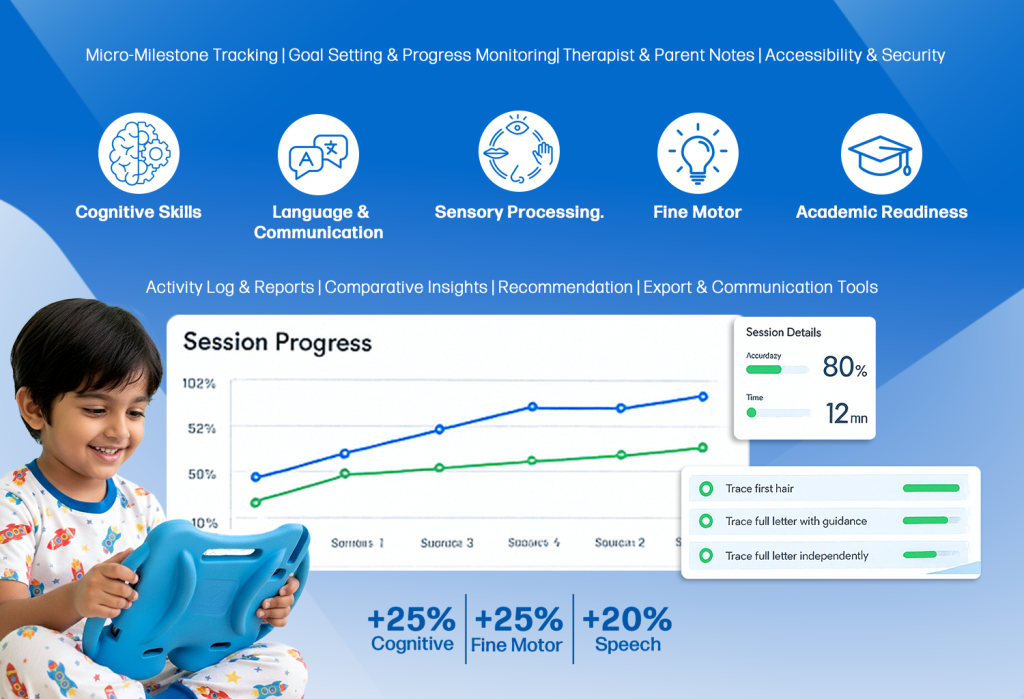
Visualizing Developmental Milestone Tracking Dashboard in Action

Why Traditional Dashboards are Not Enough

Dashboards typically show:

  • Overall progress percentages
  • Skill completion rates
  • Average performance over time

Limitations:

  • No insight into micro-milestones
  • Cannot pinpoint exact skill gaps
  • Lacks actionable guidance for next steps
  • Ignores session-to-session variations

For example, a child might show 70% accuracy in a fine motor task on a dashboard—but which part of the task they struggle with, how long it takes, and which strategies they use remain unknown. 

This is where VergeTAB’s structured developmental milestones assessment (powered by XceptionalLEARNING platform) comes in. Using activities like memory games, tracing letters, and sorting, children can practice core skills in cognitive, motor, speech, social, emotional, sensory, and executive function domains, and parents, therapists, and educators get observable insights to support learning.
Chat with our team on WhatsApp for guidance

What is the Structured Developmental Milestones Assessment?  

A systematic approach to tracking skills in actionable increments.

Core Principles:

  • Micro-Milestone Tracking: Break skills into smaller steps (e.g., tracing one letter before a full word).
  • Domain-Specific Observation: Track 8 domains: Cognitive, Speech & Language, Fine Motor, Social-Emotional, Gross Motor, Adaptive, Sensory, Executive Functioning.
  • Actionable Insights: Identify strengths, gaps, and next steps to drive effective action.
  • Dynamic Adjustment: Tailor learning paths based on real performance.
  • Collaborative Reporting: Share structured insights with therapists, educators, and parents.

Step 1: Establish Baseline Performance  

How to:

  • Observe the child without guidance or prompts.
  • Note accuracy, completion time, hesitation, and strategies.
  • Repeat the activity over 2–3 sessions to capture fluctuations.

Example:

During a 3-step sequencing activity:

  • Step 1: The child arranges two steps correctly → Success.
  • Step 2: Hesitation on the third piece → Partial understanding.
  • Step 3: Requires prompt or visual cue → Support needed.

Outcome: Clear understanding of strengths, weaknesses, and attention patterns.

Step 2: Select Domain-Specific Activities  

  • Objective: Cover all 8 developmental domains for holistic assessment.
  • Domains and Example Activities:
    • Cognitive Skills: Memory matching, sequencing, problem-solving, puzzles
    • Speech & Language Skills: Vocabulary repetition, sentence formation, storytelling
    • Fine Motor Skills: Tracing, stacking blocks, drag-and-drop tasks
    • Social-Emotional Skills: Emotion recognition games, turn-taking activities
    • Gross Motor Skills: Hopping, balance exercises, obstacle courses
    • Adaptive Skills: Dressing, hygiene routines, pouring tasks
    • Sensory Skills: Tactile sorting, sound discrimination, colour/shape sorting
    • Executive Functioning: Multi-step tasks, sorting and organizing, planning exercises

Example: During a cognitive session, a child may complete memory matching correctly but takes excessive time sequencing steps. This reveals processing speed vs. memory capacity differences.

Outcome: Identify which domains need reinforcement and tailor learning paths accordingly.

Step 3: Track Micro-Milestones  

  • Objective: With VergeTAB activities powered by the XL Platform, progress becomes easy to observe and interpret.
  • Method: Break every skill into tiny, achievable steps.
  • Example – Fine Motor Skills (Tracing Letters):
    • Step 1: Trace the first half of the letter → Support required.
    • Step 2: Trace the full letter with guidance → Improvement noted.
    • Step 3: Trace the full letter independently → Goal achieved.
    • Step 4: Trace letters in sequence to form a word → Skill generalization.
  • Example Tracking Insights (via XL Platform):
    • Accuracy at each step
    • Time taken
    • Errors or repeated attempts
    • Need for assistance

The XL integration captures progress data such as accuracy, timing, and completion rates, while therapists observe engagement and consistency.

Outcome: Insight into attention, fatigue, and readiness for increased task complexity.

Step 4: Analyze Patterns and Trends  

  • Objective: Turn observations into actionable insight.
  • Observation Focus:
    • Which skills consistently improve
    • Which skills slow down
    • How attention, fatigue, or motivation affects performance

Scenario Examples:

  • During fine motor sessions, a child may trace letters accurately in the morning but struggle in the afternoon. This highlights attention and fatigue patterns, guiding therapists to schedule challenging tasks during peak focus hours.
  • In a social-emotional activity, a child may struggle during group play but engage confidently in one-on-one interactions. This reveals social processing sensitivity and suggests a gradual approach to group participation.
  • In speech therapy, a child may pronounce words clearly during repetition exercises but lose articulation when forming full sentences. This highlights challenges in linguistic integration, guiding focus toward structured sentence-building tasks.

Outcome: Smarter scheduling, tailored strategies, and data-driven insights.

Step 5: Adjust Learning Paths Dynamically  

  • Objective: VergeTAB activities allow flexible adaptation based on how children perform.
  • Methods:
    • Increase difficulty for mastered skills
    • Provide additional scaffolding for lagging skills
    • Adjust the mix of activities per session based on attention and engagement

Example: If sequencing tasks are challenging, start with simpler patterns before progressing. If fine motor control lags, integrate tactile tracing activities.

Outcome: Dynamic, personalized learning paths that evolve with the child.

Step 6: Share Structured Reports for Collaborative Intervention  

  • Objective: When VergeTAB is used alongside the XL Platform, progress reports can be shared with therapists, educators, and parents to ensure cohesive support.
  • Report Components:
    • Step-by-step skill mastery
    • Session-by-session performance metrics
    • Suggested next steps for each domain

Scenario Examples:

  • A child shows plateauing in executive function tasks → therapists can implement focused planning exercises in therapy sessions.
  • Parents notice attention dips in multi-step cognitive tasks → adjust home sessions for shorter, frequent practice.
  • Social-emotional challenges in group settings → teachers can provide structured peer interactions.

Tip: Schedule weekly or monthly review sessions with educators and therapists to align strategies and track progress collaboratively.

Outcome: Everyone supporting the child is coordinated and informed, interventions are cohesive across home, therapy, and school, and child growth is measurable and actionable.

Step 7: Involve Parents in Ongoing Development  

Objective:

Parents play a vital role in reinforcing therapy outcomes. With VergeTAB, they can continue structured learning at home, ensuring that progress made during sessions extends into daily routines.

Observation & Involvement:

Through the XceptionalLEARNING (XL) Platform, parents can view session highlights, track micro-milestones, and observe behaviour or attention patterns. They’re encouraged to record contextual insights — such as the time of day, environment, or mood — that may influence their child’s performance.

Scenario Examples:

  • A parent notices their child’s focus drops after meals. Therapists use this insight to adjust session timing for improved attention.
  • A child demonstrates strong memory recall but hesitates with fine motor tasks. Parents include short, guided exercises at home to strengthen coordination.
  • During weekend social play, a child struggles with turn-taking. Parents coordinate with teachers to practice similar activities at school, reinforcing social-emotional growth.

Tip: Parents can submit weekly observations through the XceptionalLEARNING Platform, allowing therapists and educators to review real-life insights and adapt upcoming sessions.

Outcome: Therapy becomes personalized, consistent, and family-centered, minimizing regression and accelerating developmental progress by bridging home and classroom learning.

Step 8: Turning Data into Development  

The integration of VergeTAB with XceptionalLEARNING transforms daily learning into measurable developmental progress. Each activity — from sequencing puzzles to tracing letters — captures growth across eight developmental domains: Cognitive, Motor, Speech, Social, Emotional, Sensory, Behavioural, and Academic.

Structured assessments reveal:

  • Which domains show the fastest improvement?
  • Areas that require additional support
  • Patterns of long-term developmental growth

Example: Three-Month Progress Snapshot

  • Cognitive Skills: +25% accuracy in sequencing puzzles
  • Fine Motor Skills: +30% improvement in tracing tasks
  • Social-Emotional Growth: Better turn-taking and peer collaboration
  • Speech Fluency: +28% improvement in sentence formation
  • Memory Retention: +18% increase in recall during sequencing activities

Outcome: Therapists and educators can design evidence-based, data-driven developmental plans that respond to real-world performance, not just dashboard numbers.

In real therapy and classroom environments, these skills are practiced using VergeTAB in a controlled, distraction-free setup designed specifically for special education and therapy use. Schools and clinics use VergeTAB along with XceptionalLEARNING to ensure structured skill development and measurable progress.
See how VergeTAB works in real sessions

Why This Approach Works  

By using this structured, observation-driven model:

  • Children gain measurable progress across all 8 developmental domains.
  • Parents and educators receive actionable insights into learning behaviours and gaps.
  • Interventions are personalized, goal-directed, and adaptive.
  • Consistent tracking ensures targeted growth rather than generalized progress.

Real Example: A child who once struggled with multi-step cognitive tasks can now complete 4–5 steps independently — confidently participating in group learning and activities.

Practical Tips for Milestone Tracking  

  • Break skills into micro-milestones (e.g., tracing letters before full words)
  • Track progress session by session in XL, not just weekly
  • Focus separately on strengths and gaps for each domain
  • Adjust learning paths based on actual performance
  • Share milestone reports with therapists or educators for integrated intervention

Next Steps & Contact  

If your school or clinic is looking for a practical way to track developmental milestones while building essential skills using a dedicated therapy device, VergeTAB provides a safe, guided, and distraction-free digital environment built specifically for special education and therapy.
Request a VergeTAB Demo
Talk to our team on WhatsApp for institutional enquiries

How VergeTAB Builds Self-Directed Learning Skills in Therapy Sessions 

Reading Time: 4 minutes

Clinically Reviewed by

Meha P Parekh

Special Educator, Digital Practitioner – SPED

In therapy sessions and special education classrooms, therapists and educators often notice that children struggle to learn independently. Many children wait for constant instructions, lose focus quickly, or depend heavily on adult guidance to complete even simple tasks.

Traditional worksheets and generic learning apps do not effectively build self-directed learning because they lack structure, guided progression, and measurable reinforcement.

VergeTAB, used together with the XceptionalLEARNING platform, is implemented in schools and therapy clinics to deliver distraction-free, goal-based digital activities that help children gradually develop self-directed learning skills through structured practice and guided independence.
Talk to our team on WhatsApp

Why Self-Directed Learning is Essential for Children  

The traditional teacher-centered approach often limits children’s ability to engage meaningfully with learning materials. In contrast, self-directed learning empowers children to:

  • Take ownership of their learning
  • Build decision-making and problem-solving skills
  • Enhance curiosity and a love for learning
  • Develop confidence and self-reliance
  • Reflect on progress and self-evaluate

Research in child development shows that children who engage in SDL are more likely to demonstrate better academic performance, improved social skills, and enhanced emotional regulation. SDL prepares children not just for classroom success, but for everyday challenges.

VergeTAB: The Ideal Tool for Self-Directed Learning 

VergeTAB, combined with the XceptionalLEARNING platform, offers a unique, streamlined learning environment that eliminates common distractions found on traditional tablets. It provides:

  • Customizable therapy activities tailored to individual needs
  • Real-time progress tracking and feedback
  • Limits how long and how often a child can do each activity.
  • Goal-setting and achievement markers.
  • No access to other apps and websites.
  • Integration with Individualized Education Programs (IEPs)

By shifting from an instructor-led approach to a child-led experience, VergeTAB transforms therapy sessions into interactive, self-paced, and rewarding learning journeys.
Chat with our team on WhatsApp for guidance

Innovative Self-Directed Learning Activities with VergeTAB 

1. Challenge Wheel: Spin and Learn  

In this fun and spontaneous activity, children spin a virtual challenge wheel to select from a variety of tasks such as language puzzles, fine motor challenges, memory games, or academic exercises. The randomness of the wheel adds excitement and unpredictability to learning.

Skills Developed:

  • Spontaneous decision-making
  • Adaptability and flexibility
  • Self-motivation

Therapist Tip: Customize the sections of the wheel according to the child’s developmental goals, making it versatile for different therapy domains.

2. Skill Adventure Maps  

Children use an adventure map where they can click or tap on fun places like Memory Mountain or Language Lake. Each place has different games or challenges just for them, making learning playful and easy to follow.

Skills Developed:

  • Sequential planning
  • Long-term goal setting
  • Self-paced progression

Bonus: Children earn virtual badges as they complete challenges, encouraging them to seek continuous improvement.

3. Build-Your-Day Planners  

Children manage their own therapy schedule by choosing activities like speech tasks, occupational exercises, academic games, and sensory breaks. They decide how much time to spend on each, giving them control over their daily learning routine

Skills Developed:

  • Time management
  • Self-organization
  • Responsibility for personal routines

Parental Involvement: This activity can be extended to home routines, helping children plan their daily activities independently.

4. Choice-Based Story Adventures  

In this activity, children help guide a story by making choices for the characters at important moments. For example, they might decide if a character helps a friend or finishes a task first, and the story changes based on what they pick

Skills Developed:

  • Consequential thinking
  • Moral reasoning
  • Empathy development

Therapist Tip: Engage children in post-story discussions, encouraging them to reflect on their choices and outcomes.

5. Do-It-Yourself Reward Designer

Children create their personalized reward system by choosing their virtual incentives, such as activating new themes, customizing avatars, or accessing fun mini-games after completing goals.

Skills Developed:

  • Personal goal ownership
  • Motivation reinforcement
  • Delayed gratification

Therapist Tip: Guide children to set realistic, achievable goals and select meaningful rewards that align with their interests.

6. Independent Exploration Zones  

VergeTAB provides open-ended exploration areas where children can engage in unstructured learning activities like digital drawing, sound exploration, or sensory interactions. These zones encourage curiosity and creativity.

Skills Developed:

  • Creative expression
  • Exploratory learning
  • Independent engagement

Parental Use: Parents can use these zones during free play at home to promote autonomous exploration.

7. Self-Paced Mastery Levels  

Children work through progressively challenging levels within a specific skill set, such as phonics, sequencing, or maths facts. They determine when they are ready to advance to the next level, promoting self-assessment.

Skills Developed:

  • Self-evaluation
  • Confidence in skill mastery
  • Personal goal progression

Bonus Feature: Reflection checkpoints encourage children to articulate their readiness to advance, promoting metacognitive skills.

8. Reflection Galleries  

Children compile a digital portfolio showcasing their proud moments, favourite tasks, and successful completions. This gallery can include screenshots, audio clips, and drawings.

Skills Developed:

  • Self-recognition
  • Reflective thinking
  • Confidence boosting

Therapist Tip: Review the Reflection Gallery periodically to celebrate progress and set new targets.

In real therapy and classroom environments, these skills are practiced using VergeTAB in a controlled, distraction-free setup designed specifically for special education and therapy use. Schools and clinics use VergeTAB along with XceptionalLEARNING to ensure structured skill development and measurable progress.
See how VergeTAB works in real sessions

Extending Self-Directed Learning Beyond Therapy  

The skills children develop through SDL activities on VergeTAB translate seamlessly into real-life situations:

  • Academic Skills: Children transfer time management and planning to school assignments.
  • Daily Routines: Self-planning and sequencing skills help with morning routines and household chores.
  • Social Development: Choice-making and reflective thinking improve interpersonal relationships.

Families and educators can use VergeTAB to foster consistency across home, school, and therapy settings, ensuring that children apply SDL strategies in multiple environments.

The Therapist’s Role: Guiding, Not Directing  

In the SDL model, therapists shift from traditional directive roles to facilitators of learning. They:

  • Guide children through goal-setting
  • Offer choices and encourage autonomy
  • Prompt self-reflection and self-monitoring
  • Celebrate child-led achievements

This approach increases therapy engagement, reduces frustration, and empowers children to take charge of their progress.

Conclusion 

Therapy becomes more meaningful when children lead the way. If your school or clinic is looking for a practical way to build self-directed learning skills using a dedicated therapy device, VergeTAB provides a safe, guided, and distraction-free digital environment built specifically for special education and therapy.
Request a VergeTAB Demo
Talk to our team on WhatsApp for institutional enquiries