Balance and Coordination Difficulties in Children: When Should Parents Seek Guidance?

Reading Time: 6 minutes
Clinically Reviewed by Aryamol M.M

Physiotherapist

Quick Summary

Every child trips, stumbles and falls while learning to move. But when a child seems much clumsier than other children their age, avoids playground games, or has trouble staying steady during everyday tasks, parents often wonder whether this is just a phase or something that needs attention. This guide explains what balance and coordination are, what is typical at different ages, which signs are worth a closer look, and when it is time to speak to a paediatrician or paediatric physiotherapist. It also explains how structured home practice can support a therapist’s plan.

What Do Balance and Coordination Mean?

Balance is the ability to keep the body steady, whether standing still, walking, or changing direction. It depends on the brain combining information from the eyes, the inner ear, and the muscles and joints.

Coordination is the ability to make different parts of the body work together smoothly, such as arms and legs together when running, or eyes and hands together when catching a ball.

Both skills develop through movement and play. Some children pick them up easily. Others need more time, more practice, or professional support.

What Is Typical at Different Ages?

Children develop at their own pace, so these are rough guides rather than strict deadlines.

  • 12 to 18 months: Most children start walking on their own. Early steps are wide-based and wobbly.
  • About 2 years: Children run (a little stiffly), kick a ball, and climb onto low furniture.
  • About 3 years: Children climb stairs, pedal a tricycle, and jump with both feet.
  • About 4 to 5 years: Children can usually balance on one foot for a few seconds, hop, and catch a large ball with some success.
  • School age: Movements become smoother, quicker and better controlled, which supports play, sport and classroom tasks.

A child who is a little behind in one area but is steadily gaining new skills is often simply developing more slowly. What matters most is the overall pattern over time.

Signs a Child May Be Having Difficulty

You may notice that your child:

  • Trips or falls much more often than other children of the same age
  • Bumps into furniture or people, or seems unaware of where their body is in space
  • Avoids climbing, running, swings or playground equipment
  • Tires quickly during walking or play
  • Has difficulty with stairs, jumping, hopping or riding a bicycle
  • Struggles to catch, throw or kick a ball
  • Sits on the floor in unusual positions or props themselves up often
  • Finds buttons, zips, cutlery or handwriting unusually hard (a sign that coordination may be affected more widely)

One sign on its own is rarely a concern. A cluster of signs that continues over weeks or months deserves attention.

Red Flags: When to Seek Guidance

Speak to a paediatrician or paediatric physiotherapist soon if:
Your child is not walking independently by about 18 months
Falls or clumsiness are clearly more frequent than in other children, or are getting worse
Your child consistently walks on their toes, shows a noticeable difference between the two sides of the body, or appears to have difficulty using one side
Your child’s walking looks stiff, very wide-based, or very uneven
Your child seems to be far behind peers in running, jumping, climbing or hopping
Clumsiness is affecting play, school activities or confidence
You simply feel that something is not right. Parents often notice early signs, and that instinct deserves to be taken seriously.
Seek urgent medical care if:
Your child loses skills they previously had, such as walking steadily
Unsteadiness appears suddenly, especially with headache, vomiting, vision changes, unusual sleepiness, weakness or confusion
These signs need prompt medical assessment and should not wait for a therapy appointment.

Why Do Some Children Struggle With Balance and Coordination?

There is no single cause, and only a qualified professional can say what is going on for an individual child. Possible factors include:

  • Slower motor development, sometimes linked to premature birth
  • Low muscle tone or reduced strength
  • Developmental coordination difficulties
  • Neurological conditions, including cerebral palsy
  • Vision problems or inner ear (vestibular) issues
  • Differences in sensory processing
  • Joint flexibility (hypermobility) affecting stability

These factors do not necessarily indicate a particular condition. A professional assessment is needed to understand the reason for an individual child’s difficulties.

Coordination difficulties also sometimes appear alongside other developmental differences, which is why a full assessment looks at the whole child.

What Happens at a Paediatric Physiotherapy Assessment?

A good assessment is gentle, play-based and focused on understanding your child. A paediatric physiotherapist will typically:

  1. Listen to your concerns and ask about birth history, development and daily activities
  2. Observe how your child moves during play, including walking, running, climbing and balancing
  3. Check strength, muscle tone, posture and joint movement
  4. Assess balance and coordination with simple, age-appropriate tasks
  5. Set clear, measurable goals with you, based on what matters in your child’s daily life
  6. Plan intervention, usually through play-based sessions and a home programme

If other concerns appear, such as vision, hearing or learning, the physiotherapist may suggest input from other professionals as well.

How Parents Can Support Balance and Coordination at Home

These ideas support healthy motor development in most children. They do not replace an assessment if you have concerns, and a physiotherapist can adapt them for your child.

Choose activities according to your child’s age, movement ability and safety needs. If your child has significant balance difficulties, consult a physiotherapist before introducing challenging activities.

  • Walk the line: Lay tape on the floor and encourage your child to walk along it, forwards, then sideways.
  • Stepping stones: Use cushions or paper plates as “stones” to step or jump between.
  • Animal walks: Bear walks, frog jumps and crab walks build strength and body awareness.
  • Ball play: Rolling, throwing and catching with a large, soft ball.
  • Playground time: Swings, slides and climbing frames, always supervised.
  • Obstacle courses: Crawl under, step over and walk around household items.

Keep it playful. Short, frequent, enjoyable practice works better than long, tiring sessions. Make sure the space is safe, and stay close to your child while they practise.

Supporting Home Practice With VergeTAB and the XceptionalLEARNING Platform

Progress in physiotherapy depends heavily on what happens between sessions. Many families leave a session motivated but find it hard to remember the exercises, keep to a routine, or know whether they are making progress.

This is where structured digital support can help. To be clear, a tablet does not improve balance or coordination by itself. Children build these skills by moving.

Powered by the XceptionalLEARNING, VergeTAB is a locked digital activity device that works exclusively with the XL Platform. Therapists can use the platform to plan and assign structured digital activities aligned with a child’s individual goals. VergeTAB provides access to those assigned activities in a controlled digital environment.

VergeTAB does not deliver physiotherapy exercises, and it does not measure balance, walking ability, strength or coordination. Those are assessed by a physiotherapist in person. For families, the platform and device can offer:

  • Activities linked to therapist goals: Structured digital activities that the therapist has assigned in line with the goals set for your child
  • Visual prompts and routines: Picture-based task prompts and countdowns that can help children follow a routine
  • A shared view of activity and goal progress: Parents and therapists can see progress recorded within the platform, such as assigned activities and progress against the goals set there. This reflects digital activity and platform-based progress. It is not an automatic measurement of physical improvement.
  • Continuity between sessions: Structured practice that carries on at home, with the therapist’s plan in view

Learn more about how VergeTAB supports physiotherapy, or read about how children learn better motor control through guided movement.

Frequently Asked Questions

Key Takeaways

  • Balance and coordination develop gradually, and children vary widely in their timing.
  • Occasional clumsiness is normal. Frequent falls, falling behind peers, or skills being lost are not something to wait out.
  • Sudden unsteadiness, especially with other symptoms, needs urgent medical care.
  • Early assessment by a paediatric physiotherapist can give clarity and a clear plan.
  • Playful, regular practice at home makes a real difference, and structured tools can help families stay consistent.

Final Thoughts

Every child develops movement skills at their own pace. However, persistent balance and coordination difficulties should not be ignored. Early professional guidance can help identify a child’s needs and establish appropriate movement-based goals.

For parents, therapists and special schools interested in structured digital activities that complement professional intervention, VergeTAB works with the XceptionalLEARNING Platform to support therapist-assigned activities and continuity between sessions.

This article is for general information only and does not replace professional medical advice, diagnosis or treatment. Please consult a qualified healthcare professional about your child’s individual needs.

Support Structured Practice Beyond Therapy Sessions

Explore how VergeTAB, powered by the XceptionalLEARNING Platform, helps therapists assign structured digital activities aligned with individual goals and supports continuity between therapy sessions.

Powered by XceptionalLEARNING

Tracking Developmental Milestones in Therapy: How Schools and Therapists Use VergeTAB for Measurable Progress

Reading Time: 6 minutes

Clinically Reviewed by

Rakshitha S

Consultant Speech Swallow pathologist, Digital practitioner -SLP

In therapy rooms and special education classrooms, one of the biggest challenges educators and therapists face is tracking developmental milestones in a way that is clear, consistent, and measurable. Many children show progress in small steps, but traditional methods make it difficult to document, compare, and evaluate these improvements over time.

Paper records, observation notes, and scattered activity sheets often fail to give a structured view of how a child is actually progressing across cognitive, language, motor, and behavioral skills.

VergeTAB, used together with the XceptionalLEARNING platform, is implemented in schools and therapy clinics to deliver distraction-free, goal-based digital activities while automatically helping professionals track developmental milestones through structured practice and measurable outcomes.
Talk to our team on WhatsApp

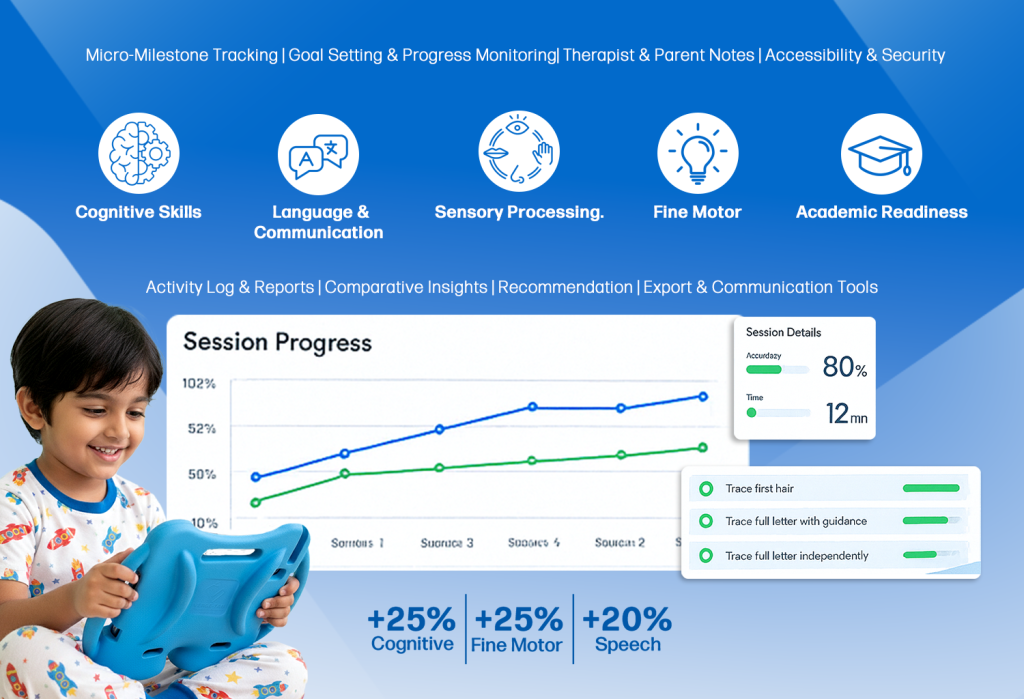
Visualizing Developmental Milestone Tracking Dashboard in Action

Why Traditional Dashboards are Not Enough

Dashboards typically show:

  • Overall progress percentages
  • Skill completion rates
  • Average performance over time

Limitations:

  • No insight into micro-milestones
  • Cannot pinpoint exact skill gaps
  • Lacks actionable guidance for next steps
  • Ignores session-to-session variations

For example, a child might show 70% accuracy in a fine motor task on a dashboard—but which part of the task they struggle with, how long it takes, and which strategies they use remain unknown. 

This is where VergeTAB’s structured developmental milestones assessment (powered by XceptionalLEARNING platform) comes in. Using activities like memory games, tracing letters, and sorting, children can practice core skills in cognitive, motor, speech, social, emotional, sensory, and executive function domains, and parents, therapists, and educators get observable insights to support learning.
Chat with our team on WhatsApp for guidance

What is the Structured Developmental Milestones Assessment?  

A systematic approach to tracking skills in actionable increments.

Core Principles:

  • Micro-Milestone Tracking: Break skills into smaller steps (e.g., tracing one letter before a full word).
  • Domain-Specific Observation: Track 8 domains: Cognitive, Speech & Language, Fine Motor, Social-Emotional, Gross Motor, Adaptive, Sensory, Executive Functioning.
  • Actionable Insights: Identify strengths, gaps, and next steps to drive effective action.
  • Dynamic Adjustment: Tailor learning paths based on real performance.
  • Collaborative Reporting: Share structured insights with therapists, educators, and parents.

Step 1: Establish Baseline Performance  

How to:

  • Observe the child without guidance or prompts.
  • Note accuracy, completion time, hesitation, and strategies.
  • Repeat the activity over 2–3 sessions to capture fluctuations.

Example:

During a 3-step sequencing activity:

  • Step 1: The child arranges two steps correctly → Success.
  • Step 2: Hesitation on the third piece → Partial understanding.
  • Step 3: Requires prompt or visual cue → Support needed.

Outcome: Clear understanding of strengths, weaknesses, and attention patterns.

Step 2: Select Domain-Specific Activities  

  • Objective: Cover all 8 developmental domains for holistic assessment.
  • Domains and Example Activities:
    • Cognitive Skills: Memory matching, sequencing, problem-solving, puzzles
    • Speech & Language Skills: Vocabulary repetition, sentence formation, storytelling
    • Fine Motor Skills: Tracing, stacking blocks, drag-and-drop tasks
    • Social-Emotional Skills: Emotion recognition games, turn-taking activities
    • Gross Motor Skills: Hopping, balance exercises, obstacle courses
    • Adaptive Skills: Dressing, hygiene routines, pouring tasks
    • Sensory Skills: Tactile sorting, sound discrimination, colour/shape sorting
    • Executive Functioning: Multi-step tasks, sorting and organizing, planning exercises

Example: During a cognitive session, a child may complete memory matching correctly but takes excessive time sequencing steps. This reveals processing speed vs. memory capacity differences.

Outcome: Identify which domains need reinforcement and tailor learning paths accordingly.

Step 3: Track Micro-Milestones  

  • Objective: With VergeTAB activities powered by the XL Platform, progress becomes easy to observe and interpret.
  • Method: Break every skill into tiny, achievable steps.
  • Example – Fine Motor Skills (Tracing Letters):
    • Step 1: Trace the first half of the letter → Support required.
    • Step 2: Trace the full letter with guidance → Improvement noted.
    • Step 3: Trace the full letter independently → Goal achieved.
    • Step 4: Trace letters in sequence to form a word → Skill generalization.
  • Example Tracking Insights (via XL Platform):
    • Accuracy at each step
    • Time taken
    • Errors or repeated attempts
    • Need for assistance

The XL integration captures progress data such as accuracy, timing, and completion rates, while therapists observe engagement and consistency.

Outcome: Insight into attention, fatigue, and readiness for increased task complexity.

Step 4: Analyze Patterns and Trends  

  • Objective: Turn observations into actionable insight.
  • Observation Focus:
    • Which skills consistently improve
    • Which skills slow down
    • How attention, fatigue, or motivation affects performance

Scenario Examples:

  • During fine motor sessions, a child may trace letters accurately in the morning but struggle in the afternoon. This highlights attention and fatigue patterns, guiding therapists to schedule challenging tasks during peak focus hours.
  • In a social-emotional activity, a child may struggle during group play but engage confidently in one-on-one interactions. This reveals social processing sensitivity and suggests a gradual approach to group participation.
  • In speech therapy, a child may pronounce words clearly during repetition exercises but lose articulation when forming full sentences. This highlights challenges in linguistic integration, guiding focus toward structured sentence-building tasks.

Outcome: Smarter scheduling, tailored strategies, and data-driven insights.

Step 5: Adjust Learning Paths Dynamically  

  • Objective: VergeTAB activities allow flexible adaptation based on how children perform.
  • Methods:
    • Increase difficulty for mastered skills
    • Provide additional scaffolding for lagging skills
    • Adjust the mix of activities per session based on attention and engagement

Example: If sequencing tasks are challenging, start with simpler patterns before progressing. If fine motor control lags, integrate tactile tracing activities.

Outcome: Dynamic, personalized learning paths that evolve with the child.

Step 6: Share Structured Reports for Collaborative Intervention  

  • Objective: When VergeTAB is used alongside the XL Platform, progress reports can be shared with therapists, educators, and parents to ensure cohesive support.
  • Report Components:
    • Step-by-step skill mastery
    • Session-by-session performance metrics
    • Suggested next steps for each domain

Scenario Examples:

  • A child shows plateauing in executive function tasks → therapists can implement focused planning exercises in therapy sessions.
  • Parents notice attention dips in multi-step cognitive tasks → adjust home sessions for shorter, frequent practice.
  • Social-emotional challenges in group settings → teachers can provide structured peer interactions.

Tip: Schedule weekly or monthly review sessions with educators and therapists to align strategies and track progress collaboratively.

Outcome: Everyone supporting the child is coordinated and informed, interventions are cohesive across home, therapy, and school, and child growth is measurable and actionable.

Step 7: Involve Parents in Ongoing Development  

Objective:

Parents play a vital role in reinforcing therapy outcomes. With VergeTAB, they can continue structured learning at home, ensuring that progress made during sessions extends into daily routines.

Observation & Involvement:

Through the XceptionalLEARNING (XL) Platform, parents can view session highlights, track micro-milestones, and observe behaviour or attention patterns. They’re encouraged to record contextual insights — such as the time of day, environment, or mood — that may influence their child’s performance.

Scenario Examples:

  • A parent notices their child’s focus drops after meals. Therapists use this insight to adjust session timing for improved attention.
  • A child demonstrates strong memory recall but hesitates with fine motor tasks. Parents include short, guided exercises at home to strengthen coordination.
  • During weekend social play, a child struggles with turn-taking. Parents coordinate with teachers to practice similar activities at school, reinforcing social-emotional growth.

Tip: Parents can submit weekly observations through the XceptionalLEARNING Platform, allowing therapists and educators to review real-life insights and adapt upcoming sessions.

Outcome: Therapy becomes personalized, consistent, and family-centered, minimizing regression and accelerating developmental progress by bridging home and classroom learning.

Step 8: Turning Data into Development  

The integration of VergeTAB with XceptionalLEARNING transforms daily learning into measurable developmental progress. Each activity — from sequencing puzzles to tracing letters — captures growth across eight developmental domains: Cognitive, Motor, Speech, Social, Emotional, Sensory, Behavioural, and Academic.

Structured assessments reveal:

  • Which domains show the fastest improvement?
  • Areas that require additional support
  • Patterns of long-term developmental growth

Example: Three-Month Progress Snapshot

  • Cognitive Skills: +25% accuracy in sequencing puzzles
  • Fine Motor Skills: +30% improvement in tracing tasks
  • Social-Emotional Growth: Better turn-taking and peer collaboration
  • Speech Fluency: +28% improvement in sentence formation
  • Memory Retention: +18% increase in recall during sequencing activities

Outcome: Therapists and educators can design evidence-based, data-driven developmental plans that respond to real-world performance, not just dashboard numbers.

In real therapy and classroom environments, these skills are practiced using VergeTAB in a controlled, distraction-free setup designed specifically for special education and therapy use. Schools and clinics use VergeTAB along with XceptionalLEARNING to ensure structured skill development and measurable progress.
See how VergeTAB works in real sessions

Why This Approach Works  

By using this structured, observation-driven model:

  • Children gain measurable progress across all 8 developmental domains.
  • Parents and educators receive actionable insights into learning behaviours and gaps.
  • Interventions are personalized, goal-directed, and adaptive.
  • Consistent tracking ensures targeted growth rather than generalized progress.

Real Example: A child who once struggled with multi-step cognitive tasks can now complete 4–5 steps independently — confidently participating in group learning and activities.

Practical Tips for Milestone Tracking  

  • Break skills into micro-milestones (e.g., tracing letters before full words)
  • Track progress session by session in XL, not just weekly
  • Focus separately on strengths and gaps for each domain
  • Adjust learning paths based on actual performance
  • Share milestone reports with therapists or educators for integrated intervention

Next Steps & Contact  

If your school or clinic is looking for a practical way to track developmental milestones while building essential skills using a dedicated therapy device, VergeTAB provides a safe, guided, and distraction-free digital environment built specifically for special education and therapy.
Request a VergeTAB Demo
Talk to our team on WhatsApp for institutional enquiries