
In therapy rooms and special education classrooms, one of the biggest challenges educators and therapists face is tracking developmental milestones in a way that is clear, consistent, and measurable. Many children show progress in small steps, but traditional methods make it difficult to document, compare, and evaluate these improvements over time.
Paper records, observation notes, and scattered activity sheets often fail to give a structured view of how a child is actually progressing across cognitive, language, motor, and behavioral skills.
VergeTAB, used together with the XceptionalLEARNING platform, is implemented in schools and therapy clinics to deliver distraction-free, goal-based digital activities while automatically helping professionals track developmental milestones through structured practice and measurable outcomes.
Talk to our team on WhatsApp
Why Traditional Dashboards are Not Enough
Dashboards typically show:
- Overall progress percentages
- Skill completion rates
- Average performance over time
Limitations:
- No insight into micro-milestones
- Cannot pinpoint exact skill gaps
- Lacks actionable guidance for next steps
- Ignores session-to-session variations
For example, a child might show 70% accuracy in a fine motor task on a dashboard—but which part of the task they struggle with, how long it takes, and which strategies they use remain unknown.
This is where VergeTAB’s structured developmental milestones assessment (powered by XceptionalLEARNING platform) comes in. Using activities like memory games, tracing letters, and sorting, children can practice core skills in cognitive, motor, speech, social, emotional, sensory, and executive function domains, and parents, therapists, and educators get observable insights to support learning.
Chat with our team on WhatsApp for guidance
What is the Structured Developmental Milestones Assessment?
A systematic approach to tracking skills in actionable increments.
Core Principles:
- Micro-Milestone Tracking: Break skills into smaller steps (e.g., tracing one letter before a full word).
- Domain-Specific Observation: Track 8 domains: Cognitive, Speech & Language, Fine Motor, Social-Emotional, Gross Motor, Adaptive, Sensory, Executive Functioning.
- Actionable Insights: Identify strengths, gaps, and next steps to drive effective action.
- Dynamic Adjustment: Tailor learning paths based on real performance.
- Collaborative Reporting: Share structured insights with therapists, educators, and parents.
Step 1: Establish Baseline Performance
How to:
- Observe the child without guidance or prompts.
- Note accuracy, completion time, hesitation, and strategies.
- Repeat the activity over 2–3 sessions to capture fluctuations.
Example:
During a 3-step sequencing activity:
- Step 1: The child arranges two steps correctly → Success.
- Step 2: Hesitation on the third piece → Partial understanding.
- Step 3: Requires prompt or visual cue → Support needed.
Outcome: Clear understanding of strengths, weaknesses, and attention patterns.
Step 2: Select Domain-Specific Activities
- Objective: Cover all 8 developmental domains for holistic assessment.
- Domains and Example Activities:
- Cognitive Skills: Memory matching, sequencing, problem-solving, puzzles
- Speech & Language Skills: Vocabulary repetition, sentence formation, storytelling
- Fine Motor Skills: Tracing, stacking blocks, drag-and-drop tasks
- Social-Emotional Skills: Emotion recognition games, turn-taking activities
- Gross Motor Skills: Hopping, balance exercises, obstacle courses
- Adaptive Skills: Dressing, hygiene routines, pouring tasks
- Sensory Skills: Tactile sorting, sound discrimination, colour/shape sorting
- Executive Functioning: Multi-step tasks, sorting and organizing, planning exercises
Example: During a cognitive session, a child may complete memory matching correctly but takes excessive time sequencing steps. This reveals processing speed vs. memory capacity differences.
Outcome: Identify which domains need reinforcement and tailor learning paths accordingly.
Step 3: Track Micro-Milestones
- Objective: With VergeTAB activities powered by the XL Platform, progress becomes easy to observe and interpret.
- Method: Break every skill into tiny, achievable steps.
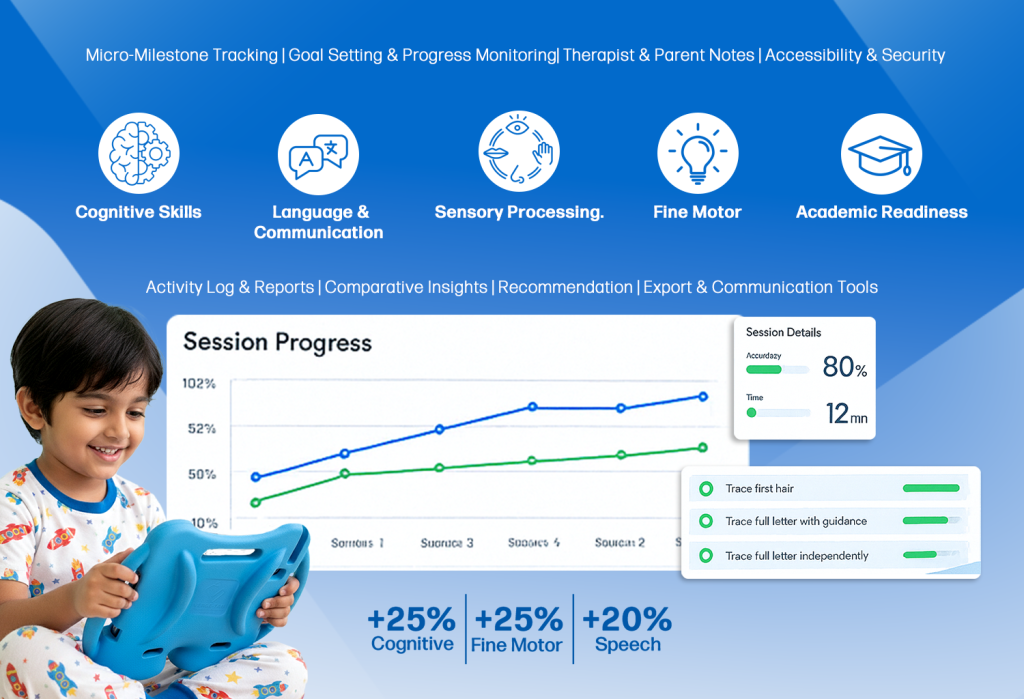
- Example – Fine Motor Skills (Tracing Letters):
- Step 1: Trace the first half of the letter → Support required.
- Step 2: Trace the full letter with guidance → Improvement noted.
- Step 3: Trace the full letter independently → Goal achieved.
- Step 4: Trace letters in sequence to form a word → Skill generalization.
- Example Tracking Insights (via XL Platform):
- Accuracy at each step
- Time taken
- Errors or repeated attempts
- Need for assistance
The XL integration captures progress data such as accuracy, timing, and completion rates, while therapists observe engagement and consistency.
Outcome: Insight into attention, fatigue, and readiness for increased task complexity.
Step 4: Analyze Patterns and Trends
- Objective: Turn observations into actionable insight.
- Observation Focus:
- Which skills consistently improve
- Which skills slow down
- How attention, fatigue, or motivation affects performance
Scenario Examples:
- During fine motor sessions, a child may trace letters accurately in the morning but struggle in the afternoon. This highlights attention and fatigue patterns, guiding therapists to schedule challenging tasks during peak focus hours.
- In a social-emotional activity, a child may struggle during group play but engage confidently in one-on-one interactions. This reveals social processing sensitivity and suggests a gradual approach to group participation.
- In speech therapy, a child may pronounce words clearly during repetition exercises but lose articulation when forming full sentences. This highlights challenges in linguistic integration, guiding focus toward structured sentence-building tasks.
Outcome: Smarter scheduling, tailored strategies, and data-driven insights.
Step 5: Adjust Learning Paths Dynamically
- Objective: VergeTAB activities allow flexible adaptation based on how children perform.
- Methods:
- Increase difficulty for mastered skills
- Provide additional scaffolding for lagging skills
- Adjust the mix of activities per session based on attention and engagement
Example: If sequencing tasks are challenging, start with simpler patterns before progressing. If fine motor control lags, integrate tactile tracing activities.
Outcome: Dynamic, personalized learning paths that evolve with the child.
Step 6: Share Structured Reports for Collaborative Intervention
- Objective: When VergeTAB is used alongside the XL Platform, progress reports can be shared with therapists, educators, and parents to ensure cohesive support.
- Report Components:
- Step-by-step skill mastery
- Session-by-session performance metrics
- Suggested next steps for each domain
Scenario Examples:
- A child shows plateauing in executive function tasks → therapists can implement focused planning exercises in therapy sessions.
- Parents notice attention dips in multi-step cognitive tasks → adjust home sessions for shorter, frequent practice.
- Social-emotional challenges in group settings → teachers can provide structured peer interactions.
Tip: Schedule weekly or monthly review sessions with educators and therapists to align strategies and track progress collaboratively.
Outcome: Everyone supporting the child is coordinated and informed, interventions are cohesive across home, therapy, and school, and child growth is measurable and actionable.
Step 7: Involve Parents in Ongoing Development
Objective:
Parents play a vital role in reinforcing therapy outcomes. With VergeTAB, they can continue structured learning at home, ensuring that progress made during sessions extends into daily routines.
Observation & Involvement:
Through the XceptionalLEARNING (XL) Platform, parents can view session highlights, track micro-milestones, and observe behaviour or attention patterns. They’re encouraged to record contextual insights — such as the time of day, environment, or mood — that may influence their child’s performance.
Scenario Examples:
- A parent notices their child’s focus drops after meals. Therapists use this insight to adjust session timing for improved attention.
- A child demonstrates strong memory recall but hesitates with fine motor tasks. Parents include short, guided exercises at home to strengthen coordination.
- During weekend social play, a child struggles with turn-taking. Parents coordinate with teachers to practice similar activities at school, reinforcing social-emotional growth.
Tip: Parents can submit weekly observations through the XceptionalLEARNING Platform, allowing therapists and educators to review real-life insights and adapt upcoming sessions.
Outcome: Therapy becomes personalized, consistent, and family-centered, minimizing regression and accelerating developmental progress by bridging home and classroom learning.
Step 8: Turning Data into Development
The integration of VergeTAB with XceptionalLEARNING transforms daily learning into measurable developmental progress. Each activity — from sequencing puzzles to tracing letters — captures growth across eight developmental domains: Cognitive, Motor, Speech, Social, Emotional, Sensory, Behavioural, and Academic.
Structured assessments reveal:
- Which domains show the fastest improvement?
- Areas that require additional support
- Patterns of long-term developmental growth
Example: Three-Month Progress Snapshot
- Cognitive Skills: +25% accuracy in sequencing puzzles
- Fine Motor Skills: +30% improvement in tracing tasks
- Social-Emotional Growth: Better turn-taking and peer collaboration
- Speech Fluency: +28% improvement in sentence formation
- Memory Retention: +18% increase in recall during sequencing activities
Outcome: Therapists and educators can design evidence-based, data-driven developmental plans that respond to real-world performance, not just dashboard numbers.
In real therapy and classroom environments, these skills are practiced using VergeTAB in a controlled, distraction-free setup designed specifically for special education and therapy use. Schools and clinics use VergeTAB along with XceptionalLEARNING to ensure structured skill development and measurable progress.
See how VergeTAB works in real sessions
Why This Approach Works
By using this structured, observation-driven model:
- Children gain measurable progress across all 8 developmental domains.
- Parents and educators receive actionable insights into learning behaviours and gaps.
- Interventions are personalized, goal-directed, and adaptive.
- Consistent tracking ensures targeted growth rather than generalized progress.
Real Example: A child who once struggled with multi-step cognitive tasks can now complete 4–5 steps independently — confidently participating in group learning and activities.
Practical Tips for Milestone Tracking
- Break skills into micro-milestones (e.g., tracing letters before full words)
- Track progress session by session in XL, not just weekly
- Focus separately on strengths and gaps for each domain
- Adjust learning paths based on actual performance
- Share milestone reports with therapists or educators for integrated intervention
Next Steps & Contact
If your school or clinic is looking for a practical way to track developmental milestones while building essential skills using a dedicated therapy device, VergeTAB provides a safe, guided, and distraction-free digital environment built specifically for special education and therapy.
Request a VergeTAB Demo
Talk to our team on WhatsApp for institutional enquiries