From Touch to Transformation: A Special Child’s Journey with Digital Learning

Reading Time: 5 minutes

Written by:

Sruthy S. Kumar

Special Educator

Watch Antony’s journey in our YouTube Shorts, Small Steps, Big Change: Antony’s Journey Through Digital Learning,” to see how structured digital routines supported his progress in the classroom. If you’d like to explore how similar support can be created in your school or therapy setting, feel free to connect with our team on WhatsApp for guidance.

When Learning Takes a New Path

Every Small Step Matters

Working with children with special needs teaches us a truth that cannot be learned from textbooks alone, the progress does not always come in big, visible milestones. Sometimes, it comes quietly, hidden inside moments that only a teacher’s heart truly understands. A child sitting for a few extra minutes, responding to a call, or showing interest in learning may seem small to the outside world, but in special education, these moments carry deep meaning.

I work as a Digital Specialist – Special Educator at XceptionalLEARNING, where my role involves visiting special schools and training teachers to use our Digital Activity Book. This is a tablet-based learning tool designed specifically for children with diverse learning needs. It includes movable and draggable activities, digital flashcards, structured tasks, and interactive content that supports attention, routine, and engagement.

One particular school visit reminded me why this work truly matters—not just as a professional responsibility, but as a deeply human experience.

When Routine Met the Right Tool

During a visit to Thiruhirdyanivas Sevanikethan Special School, Changanacherry, I met a child named Antony. This was not our first meeting. I already knew Antony from a therapy centre where I had previously worked, and seeing him again brought back many memories—some difficult, some hopeful.

Antony is a child with Autism. He is non-verbal, communicates through a few sounds, and shows a strong interest in music. During his earlier therapy days, Antony faced significant challenges. He displayed hyperactivity, head banging, spitting, aggression, and had a strong attachment to one specific teacher. Sitting tolerance was very low, and emotional regulation was complicated for him.

He attended occupational therapy, speech therapy, and behaviour therapy, and while consistent efforts were made, progress was slow and limited. One of the occupational therapy strategies used was wrapping with a bed sheet, aimed at providing deep pressure input to help with sensory regulation. Initially, Antony strongly resisted this intervention—crying intensely and showing aggressive behaviour. However, with consistency, he slowly began to tolerate it. Though he continued to cry, the intensity of aggression reduced, showing that Antony could adapt when a routine was followed regularly.

This understanding—that routine plays a crucial role in Antony’s regulation, became showing that routine and consistency helped him regulate himself.

A New Setting, Familiar Challenges

After Antony joined school along with continued therapy support, his challenges did not disappear overnight. In the school environment, he continued to show aggression, loud crying, difficulty settling in class, and poor sitting tolerance. Transitions were hard, and classroom expectations often overwhelmed him.

As part of my role, I visited the school to provide training to teachers on digital learning strategies. When I saw Antony in the school, he did not recognize me, which was expected. However, when I noticed his name listed under the digital classroom, I felt a mix of emotions—genuine happiness and quiet doubt stayed with me. I wondered whether he could sit in a digital classroom, whether the tablet might overstimulate him, and whether his aggression would increase in this new learning environment.

When the digital sessions began, my doubts seemed valid. In the initial days, Antony struggled. He ran out of the classroom, picked up objects from the environment, showed resistance to activities, and found it hard to stay seated. Teachers attempted to show him pictures and activities from the Digital Activity Book, but he did not cooperate.

Still, the teachers did not give up.

Teacher’s Intervention: Patience, Structure, and Support

From the teacher’s perspective, Antony’s case required gentle handling, patience, and realistic expectations. Instead of forcing participation, the teachers focused on consistency and emotional safety.

The key interventions included:

  • Following a fixed routine for the digital classroom
  • Using simple, clear instructions
  • Providing verbal reassurance and calm prompts
  • Allowing Antony to observe before participating
  • Offering continuous teacher support and guidance

The Digital Activity Book was not introduced as a demand, but as an invitation. Teachers allowed Antony to explore the tablet at his own pace, creating a safe and pressure-free learning environment. Knowing his love for music, sound-based activities were introduced first to capture his interest. Draggable and movable activities were carefully selected to match his attention level, and there was no expectation for him to complete tasks independently, as continuous teacher support and guidance were provided throughout.

As one teacher shared later,
“Our focus was not on perfection. It was on helping him feel safe and accepted in the learning space.”

The Turning Point

Almost two months later, something unexpected happened—something no one had forced or planned.

One day, Antony gently pushed his teacher and led her towards the digital classroom. This small action spoke volumes. He was choosing the space on his own.He entered the classroom, sat down, and stayed. When he became distracted by books in the room and moved away, the teacher said, “Antony, come and sit here.”

And he did. That small moment filled my heart.

From that point onward, gradual but meaningful changes were observed. Antony’s sitting tolerance improved, and he began staying seated for longer periods. He started listening to instructions, responding when called, and returning to his seat when guided. His attention span increased, and eye contact improved during sessions.

He is not yet an expert in using digital activities independently, but he listens, observes, and attempts tasks with teacher support and guidance. He taps the screen, explores draggable elements, and looks to the teacher for reassurance and direction.These were not dramatic changes but they were real.

Growth Through Connection

After one session, I called out to Antony, and he came toward me. When I asked for a high-five, he responded, and when I asked for a kiss, he gave that too. In that moment, I did not see a diagnosis or a case file—I saw a child learning to trust, connect, and respond.

Later, we compared the older condition of Antony showing intense aggression with the recent condition of his calm participation in the digital classroom. The difference was vast.

When I shared this with his teacher, she smiled with visible emotion and said,
“He loves coming to the digital class. His attention has improved, his eye contact is better, and he listens to commands more now.”

There were sparkles in her eyes—not because the journey was complete, but because the effort was finally showing results. Each small step motivates her to continue with patience and belief. For her, Antony’s progress is a reminder that consistent intervention and structured digital learning truly make a difference.

Hope of Every Child 

This journey matters because what may seem like a small change to the world can be a life-changing achievement for a special child. Antony’s story reminds us that progress is not always fast or obvious—it grows through structured support, consistent routines, and teachers who continue to believe, even when change takes time.

It also highlights an important truth: when used thoughtfully, digital tools are not distractions. They become powerful learning supports that help children improve attention, manage behaviour, and engage with content in ways that traditional methods may not always reach. Through XceptionalLEARNING, these tools are used with care to create meaningful and accessible learning experiences for every child.

For children like Antony, every small step forward is a victory.
For teachers, it confirms that patience and effort truly matter.
For parents, it brings hope.

For me, as a special educator, this journey is a reminder that routine, patience, belief, and the right support can open new pathways for learning. Through XceptionalLEARNING, support becomes more than a session—it becomes a continuous process of care, connection, and possibility woven into everyday life.

Antony’s journey reminds us that progress in special education is not always loud or immediate. It grows quietly through routine, patience, and the belief of teachers who continue to show up every day.

What may seem like a small step to others can be a life-changing achievement for a child. With the right support, structure, and understanding, children begin to feel safe, connected, and ready to learn.

For educators, it reaffirms that consistency matters. For parents, it brings hope. And for me, it is a reminder that meaningful learning happens when care, belief, and the right tools come together in everyday moments.


Solid, Liquid, or Gas? How VergeTAB Helps Children Understand States of Matter Through Real-Life Activities

Reading Time: 6 minutes

Clinically Reviewed by

Ann Mary Jose

Special Educator

In classrooms and therapy sessions, educators often find that children struggle to understand abstract science concepts like solids, liquids, and gases. These ideas can be difficult to grasp through textbook explanations alone, especially for children who need visual, experiential, and guided learning.

Traditional teaching methods may explain the theory, but children often fail to connect these concepts with real-life understanding and observation.

VergeTAB, used together with the XceptionalLEARNING platform, is implemented in schools and therapy clinics to provide distraction-free, goal-based digital activities that help children explore and understand states of matter through structured, visual, and real-life learning experiences.
Talk to our team on WhatsApp

1. Solids — The World We Can Hold

Everyday Story

Imagine a child playing with building blocks. The blocks stay the same shape whether they’re stacked, lined up, or scattered. This simple play activity introduces the concept of solids—objects that have a fixed shape and volume.

Explanation in Simple Terms

Solids don’t change shape on their own. You can hold them, touch them, and move them, but unless you break or reshape them, they remain the same. Examples include toys, furniture, food items, and even your own body.

VergeTAB Experience

On VergeTAB, students can:

  • Drag and drop objects into categories (solid vs. not solid).
  • Use 3D visuals of ice cubes, chairs, and pencils to identify real-world solids.
  • Play interactive sorting games where they distinguish between things that keep their shape and things that don’t.

Real-Life Connection

From brushing teeth with a toothbrush to eating a biscuit, solids dominate daily routines. Linking science to these tasks helps children integrate the concept.

Skills Developed

  • Observation: Spotting solid objects in different environments.
  • Categorization: Sorting items correctly.
  • Fine motor control: Drag-and-drop tasks on VergeTAB encourage motor coordination.

Higher-Order Thinking

  • Analysis: Why does a chair remain the same shape, but water doesn’t?
  • Application: Predicting which objects will break or bend under force.

2. Liquids — The World That Flows

Everyday Story

At breakfast, a child pours milk into a glass. The milk takes the shape of the glass, unlike a biscuit that keeps its shape on the plate. This is a perfect example of a liquid.

Explanation in Simple Terms

Liquids don’t have a fixed shape—they flow and take the shape of the container.
But they do have a fixed volume: a glass of water will always remain the same amount, no matter what container it’s in.

VergeTAB Experience

On VergeTAB, learners can:

  • Explore animated simulations of water being poured into different containers.
  • Compare liquids like juice, oil, and milk through interactive visuals.
  • Experiment virtually with “What happens if…?” scenarios: What if you freeze juice? What if you spill water?

Real-Life Connection

Whether drinking juice, washing hands, or watching rain fall, liquids are everywhere. Children quickly see how liquids shape everyday experiences.

Skills Developed

  • Comparative thinking: Seeing how liquids differ from solids.
  • Prediction: Guessing what will happen when a liquid is poured or frozen.
  • Scientific curiosity: Observing cause-and-effect.

Higher-Order Thinking

  • Evaluation: Which container is best for storing water—an open bowl or a closed bottle?
  • Application: Designing a simple experiment at home (e.g., freezing different liquids).

3. Gases — The World We Breathe

Everyday Story

Picture a birthday party where balloons are being blown up. At first, the balloon is flat, but as air is blown in, it expands. That invisible air is a gas.

Explanation in Simple Terms

Gases have no fixed shape and no fixed volume. They spread out to fill any space. We can’t see them most of the time, but we can feel their effects—like when the wind blows or when we breathe.

VergeTAB Experience

With VergeTAB, children can:

  • Watch simulations of balloons inflating and deflating.
  • See animations of steam rising from hot water.
  • Play “Guess the Gas” games, learning about oxygen, carbon dioxide, and everyday gases.

Real-Life Connection

From blowing bubbles to riding in a car, gases are part of daily experiences. Even something as ordinary as breathing becomes a science lesson when framed correctly.

Skills Developed

  • Imaginative reasoning: Visualizing invisible gases.
  • Connection-making: Linking gases to breathing and weather.
  • Critical observation: Identifying evidence of gases in action (steam, balloons, bubbles).

Higher-Order Thinking

  • Analysis: Why does a balloon burst when overfilled?
  • Evaluation: What happens if there’s no oxygen?
  • Application: Relating air pressure to weather changes.

4. Linking All Three — The Water Story

The best way to tie solids, liquids, and gases together is through water:

  • As ice, it’s a solid.
  • As liquid water, it’s a liquid.
  • As steam, it’s a gas.

VergeTAB Activity

Learners can explore the water cycle interactively: freezing, melting, evaporating, and condensing. This cycle connects all three states in a way children can visualize and remember.

Skills Developed

  • Sequencing: Understanding transformation steps.
  • Problem-solving: Predicting what happens under heat or cold.
  • Concept integration: Linking three separate concepts into one framework.

Higher-Order Thinking

  • Synthesis: Combining knowledge of solids, liquids, and gases to explain weather.
  • Evaluation: Judging why states change under temperature conditions.

Classroom and Home Applications

  • In Schools: Teachers can guide group experiments with VergeTAB, like categorizing lunchbox items into solid/liquid.
  • At Home: Parents can use everyday cooking (rice boiling, juice pouring) and then connect it with the interactive VergeTAB lesson.
    This blended approach makes learning continuous and natural.

In real therapy and classroom environments, real-life concepts observed in nature are reinforced using VergeTAB in a controlled, distraction-free setup designed specifically for special education and therapy use. Schools and clinics use VergeTAB along with XceptionalLEARNING to ensure structured skill development and measurable progress.
See how VergeTAB works in real sessions

Interactive Challenges and Practice

VergeTAB doesn’t stop at explanations—it builds learning through practice. Some examples include:

  • Challenge 1: Sort 20 everyday items into solids, liquids, or gases.
  • Challenge 2: Predict what will happen if you freeze juice, heat butter, or blow into a balloon.
  • Challenge 3: Interactive quiz—match each state of matter with a real-world example.

These challenges ensure learners don’t just memorize facts but apply them actively.

Reflection & Cognitive Skills

After activities, children are guided to reflect:

  • What did I learn about solids, liquids, and gases?
  • Where do I see them in my own life?
  • How can I explain these concepts to someone else?

This reflection helps deepen cognitive skills like memory, communication, and critical thinking.

Cognitive Skills Developed

  • Memory recall (facts and definitions).
  • Critical thinking (evaluating examples).
  • Problem-solving (predicting transformations).
  • Communication (explaining concepts in their own words).

Higher-Order Thinking in Action

By the end, children don’t just recognize states of matter—they understand how and why they change, and can transfer this knowledge to new situations.

Cross-Curricular Links

VergeTAB lessons don’t stop at science—they connect across subjects:

  • Mathematics → Measuring liquids in liters or milliliters.
  • Geography → Understanding the water cycle—evaporation (gas), condensation (liquid), precipitation (solid/liquid).
  • Art → Sculpting clay (solid) or mixing paints (liquid).
  • Art + Science → Drawing steam rising to show air movement.

This makes learning integrated and practical, giving children multiple ways to connect with the same concept.

VergeTAB for Diverse Learners

Every child learns differently. VergeTAB’s digital activities, interactive quizzes, and step-by-step visuals ensure accessibility for:

  • Children with speech delays who benefit from voice-activated prompts.
  • Learners with attention difficulties, who thrive with gamified activities.
  • Children with special needs, who rely on repetition, visuals, and tactile engagement.

This ensures no learner is left behind—each can experience success at their own pace.

Mini Case Study: Learning in Action

At a special education classroom, students struggled to grasp why air “takes up space.” Using VergeTAB, the teacher demonstrated inflating balloons. One student exclaimed, “The balloon is full, so air is real!”—a breakthrough moment only possible through interactive, visualized learning.

The Science Behind the Fun

Children discover that air is matter because it takes up space and can be observed through simple changes—like watching a balloon inflate.

STEM (Science, Technology, Engineering, and Mathematics) Connection

This activity ties directly to science and everyday learning, helping students see how classroom concepts connect with real-world understanding.

Quick Recap with a Visual Anchor

The balloon becomes a memory clue—whenever students see or use a balloon, they recall that “air is real.”

Future Explorations

Once children master solids, liquids, and gases, VergeTAB sparks curiosity for more:

  • Plasma: The glowing matter in stars and lightning.
  • Mixtures: Milkshakes, fog, and butter—everyday examples of multiple states.
  • Changes of state: Freezing water into ice or boiling it into steam.

This keeps the journey open-ended, inviting learners to see science everywhere.

Conclusion

In conclusion, understanding solids, liquids, and gases isn’t just a school lesson—it’s a life skill. When children recognize the science in their food, play, weather, and breathing, the world becomes their classroom. VergeTAB brings this transformation alive with its interactive, multisensory, and personalized approach to learning. With every drag-and-drop game, animated simulation, or real-life connection, students gain not only knowledge but also skills that support independence, problem-solving, and critical thinking. Science stops being abstract and becomes a lived experience—one that children can see, touch, and apply every day.

If your school or clinic is looking for a practical way to help children understand states of matter through guided digital activities using a dedicated therapy device, VergeTAB provides a safe, structured, and distraction-free environment built specifically for special education and therapy.
Request a VergeTAB Demo
Talk to our team on WhatsApp for institutional enquiries

Tracking Developmental Milestones in Therapy: How Schools and Therapists Use VergeTAB for Measurable Progress

Reading Time: 6 minutes

Clinically Reviewed by

Rakshitha S

Consultant Speech Swallow pathologist, Digital practitioner -SLP

In therapy rooms and special education classrooms, one of the biggest challenges educators and therapists face is tracking developmental milestones in a way that is clear, consistent, and measurable. Many children show progress in small steps, but traditional methods make it difficult to document, compare, and evaluate these improvements over time.

Paper records, observation notes, and scattered activity sheets often fail to give a structured view of how a child is actually progressing across cognitive, language, motor, and behavioral skills.

VergeTAB, used together with the XceptionalLEARNING platform, is implemented in schools and therapy clinics to deliver distraction-free, goal-based digital activities while automatically helping professionals track developmental milestones through structured practice and measurable outcomes.
Talk to our team on WhatsApp

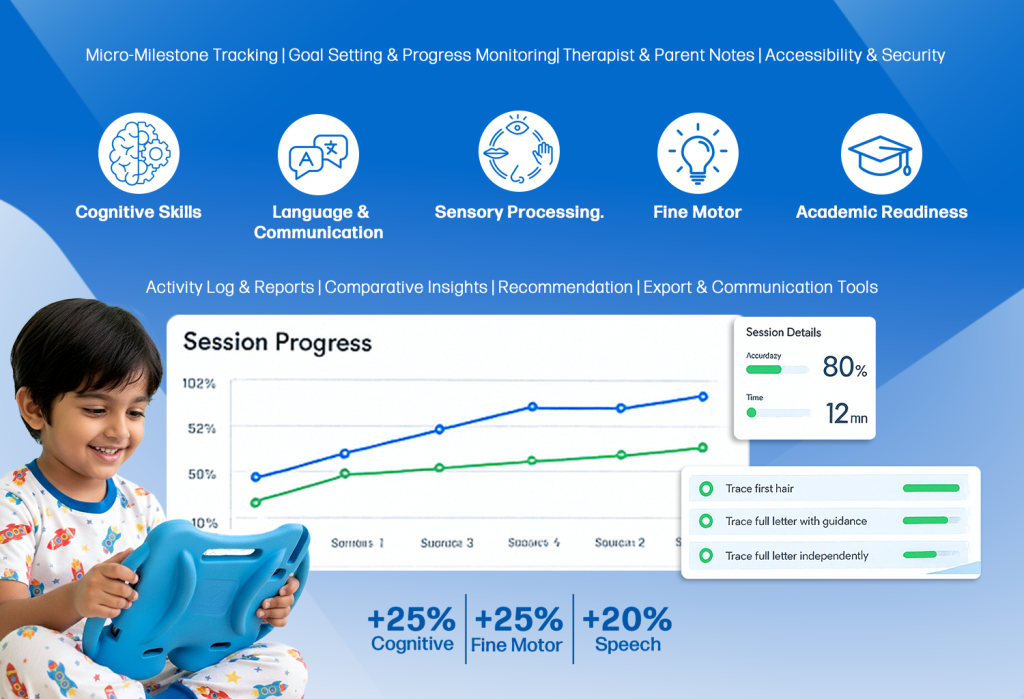
Visualizing Developmental Milestone Tracking Dashboard in Action

Why Traditional Dashboards are Not Enough

Dashboards typically show:

  • Overall progress percentages
  • Skill completion rates
  • Average performance over time

Limitations:

  • No insight into micro-milestones
  • Cannot pinpoint exact skill gaps
  • Lacks actionable guidance for next steps
  • Ignores session-to-session variations

For example, a child might show 70% accuracy in a fine motor task on a dashboard—but which part of the task they struggle with, how long it takes, and which strategies they use remain unknown. 

This is where VergeTAB’s structured developmental milestones assessment (powered by XceptionalLEARNING platform) comes in. Using activities like memory games, tracing letters, and sorting, children can practice core skills in cognitive, motor, speech, social, emotional, sensory, and executive function domains, and parents, therapists, and educators get observable insights to support learning.
Chat with our team on WhatsApp for guidance

What is the Structured Developmental Milestones Assessment?  

A systematic approach to tracking skills in actionable increments.

Core Principles:

  • Micro-Milestone Tracking: Break skills into smaller steps (e.g., tracing one letter before a full word).
  • Domain-Specific Observation: Track 8 domains: Cognitive, Speech & Language, Fine Motor, Social-Emotional, Gross Motor, Adaptive, Sensory, Executive Functioning.
  • Actionable Insights: Identify strengths, gaps, and next steps to drive effective action.
  • Dynamic Adjustment: Tailor learning paths based on real performance.
  • Collaborative Reporting: Share structured insights with therapists, educators, and parents.

Step 1: Establish Baseline Performance  

How to:

  • Observe the child without guidance or prompts.
  • Note accuracy, completion time, hesitation, and strategies.
  • Repeat the activity over 2–3 sessions to capture fluctuations.

Example:

During a 3-step sequencing activity:

  • Step 1: The child arranges two steps correctly → Success.
  • Step 2: Hesitation on the third piece → Partial understanding.
  • Step 3: Requires prompt or visual cue → Support needed.

Outcome: Clear understanding of strengths, weaknesses, and attention patterns.

Step 2: Select Domain-Specific Activities  

  • Objective: Cover all 8 developmental domains for holistic assessment.
  • Domains and Example Activities:
    • Cognitive Skills: Memory matching, sequencing, problem-solving, puzzles
    • Speech & Language Skills: Vocabulary repetition, sentence formation, storytelling
    • Fine Motor Skills: Tracing, stacking blocks, drag-and-drop tasks
    • Social-Emotional Skills: Emotion recognition games, turn-taking activities
    • Gross Motor Skills: Hopping, balance exercises, obstacle courses
    • Adaptive Skills: Dressing, hygiene routines, pouring tasks
    • Sensory Skills: Tactile sorting, sound discrimination, colour/shape sorting
    • Executive Functioning: Multi-step tasks, sorting and organizing, planning exercises

Example: During a cognitive session, a child may complete memory matching correctly but takes excessive time sequencing steps. This reveals processing speed vs. memory capacity differences.

Outcome: Identify which domains need reinforcement and tailor learning paths accordingly.

Step 3: Track Micro-Milestones  

  • Objective: With VergeTAB activities powered by the XL Platform, progress becomes easy to observe and interpret.
  • Method: Break every skill into tiny, achievable steps.
  • Example – Fine Motor Skills (Tracing Letters):
    • Step 1: Trace the first half of the letter → Support required.
    • Step 2: Trace the full letter with guidance → Improvement noted.
    • Step 3: Trace the full letter independently → Goal achieved.
    • Step 4: Trace letters in sequence to form a word → Skill generalization.
  • Example Tracking Insights (via XL Platform):
    • Accuracy at each step
    • Time taken
    • Errors or repeated attempts
    • Need for assistance

The XL integration captures progress data such as accuracy, timing, and completion rates, while therapists observe engagement and consistency.

Outcome: Insight into attention, fatigue, and readiness for increased task complexity.

Step 4: Analyze Patterns and Trends  

  • Objective: Turn observations into actionable insight.
  • Observation Focus:
    • Which skills consistently improve
    • Which skills slow down
    • How attention, fatigue, or motivation affects performance

Scenario Examples:

  • During fine motor sessions, a child may trace letters accurately in the morning but struggle in the afternoon. This highlights attention and fatigue patterns, guiding therapists to schedule challenging tasks during peak focus hours.
  • In a social-emotional activity, a child may struggle during group play but engage confidently in one-on-one interactions. This reveals social processing sensitivity and suggests a gradual approach to group participation.
  • In speech therapy, a child may pronounce words clearly during repetition exercises but lose articulation when forming full sentences. This highlights challenges in linguistic integration, guiding focus toward structured sentence-building tasks.

Outcome: Smarter scheduling, tailored strategies, and data-driven insights.

Step 5: Adjust Learning Paths Dynamically  

  • Objective: VergeTAB activities allow flexible adaptation based on how children perform.
  • Methods:
    • Increase difficulty for mastered skills
    • Provide additional scaffolding for lagging skills
    • Adjust the mix of activities per session based on attention and engagement

Example: If sequencing tasks are challenging, start with simpler patterns before progressing. If fine motor control lags, integrate tactile tracing activities.

Outcome: Dynamic, personalized learning paths that evolve with the child.

Step 6: Share Structured Reports for Collaborative Intervention  

  • Objective: When VergeTAB is used alongside the XL Platform, progress reports can be shared with therapists, educators, and parents to ensure cohesive support.
  • Report Components:
    • Step-by-step skill mastery
    • Session-by-session performance metrics
    • Suggested next steps for each domain

Scenario Examples:

  • A child shows plateauing in executive function tasks → therapists can implement focused planning exercises in therapy sessions.
  • Parents notice attention dips in multi-step cognitive tasks → adjust home sessions for shorter, frequent practice.
  • Social-emotional challenges in group settings → teachers can provide structured peer interactions.

Tip: Schedule weekly or monthly review sessions with educators and therapists to align strategies and track progress collaboratively.

Outcome: Everyone supporting the child is coordinated and informed, interventions are cohesive across home, therapy, and school, and child growth is measurable and actionable.

Step 7: Involve Parents in Ongoing Development  

Objective:

Parents play a vital role in reinforcing therapy outcomes. With VergeTAB, they can continue structured learning at home, ensuring that progress made during sessions extends into daily routines.

Observation & Involvement:

Through the XceptionalLEARNING (XL) Platform, parents can view session highlights, track micro-milestones, and observe behaviour or attention patterns. They’re encouraged to record contextual insights — such as the time of day, environment, or mood — that may influence their child’s performance.

Scenario Examples:

  • A parent notices their child’s focus drops after meals. Therapists use this insight to adjust session timing for improved attention.
  • A child demonstrates strong memory recall but hesitates with fine motor tasks. Parents include short, guided exercises at home to strengthen coordination.
  • During weekend social play, a child struggles with turn-taking. Parents coordinate with teachers to practice similar activities at school, reinforcing social-emotional growth.

Tip: Parents can submit weekly observations through the XceptionalLEARNING Platform, allowing therapists and educators to review real-life insights and adapt upcoming sessions.

Outcome: Therapy becomes personalized, consistent, and family-centered, minimizing regression and accelerating developmental progress by bridging home and classroom learning.

Step 8: Turning Data into Development  

The integration of VergeTAB with XceptionalLEARNING transforms daily learning into measurable developmental progress. Each activity — from sequencing puzzles to tracing letters — captures growth across eight developmental domains: Cognitive, Motor, Speech, Social, Emotional, Sensory, Behavioural, and Academic.

Structured assessments reveal:

  • Which domains show the fastest improvement?
  • Areas that require additional support
  • Patterns of long-term developmental growth

Example: Three-Month Progress Snapshot

  • Cognitive Skills: +25% accuracy in sequencing puzzles
  • Fine Motor Skills: +30% improvement in tracing tasks
  • Social-Emotional Growth: Better turn-taking and peer collaboration
  • Speech Fluency: +28% improvement in sentence formation
  • Memory Retention: +18% increase in recall during sequencing activities

Outcome: Therapists and educators can design evidence-based, data-driven developmental plans that respond to real-world performance, not just dashboard numbers.

In real therapy and classroom environments, these skills are practiced using VergeTAB in a controlled, distraction-free setup designed specifically for special education and therapy use. Schools and clinics use VergeTAB along with XceptionalLEARNING to ensure structured skill development and measurable progress.
See how VergeTAB works in real sessions

Why This Approach Works  

By using this structured, observation-driven model:

  • Children gain measurable progress across all 8 developmental domains.
  • Parents and educators receive actionable insights into learning behaviours and gaps.
  • Interventions are personalized, goal-directed, and adaptive.
  • Consistent tracking ensures targeted growth rather than generalized progress.

Real Example: A child who once struggled with multi-step cognitive tasks can now complete 4–5 steps independently — confidently participating in group learning and activities.

Practical Tips for Milestone Tracking  

  • Break skills into micro-milestones (e.g., tracing letters before full words)
  • Track progress session by session in XL, not just weekly
  • Focus separately on strengths and gaps for each domain
  • Adjust learning paths based on actual performance
  • Share milestone reports with therapists or educators for integrated intervention

Next Steps & Contact  

If your school or clinic is looking for a practical way to track developmental milestones while building essential skills using a dedicated therapy device, VergeTAB provides a safe, guided, and distraction-free digital environment built specifically for special education and therapy.
Request a VergeTAB Demo
Talk to our team on WhatsApp for institutional enquiries

Empowering Rehabilitation in the Digital Age: Introducing VergeTABs Enhanced Management Features

Reading Time: 3 minutes

In today’s digital landscape, the concept of “screen time” is a constant topic of discussion for parents. With a myriad of apps and devices vying for children’s attention, many parents seek effective ways to manage and monitor their child’s digital interactions. Popular parental control solutions like Qustodio, Norton Family, and Google Family Link offer a range of features, from setting daily time limits to filtering web content and blocking apps. These tools are invaluable in helping families navigate the complexities of digital boundaries and foster healthy tech habits.

At XceptionalLEARNING, we’ve always been committed to providing innovative solutions that support the unique learning needs of children with speech delays, developmental challenges, and diverse learning requirements. Our flagship product, VergeTAB, is a testament to this commitment. More than just a tablet, VergeTAB is a specially designed digital activity book that transforms learning into an engaging and playful experience for every child’s individual use, under parental observation.

VergeTAB’s core strengths:

  • Meticulously curated content – a rich library of games, puzzles, and digital worksheets that are purpose-built to address targeted therapy goals
  • Child-friendly interface that ensures comfort, privacy, and ease of use, making it an inviting and unintimidating learning companion
  • Custom-designed operating system purely for therapeutic purposes, deliberately excluding access to other online content
  • Intrinsic design that mitigates the common concern of increased “unproductive” screen time often associated with general-purpose tablets
  • Offline functionality that ensures uninterrupted therapy sessions, even in the absence of internet access

New Feature: individual tab management through the XL Connect app.

This highlight feature empowers caregivers to manage their child’s VergeTAB experience with purpose, directly from their mobile devices. 

Scenario 1

Imagine this scenario: your child is deeply engrossed in a particular activity on their VergeTAB, but you feel it’s time for a change, or perhaps the activity is becoming overstimulating. Traditionally, physical intervention might lead to tears and tantrums. From the XL Connect App on your phone, you can seamlessly hide that single activity from their access, without visibly disturbing your child’s activity on the VergeTAB. When the time is right, you can just as easily unhide it. This discreet control means you can guide your child’s engagement without direct confrontation.

Scenario 2

If you are a therapist, you may face a situation where your client becomes adept at navigating the VergeTAB’s menu, causing distraction within the session, making it difficult for you to manage the session properly. The XL Connect App allows you to hide the menu bar itself, ensuring they remain focused on the pre-approved, therapeutically beneficial content. 

Way Forward

This enhanced management features on VergeTAB, powered by the XL Connect app, is a game-changer. It not only reinforces our commitment to providing a safe and focused learning environment for children with special needs but also gives parents the ultimate flexibility and control they need to optimize their child’s digital therapy journey. VergeTAB, already designed to be a tool for purposeful engagement rather than mindless scrolling, now offers an even more robust and responsive way for parents to actively shape their child’s digital learning experience.

*** *** ***

In a Nutshell

VergeTAB is digital activity book, with a custom-designed operating system and purpose-built content, intentionally excluding other online content to reduce “unproductive” screen time.

Now integrated with the XL Connect app for mobile devices, it gives caregivers and therapists precise control over their child’s VergeTAB experience. This seamless, remote activity management includes: 

  • discreetly hide or unhide specific activities from their phone to guide their child’s engagement without direct confrontation or the risk of tantrums
  • skillfully hide the menu bar on the VergeTAB, ensuring children stay focused on their pre-approved therapeutic content.

This new feature gives caregivers the flexibility and control they need to shape and optimize the child’s digital therapy journey.

About the Author

Maria Teres Sebastian (formerly Rehab Program Strategist, XceptionalLEARNING)
Her insights and expertise continue to inspire our work. XceptionalLEARNING remains committed to advancing innovative digital therapy solutions like VergeTAB—empowering therapists, engaging parents, and enabling meaningful progress for children.

Contact Us

To learn more about VergeTAB, our Digital Therapy Activity Device, and how it can support your child’s learning journey, contact us today.