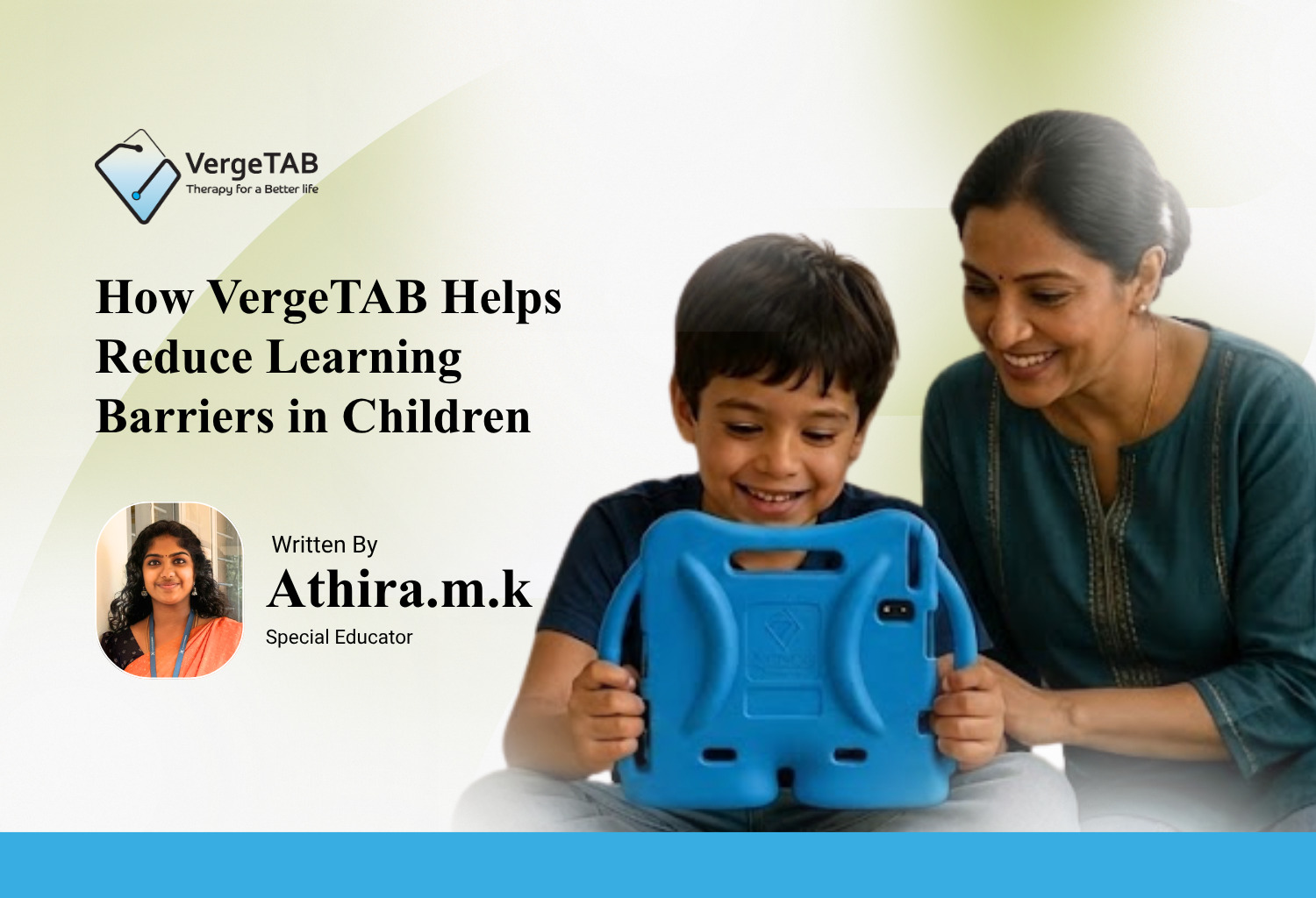
How VergeTAB Helps Reduce Learning Barriers in Children
01 Sep 2026

Written by Athira M K
Special Educator
Education is a fundamental right, yet not every child experiences learning in the same way. Some children grasp concepts quickly, while others need visual support, repeated practice, additional time, or a different way of engaging with material.
For children with learning, developmental, communication, attention, memory, or motor-related difficulties, the challenge is often not a lack of ability — it’s that the way learning is presented becomes a barrier.
Reducing learning barriers means creating more accessible and flexible opportunities for children to participate, understand, practise, and progress according to their individual needs. VergeTAB supports this by providing interactive, structured learning experiences that give children different ways to engage with educational content.
Understanding Learning Barriers
Learning barriers look different for every child. A child may:
- Find it difficult to maintain attention during an activity
- Need repeated practice to understand and remember a concept
- Struggle to follow lengthy verbal instructions
- Require additional time to complete tasks
- Find traditional worksheets difficult or unengaging
- Experience difficulty with hand-eye coordination
- Lose interest when learning doesn’t match their level or needs
These challenges shouldn’t be viewed as limits on a child’s potential. Instead, they point to a more useful question: What is making learning difficult for this child, and what support could help reduce that barrier?
Sometimes a small change in how a concept is presented creates a much greater opportunity for participation and learning.
Every Child Learns Differently
Learning barriers don’t define a child’s ability. The right combination of visual support, interaction, repetition, time, and encouragement can create more opportunities for meaningful participation.
Different Barriers Need Different Approaches
There’s no single teaching method that works for every learner:
- Attention challenges → Interactive, engaging activities encourage active participation where traditional formats fall short.
- Memory and retention difficulties → Children may understand a concept in one session but struggle to recall it later. They benefit from repeated opportunities to revisit what they’ve learned.
- Trouble following verbal instructions → Visual materials, demonstrations, and interactive activities make instructions easier to understand.
- Coordination difficulties → Repeated, low-pressure opportunities to interact with materials help build controlled movement over time.
- Different learning speeds → Being able to revisit activities at an appropriate pace reduces unnecessary pressure.
The goal isn’t to make every child learn the same way; it’s to give every child a meaningful path to learning.
How VergeTAB Helps Reduce Learning Barriers
Technology can’t remove every barrier on its own. But alongside appropriate teaching and support, it gives children more ways to access and engage with learning through:
- Visual learning materials
- Audio support
- Touch-based activities
- Interactive exercises
- Matching and identification activities
- Structured digital learning activities
- Repeated practice
These features let children see, hear, touch, practise, and actively participate rather than simply listen or complete a static worksheet. Because activities can be revisited freely, children get structured opportunities to reinforce learning at their own pace, without pressure.
Different Ways to Engage with Learning
| Learning Need | VergeTAB Support |
|---|---|
| Attention | Interactive activities |
| Memory and retention | Repeated practice |
| Verbal instruction | Visual and audio support |
| Hand-eye coordination | Touch-based activities |
| Different learning pace | Activities that can be revisited |
| Active participation | Interactive exercises |
A Real Experience from the Classroom
While working with children in a school environment, I observed some meaningful changes through VergeTAB.
Two children initially experienced significant difficulties with hand-eye coordination. Touching the correct option on the tablet and completing touch-based activities was challenging, so they required additional time and support.
Over weeks, they grew more comfortable with touch-based activities and showed gradual improvement in coordination. More encouraging was their increased willingness to participate. Activities that once felt difficult gradually became familiar, and the children showed greater interest and confidence during learning sessions.
This supported an important point: when a child gets repeated, engaging opportunities to practise, a barrier that once limited participation can gradually become manageable.
Teachers also noticed positive changes in:
- Participation
- Interest in learning activities
- Engagement during sessions
- Willingness to interact with materials
- Overall learning progress
A Small Achievement That Made a Big Difference
One experience stood out in particular: a child learning to identify colours.
It took almost two months of consistent practice, but the child eventually learned to identify two or three colours. From the outside, that might look like a small step. For that child, it was a meaningful milestone.
Learning progress can’t always be measured through conventional academic benchmarks. Sometimes progress means identifying a new colour, remembering something learned earlier, completing an activity independently, or simply participating more actively in a session. Every small step can represent significant progress in a child’s individual journey.
Small Steps Are Meaningful Progress
Learning progress isn’t always measured by academic milestones. Identifying a colour, completing an activity independently, remembering a previously learned concept, or participating more actively can all represent meaningful progress.
Supporting Teachers, Not Replacing Them
Technology doesn’t replace teachers — it supports their efforts by offering different ways to present concepts, encourage participation, and provide repeated practice. VergeTAB provides teachers with opportunities to observe how children respond to different learning approaches, helping them understand individual needs and plan appropriate next steps. The tools are additional; the teacher’s guidance and encouragement remain essential.
Extending Learning Beyond the Classroom
Learning doesn’t stop when the school day ends. When activities can be reinforced at home, children have more opportunities to practise at their own pace, while consistency between school and home can further support their progress.
Building Independence and Confidence
Reducing barriers creates more opportunities for children to experience success. When a child completes or participates in an activity with less support than before, even a small win builds confidence and motivates them to attempt the next challenge.
Conclusion
Every child faces different barriers to learning, and meaningful support starts with understanding those barriers rather than focusing on limitations. VergeTAB gives children additional ways to access, practise, and engage with learning according to their individual needs. It works best when combined with skilled teaching, appropriate content, and consistent support at home.
When technology, teachers, and families work together, small steps become meaningful progress. Every child’s progress deserves to be recognised and celebrated.
Want to see how VergeTAB can support the learners in your classroom or at home?
Explore how interactive, structured activities can give children more opportunities to access, practise, and engage with learning at their own pace.