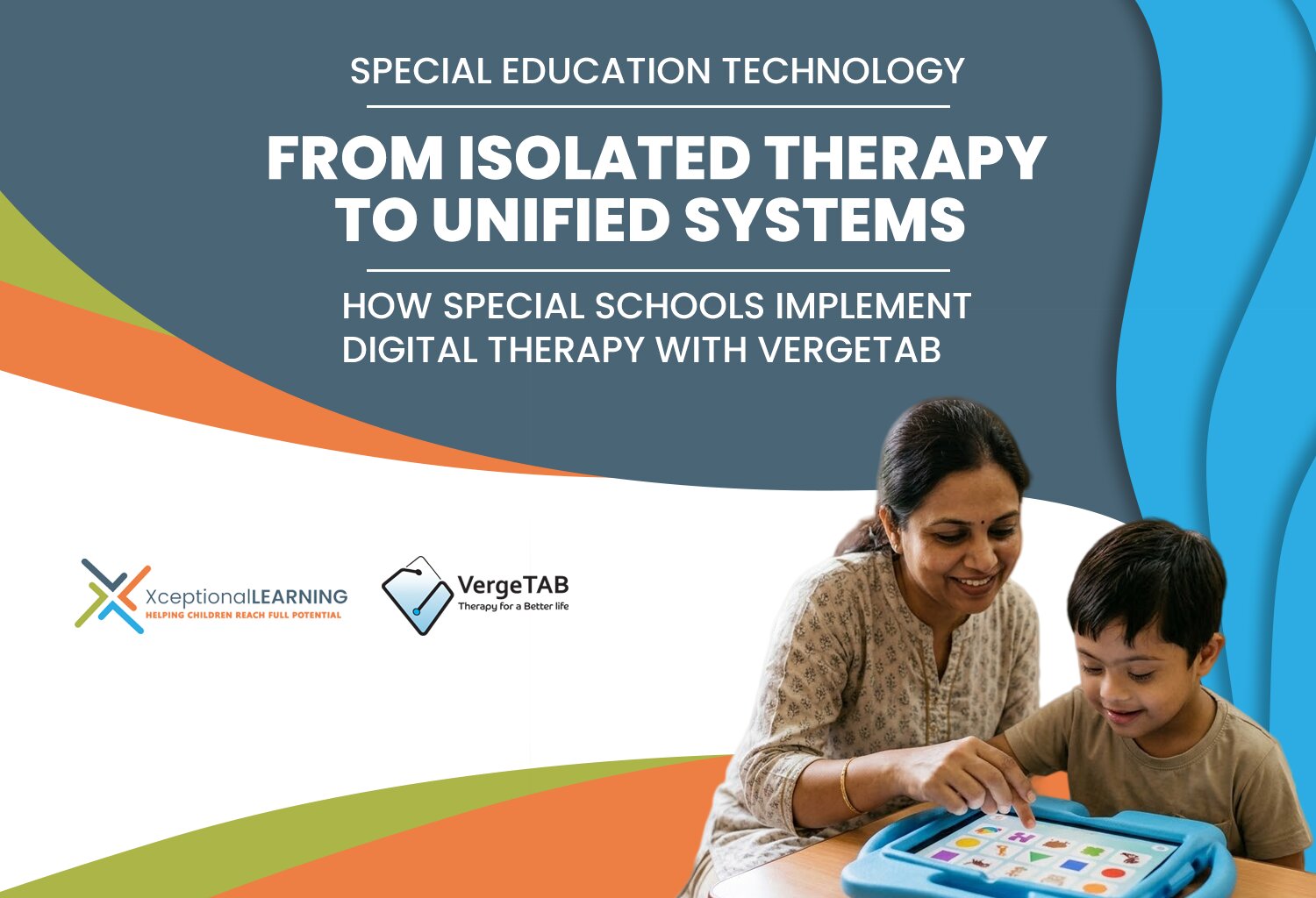
From Isolated Therapy to Unified Systems: How Special Schools Implement VergeTAB for Structured Digital Therapy
24 Mar 2026

Clinically Reviewed by
Consultant Psychologist, Special Educator & Digital Therapy Trainer
Special schools carry responsibilities that extend far beyond textbooks and timetables. Every day, they support children in developing communication skills, emotional regulation, motor coordination, independence, and essential life abilities that shape their long-term future.
The work is intensive. It is deeply personal. And it requires extraordinary dedication from educators, therapists, administrators, and families alike.
In many institutions, the commitment is unquestionable. Staff members work tirelessly. Therapists design thoughtful intervention plans. Teachers reinforce goals in the classroom. Parents try to continue practicing at home.
Yet despite all this effort, many special schools quietly face a common challenge:
Everyone is working hard — but not always working together within a unified system.
Speech therapy goals may exist in one place. Classroom reinforcement happens elsewhere. Parent updates depend on occasional meetings. Documentation is scattered across files and reports.
This is where structured digital therapy platforms for special education schools are beginning to transform how therapy and learning are delivered.
At the centre of this transformation is VergeTAB, a purpose-built therapy tablet for special education environments designed to work exclusively within the XceptionalLEARNING ecosystem. Together, they create a coordinated digital infrastructure that connects therapists, teachers, administrators, and parents within a single intervention system.
Why Structured Technology Is No Longer Optional in Special Schools
In many special schools, therapy and classroom activities still operate in partially disconnected workflows.
For example:
- Speech therapy goals may be stored in isolated files
- Occupational therapy objectives may not always be reinforced in classrooms
- Behaviour observations are often recorded manually
- Parent updates depend on periodic meetings rather than continuous engagement
The challenge is not a lack of dedication.
The challenge is infrastructure.
To deliver consistent developmental outcomes, schools increasingly require structured special education technology systems that support:
- Cross-disciplinary goal alignment
- Standardized therapy documentation
- Measurable intervention tracking
- Parent participation in home practice
- Controlled and distraction-free digital learning environments
Modern digital therapy platforms for schools allow these elements to function within one coordinated framework instead of fragmented processes.
What Makes VergeTAB Different
Today, many institutions experiment with general-purpose tablets for educational use. However, consumer devices often introduce distractions, inconsistent applications, and open internet access.
These conditions rarely support structured therapy environments.
VergeTAB was developed specifically as a therapy tablet for autism and special education programs. It is not a consumer device adapted for therapy use.
Instead, it operates entirely within the XceptionalLEARNING digital therapy platform, creating a closed, secure environment where all activities are aligned with therapeutic and educational goals.
In simple terms:
VergeTAB is the hardware.
XceptionalLEARNING is the intelligence layer.
Together, they form a controlled therapy management system for schools where every module, activity, and report supports structured intervention.
There are:
- No gaming applications
- No open browsing
- No unrelated digital distractions
This controlled architecture is critical in special education settings where overstimulation and digital safety must be carefully managed.
But beyond safety, the real advantage lies in system alignment.
VergeTAB becomes more than a device.
It becomes an institutional implementation tool.
Why Special Schools Are Adopting Digital Therapy Tablets
Across many special education institutions, administrators are recognizing that therapy outcomes depend not only on professional expertise but also on consistent reinforcement across environments.
Digital therapy tablets are increasingly adopted because they help schools:
- Reinforce therapy goals during classroom instruction
- Improve documentation and progress tracking
- Enable multidisciplinary collaboration
- Provide structured home practice modules for parents
- Reduce administrative workload through digital reporting systems
When integrated into a structured IEP digital platform, these systems help schools monitor student development more effectively and make data-informed decisions about interventions.
Instead of relying solely on periodic reviews, educators and therapists can track daily engagement and progress patterns in real time.
A Child-Level Transformation: What This Looks Like in Practice
In one special school classroom, a child working on expressive communication struggled to generalize vocabulary learned during speech therapy sessions.
Before digital integration:
- Vocabulary was practised only during therapy
- Classroom reinforcement was inconsistent
- Parents were unsure how to practice effectively at home
After VergeTAB implementation:
- The same vocabulary targets appeared in structured classroom activities.
- Teachers reinforced communication tasks digitally.
- Parents accessed guided practice modules at home.
- Progress became visible across stakeholders.
Within weeks, educators observed more spontaneous responses and improved engagement.
One educator summarized the change simply:
“Earlier, we saw progress during therapy time. Now we see it throughout the day.”
This transformation is not about replacing therapists.
It is about extending therapy impact across environments.
See VergeTAB in a Real Classroom Setting
Watch how structured digital therapy supports engagement and reinforcement during classroom learning.
Watch the classroom video
Project DESS: Structured Institutional Implementation
Technology adoption in special schools must go beyond distributing devices.
That is why the Project DESS (Digitalizing Education in Special Schools) framework focuses on system-level transformation.
The model includes:
- Institutional needs assessment
- Staff onboarding and workflow training
- Phased deployment across departments
- Performance monitoring and evaluation
- Parent integration models
- Scalable expansion planning
Schools implementing VergeTAB through Project DESS move from isolated therapy processes to coordinated intervention systems.
Transformation becomes measurable rather than theoretical.
See How Special Schools Are Implementing VergeTAB
Many institutions are adopting structured digital therapy platforms and assistive technology for autism to align therapy, classroom learning, and home practice.
Watch how real special schools are integrating VergeTAB into their daily intervention systems.
Measurable Outcomes Observed in Participating Special Schools
Within one academic cycle, institutions implementing VergeTAB under structured models have reported:
- Significant increases in structured task engagement
- Reduced administrative documentation workload
- Improved clarity during interdisciplinary review meetings
- Stronger carryover of therapy goals into classroom routines
- Increased parent participation in home practice
Interestingly, staff often report that workload does not increase.
Instead, documentation becomes more streamlined because digital systems replace repetitive manual processes.
Efficiency improves because friction within workflows is reduced.
Institutional Impact: Real Special School Transformations
Santwanam Special School
At Santwanam Special School, VergeTAB helped digitize therapy workflows and align intervention goals across departments.
Principal Athira Krishnan reported improved coordination between therapists and educators, along with more structured documentation practices.
Key outcomes included:
- Streamlined therapy scheduling
- Stronger classroom reinforcement of therapy goals
- Increased student engagement
- Clearer progress visibility
Watch Santwanam Special School Implementation
Asha Nilayam Special School
Asha Nilayam Special School adopted VergeTAB to create a hybrid therapy–classroom model.
Therapists and educators now assign goal-based digital activities, monitor progress in real time, and provide parents with structured updates.
Key outcomes included:
- Integrated therapy and classroom workflows
- Real-time multidisciplinary monitoring
- Improved parent communication
- Greater institutional transparency
Watch Asha Nilayam Special School Case
How VergeTAB Strengthens Multidisciplinary Collaboration
Effective special education relies on coordinated collaboration among professionals.
With VergeTAB integrated into daily workflows:
- Special educators reinforce therapy goals during classroom sessions
- Speech-language pathologists assign communication-focused modules
- Occupational therapists incorporate motor-based digital activities
- Behaviour therapists monitor engagement patterns
- Parents access guided home practice activities
Instead of parallel interventions, schools operate within a connected intervention model.
Research consistently shows that coordinated multidisciplinary approaches produce stronger functional outcomes than isolated therapy sessions.
Key Benefits for Special Schools
1. Improved Generalization Across Settings
A child may confidently form sentences during a session, yet remain silent when a teacher asks a simple question in class. At home, parents may still hear one-word answers. The ability is there, but consistency across environments is missing.
When therapy goals, classroom activities, and home practice are aligned, something changes. The child begins seeing the same structure, cues, and expectations everywhere — not just in one room.
Within weeks, participation improves, and confidence grows. Progress becomes visible not only in sessions but in real life. And when families are actively involved, support shifts from occasional encouragement to meaningful partnership in the child’s development.
2. Data-Driven Decision Making
Manual reporting systems are time-intensive and subjective.
Digital dashboards within the XceptionalLEARNING framework allow special schools to:
- Monitor individual goal progression
- Track performance patterns
- Identify stagnation early
- Make informed intervention adjustments
Administrators also gain visibility into institutional-level outcomes.
3. Stronger Parent Engagement
One of the biggest gaps in special education is what happens after the school day ends. Progress made in structured sessions can slow down when home practice lacks clarity.
With structured, guided modules, parents are no longer given vague advice like “practice at home.” Instead, they receive clear, step-by-step activities aligned with the child’s therapy goals. This transforms the role of parents in therapy — from passive supporters to active partners in progress.
When parents understand what to reinforce and how to do it confidently, consistency improves. Children experience the same expectations across school and home, reducing confusion and strengthening outcomes. As a result, progress feels steady, measurable, and less stressful for families.
4. Operational Efficiency
Special schools often function with limited staffing.
Structured digital systems reduce:
- Repetitive documentation
- Manual file management
- Cross-department communication delays
Staff can focus more on intervention and less on administrative tasks.
5. Scalable Institutional Growth
Digital infrastructure allows special schools to:
- Pilot implementation in one department
- Train staff systematically
- Monitor measurable outcomes
- Expand gradually
This makes adoption sustainable and financially strategic.
Ethical, Secure, and Child-Centered
Technology in special schools must remain:
- Professionally supervised
- Screen-time regulated
- Data secure
- Goal oriented
VergeTAB’s controlled architecture ensures digital usage remains structured, safe, and focused on therapeutic outcomes.
Implementation Model for Special Schools
Successful adoption follows five stages:
- Institutional assessment
- Staff onboarding and training
- Pilot classroom deployment
- Data monitoring and refinement
- Scalable institutional expansion
This phased model ensures sustainable implementation and measurable impact.
The Future of Special Schools
Special schools are gradually evolving from paper-heavy, disconnected systems toward coordinated digital ecosystems.
The future of therapy and special education will be:
- Collaborative
- Data-informed
- Parent-inclusive
- Secure
- Scalable
When therapy platforms, classrooms, and home environments are connected through structured technology, intervention becomes more consistent and effective.
VergeTAB, implemented within frameworks like Project DESS, supports this evolution by aligning therapy, education, and family participation into one unified system.
Conclusion: From Fragmentation to Institutional Leadership
When special schools adopt structured digital therapy platforms and therapy tablets for special education, intervention becomes measurable, collaborative, and sustainable.
Institutions that move beyond disconnected processes and build coordinated digital systems are better positioned to support long-term developmental outcomes for children with diverse learning needs.
If your school is exploring structured digital implementation, you can:
- Watch how other institutions have implemented VergeTAB
- Schedule a guided demonstration for your leadership team
- Connect with our team on WhatsApp for quick inquiries and implementation support
The future of special education belongs to institutions that build structured, scalable systems — not disconnected processes.
And that transformation begins with alignment.