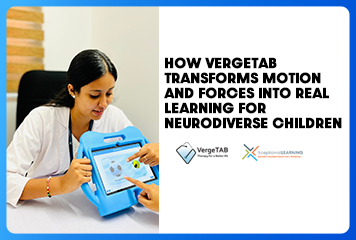
How VergeTAB Transforms Motion and Forces into Real Learning for Neurodiverse Children
03 Mar 2026

Understanding scientific concepts like motion and force can be challenging for many children. For neurodiverse learners, including children with Autism, ADHD, Intellectual Disabilities, and Learning Disabilities, these abstract concepts often require specialized teaching approaches. Traditional classroom methods relying on textbooks and verbal explanations may not always provide meaningful learning experiences.
For many neurodiverse children, learning becomes meaningful when they can actively experience and interact with concepts rather than simply hear or read about them. Assistive technology tools like VergeTAB —a blank, purpose-built device that runs exclusively on the XceptionalLEARNING Platform are transforming how these concepts are taught by making learning interactive, engaging, and functional.
Making Abstract Concepts Meaningful
Motion and force are foundational scientific concepts that explain how objects move and interact with the world. However, these ideas can be difficult to grasp when they are presented only through written explanations or static diagrams. Neurodiverse children typically benefit from visual, hands-on, and structured learning experiences that help them connect theoretical knowledge with real-life understanding.
VergeTAB, a digital therapy tablet addresses this learning gap by converting abstract scientific ideas into visually engaging and interactive activities. Through animations and guided learning modules, children can observe how objects move, change direction, or respond to pushes and pulls. This approach helps learners develop a clearer understanding of cause-and-effect relationships.
Learning Through Touch and Interaction
One of the key strengths of VergeTAB is its touch-based interactive learning environment. Instead of passively watching or listening, children actively participate by tapping, dragging, tracing, and manipulating digital objects. These activities strengthen visual-motor coordination while reinforcing conceptual understanding of motion and movement.
Interactive learning also supports children who learn better through physical engagement. When children control movement on the screen, they develop stronger connections between their motor actions and cognitive processing, leading to deeper learning retention.
Building Cause-and-Effect Understanding
Understanding motion and force requires recognizing how actions lead to outcomes. VergeTAB uses step-by-step sequencing activities and interactive simulations to help children observe how objects respond when moved, pushed, or pulled. These structured activities strengthen logical thinking and problem-solving skills while helping children connect movement concepts with everyday experiences.
Gradually increasing activity complexity allows children to build confidence while progressing at their individual learning pace. This personalized learning approach ensures that children are neither overwhelmed nor under-challenged.
To better understand how these learning principles are implemented, VergeTAB includes several interactive activities designed specifically to teach motion and force concepts in engaging and meaningful ways.
See VergeTAB in Action
Want to explore how interactive motion and force activities work in real learning environments? Watch real therapy-based simulations and guided modules designed specifically for neurodiverse children.
Explore VergeTAB in Action Now
Possible VergeTAB Activities to Teach Motion and Force
1. Push and Pull Simulation Activities
What Children Do
Children interact with digital objects by pushing or pulling them across the screen. They may move a toy car, slide a box, or pull objects toward a target.
What Children Learn
Children understand that force creates movement and influences direction. They also learn how different levels of force affect object motion.
Skills Developed
- Cause-and-effect understanding
- Direction awareness
- Visual-motor coordination
- Problem-solving skills
2. Movement Path Tracing
What Children Do
Children trace movement routes such as straight paths, curved lines, and zigzag patterns using touch interaction.
What Children Learn
Children understand how objects move along different paths and recognise various movement patterns.
Skills Developed
- Fine motor control
- Hand-eye coordination
- Visual tracking
- Spatial awareness
3. Speed Comparison Games
What Children Do
Children compare objects or characters moving at different speeds, such as fast vehicles and slow animals.
What Children Learn
Children develop an understanding of speed and recognise differences between fast and slow movement.
Skills Developed
- Observation and attention
- Visual discrimination
- Cognitive comparison skills
- Concept development of speed
4. Cause-and-Effect Motion Activities
What Children Do
Children tap, drag, or swipe objects to observe immediate movement responses. For example, tapping a ball may make it roll or bounce.
What Children Learn
Children learn how their actions create movement outcomes and develop logical connections between action and response.
Skills Developed
- Cause-and-effect reasoning
- Decision-making skills
- Motor coordination
- Engagement and participation
5. Sequencing Movement Tasks
What Children Do
Children arrange movement-related steps in the correct order, such as steps involved in throwing a ball or completing an obstacle path.
What Children Learn
Children understand that movement happens in sequences and requires planning and coordination.
Skills Developed
- Motor planning
- Executive functioning
- Sequencing and organisation
- Problem-solving skills
These structured activities not only strengthen conceptual learning but also help children apply motion and movement skills to everyday real-life situations.
Personalized Learning for Every Child
Every child learns differently, and VergeTAB supports individualized learning plans tailored to each learner’s developmental needs. Therapists and educators can customize activities, monitor progress, and adjust learning goals based on the child’s performance. Real-time progress tracking helps professionals provide targeted interventions and ensures consistent learning support across therapy, school, and home environments.
When learning experiences match a child’s abilities and interests, it naturally increases engagement and participation.
Enhancing Motivation and Engagement
Maintaining attention and motivation can be challenging for neurodiverse children. VergeTAB incorporates gamified learning elements, milestone tracking, and reward-based activities that encourage active participation. These features help children remain engaged, reduce learning anxiety, and build confidence in their abilities.
Supporting Collaborative Learning
VergeTAB promotes collaboration among therapists, teachers, and parents by providing shared progress insights and learning data. This coordinated support system helps ensure consistency in teaching strategies and reinforces learning across different environments. Parents can actively participate in their child’s learning journey by continuing reinforcement activities at home.
Conclusion
VergeTAB transforms motion and force learning from abstract scientific concepts into interactive, multisensory, and meaningful educational experiences for neurodiverse children. By combining visual simulations, touch-based interaction, adaptive learning, and collaborative progress monitoring, VergeTAB helps children develop conceptual understanding, motor coordination, and functional independence.
As technology continues to reshape special education, tools like VergeTAB are creating inclusive learning opportunities that empower neurodiverse children to explore, understand, and engage with the world around them.
Talk to Our Experts Today
Have questions about implementing VergeTAB in your school, therapy center, or home learning program?
Our specialists can guide you through device features, customization options, institutional deployment, and individualized learning plans.
Chat with us directly on WhatsApp to get a quick demo, pricing details, and implementation guidance.
Click here to start a WhatsApp conversation