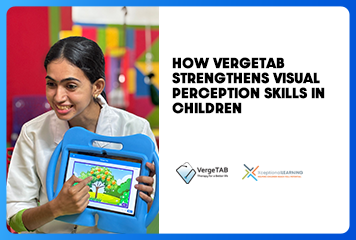
How VergeTAB Strengthens Visual Perception Skills in Children
27 Jan 2026

A Complete Visual Perception Framework Covering Visual Closure, Figure–Ground, Spatial Relations, and Spatial Reasoning
Visual perception is the foundation of learning, reading, writing, solving puzzles, understanding directions, and navigating daily life. For many children—especially those receiving early intervention, occupational therapy, speech therapy, developmental therapy, or special education support—these skills don’t develop automatically. They need structured, repeated, distraction-free practice.
This is where VergeTAB, a blank digital therapy tablet powered exclusively by the XceptionalLEARNING Platform, becomes a true game changer. It offers therapist-designed, practical modules that go far beyond theory. With interactive tasks, multi-sensory reinforcement, and real-time feedback, VergeTAB helps children build visual perception skills in a way that feels joyful, repeatable, and effective.
This blog provides a complete practical framework showing how VergeTAB strengthens four core visual perception areas:
- Visual Closure
- Figure–Ground Perception
- Spatial Relations
- Visual–Spatial Reasoning
And most importantly, how these skills grow through real, hands-on VergeTAB activities, not just theoretical explanations.
Why Visual Perception Matters for Children
Visual perception isn’t just the ability to see—it is the ability to understand what is being seen.
Children with visual perception difficulties may:
- Take longer to read or decode words
- Struggle to find items in busy environments
- Reverse letters like b/d/p/q
- Write outside lines
- Get overwhelmed by worksheets
- Misplace classroom items
- Have difficulty understanding directions
- Struggle with puzzles, maths, blocks, drawing, etc.
These challenges can affect confidence, academic performance, social participation, and independence.
VergeTAB targets these root difficulties through daily, simple, fun, structured activities.
How VergeTAB Enhances Visual Closure Skills
What Is Visual Closure?
Visual Closure is the ability to identify a complete object even when only parts are visible. Children use this skill while reading, recognizing words quickly, and identifying shapes or patterns.
Common Challenges Faced by Children:
- Slow reading
- Mixing similar letters (p/q/b/d)
- Difficulty completing worksheets
- Not finishing pictures
- Trouble recognizing objects when partially hidden
VergeTAB Activities for Building Visual Closure
Visual Closure helps children identify objects even when parts are missing. VergeTAB strengthens this skill through structured, therapist-designed activities that build prediction, recognition, and visual memory.
A) Object Completion Activities
- Focus: Helping children recognize whole objects by predicting missing parts and completing incomplete visuals.
- Skills Developed: Quick visual prediction, whole-object identification, symmetry understanding, and fine visual discrimination.
- Example: A child sees half a butterfly or a watermelon slice missing one half. VergeTAB shows multiple options, and the child selects the correct completed version.
B) Letter & Symbol Closure Tasks
- Focus: Identifying letters and symbols even when parts are missing, faded, or incomplete.
- Skills Developed: Alphabet recognition, early reading fluency, preventing letter-reversal confusion, and strong visual discrimination.
- Example: An incomplete “B” appears. The child selects the correct completed “B” from four choices.
C) Shadow & Silhouette Reconstruction Activities
- Focus: Reconstructing objects using partial shadows, outlines, and shape cues.
- Skills Developed: Rapid identification, associative thinking, attention to detail, shape analysis, and visual problem-solving.
- Example: A partial shadow of a car or a bird silhouette, missing its wings, appears. The child taps or drags the correct piece to complete the image.
How VergeTAB Strengthens Figure–Ground Perception
What Is Figure–Ground?
Figure–ground is the ability to focus on a target while ignoring background distractions. This is essential for:
- Finding words in a paragraph
- Locating items in a crowded room
- Spotting objects on classroom shelves
- Completing worksheets without confusion
- Reading lines without skipping
Children with poor figure–ground skills get easily overwhelmed.
VergeTAB Activities for Strengthening Figure–Ground Perception
A) Object Search & Identification Tasks
- Focus: Locate specific objects in busy scenes using visual scanning, colour cues, and target identification.
- Skills Developed: Visual scanning, sustained attention, distraction filtering, visual categorization, and discrimination skills.
- Example: A jungle scene with many animals appears. VergeTAB prompts: “Find the red parrot” or “Tap only the yellow stars.” The child scans the picture, filters distractions, and taps the correct target.
B) Hidden & Camouflaged Object Challenges
- Focus: Find objects that are blended, camouflaged, or partially concealed.
- Skills Developed: Deep concentration, pattern identification, and shape detection inside other shapes.
- Example: A frog hidden among leaves in a pond. The child spots and taps it.
C) Detail Detection & Symbol Search Activities
- Focus: Spot small differences or letters in complex layouts.
- Skills Developed: Precision scanning, early reading readiness, attention to detail, and comparison-based processing.
- Example: A child finds all “b” in a grid of b, d, p, q, or spots a pencil colour change between two similar images.
How VergeTAB Improves Spatial Relations Skills
What Are Spatial Relations?
Spatial Relations is the ability to understand how objects relate to each other in space. Children need this for:
- Writing within lines
- Copying from board to book
- Understanding left–right orientation
- Doing puzzles
- Navigating around obstacles
VergeTAB Activities for Strengthening Spatial Relations
A) Drag-and-Place Spatial Puzzles
- Focus: Drag shapes, blocks, or puzzle pieces into correct positions.
- Skills Developed: Directional awareness, visual–motor coordination, and accurate spatial placement.
- Example: A child drags a square, circle, and triangle to their matching positions in a house layout (roof, window, door).
B) Positional & Orientation Challenges
- Focus: Understand positional words and object orientation.
- Skills Developed: Concept learning (left/right/above/below) and orientation consistency to reduce letter reversals.
- Example: VergeTAB prompts: “Tap the cat under the table” or match tilted arrows.
C) Pattern Sequencing & Path Navigation
- Focus: Copy sequences, follow spatial patterns, and navigate digital pathways or mazes.
- Skills Developed: Spatial memory, pattern reproduction accuracy, and planning.
- Example: A child recreates a circle–square–circle sequence or traces a maze without touching edges.
How VergeTAB Boosts Visual–Spatial Reasoning
What Is Visual–Spatial Reasoning?
It is the ability to think in pictures, visualize patterns, and understand spatial logic, which is essential for:
- Mathematics
- Coding
- Engineering concepts
- Problem-solving
- Strategy games
- Pattern understanding
Children with weak reasoning struggle with concept learning, puzzles, and abstract thinking.
VergeTAB Activities for Strengthening Visual–Spatial Reasoning
A) Pattern Prediction & Mental Rotation
- Focus: Children predict the next item in a sequence and rotate shapes mentally to find the correct orientation.
- Skills Developed: Logic, sequential reasoning, spatial imagination, visual memory, STEM readiness.
- Example: A child sees red–blue–red–blue and taps blue next; another rotates a triangle to match orientation.
B) Tangram & Shape Construction
- Focus: Children use geometric shapes to build larger pictures or objects.
- Skills Developed: Problem-solving, shape segmentation, and structural reasoning.
- Example: A child builds a rocket from triangles and squares or a house from five shapes.
C) Digital Block-Building & 3D Visualization
- Focus: Children recreate 3D block structures shown on screen, improving understanding of three-dimensional space.
- Skills Developed: 3D visualization, building concepts, engineering foundations, and visual memory.
- Example: A child rebuilds a 3-layer tower or copies a block bridge displayed briefly.
Additional Activities Available on VergeTAB That Deepen Visual Perception Learning
VergeTAB offers a variety of additional activities designed to strengthen and expand children’s visual perception skills. These tasks provide structured practice that builds attention, memory, reasoning, and spatial understanding in a fun and interactive way.
- Matching Identical Pictures: Children match two identical pictures among a set of images. This activity improves quick recognition, supports attention, and strengthens visual memory.
- Shape Categorization: Children classify objects based on their shapes, helping them organize and process visual information effectively. This activity supports cognitive sorting and enhances children’s ability to recognize and group shapes logically.
- Colour–Shape Combination Tasks: Children identify objects based on both colour and shape, strengthening dual-attribute identification. This activity enhances visual discrimination and helps children pay attention to multiple visual details simultaneously.
- Find the Missing Piece Puzzles: Children complete images or shapes by finding and placing the missing piece. This activity builds completion skills, supports reasoning, and helps children develop visual closure and spatial awareness.
- Direction-Based Movement Games: Children move objects or characters according to directional instructions, such as up, down, left, or right. This activity helps children understand spatial planning, improves impulse control, and increases accuracy in eye–hand coordination.
Real Improvements Seen in Children Using VergeTAB
- Faster Reading: Children recognize incomplete letters quickly, → improves decoding fluency.
- Better Attention: Search & hidden-object tasks improve focus in class.
- Reduced Letter Reversals: Orientation tasks help prevent b/d/p/q mix-ups.
- Stronger Copying & Writing: Better spatial awareness → improved handwriting.
- Independence in Daily Routines: Children find objects easily and understand directions better.
Why VergeTAB Is the Best Tool for Visual Perception Therapy
- Designed for therapy—not entertainment: Children stay focused because there are no unrelated apps or distractions.
- Uses structured Digital Therapy Activities: Created by occupational therapists, special educators, psychologists, and speech-language pathologists to ensure evidence-based, developmentally appropriate exercises.
- Perfect for everyday home practice: Just 15 minutes a day can lead to noticeable improvement in visual perception skills.
- Tracks progress with XceptionalLERANING Platform: Therapists and parents can monitor growth over time and adjust practice as needed.
- Builds multiple skills simultaneously: Supports motor skills, attention, perception, language, and reasoning for holistic development.
Final Thoughts: VergeTAB + XceptionalLEARNING = A Complete Visual Perception Development System
Visual perception is the backbone of nearly every academic and functional skill. Children who struggle often fall behind—not due to lack of intelligence, but because they lack structured, practical practice.
VergeTAB changes that. As a digital therapy device for special education that works only with the XceptionalLEARNING Platform, it:
- Enhances Visual Closure
- Builds Figure–Ground skills
- Strengthens Spatial Relations
- Develops Visual–Spatial Reasoning
All through practical digital activities, interactive tools, and therapist-designed modules.
If you’re looking for a digital therapy tablet for special education that builds strong foundational skills through a highly engaging, distraction-free, consistent, and structured approach, VergeTAB is the ideal solution—supporting digital and in-person therapy, strengthening the role of parents in therapy, and showing clearly how digital therapy works in real learning environments. Contact us to learn more
Related Reading
- What Are Visual Discrimination Skills? How VergeTAB Activities Strengthen Them
(Supports figure–ground perception, scanning, and visual clarity) - Enhancing Orientation and Directionality Through On-Screen Movement Tasks on VergeTAB
(Directly supports spatial relations, left–right awareness, and letter orientation) - Strengthening Visual Sequential Memory Skills Using Progressive VergeTAB Activities
(Closely linked to visual closure, reading fluency, and pattern recognition) - How VergeTAB Improves Spatial–Temporal Processing and Cognitive–Linguistic Skills in Children
(Supports visual–spatial reasoning, planning, and higher-order thinking) - Exploring Science, Technology, Engineering, and Mathematics (STEM) Therapy with VergeTAB for Learning and Development
(Extends visual–spatial reasoning into problem-solving, logic, and STEM readiness)