
Why Science Feels Abstract in Special Education — And How VergeTAB Makes It Real and Visual

Reading Time: 6 minutes

Clinically Reviewed by

Meha P Parekh

Special Educator, Digital Practitioner – SPED

In many special education classrooms, science becomes difficult not because children lack interest, but because the concepts feel invisible. Ideas like evaporation, force, magnetism, plant growth, or states of matter are often explained through words or pictures that children cannot directly relate to their own experiences.

As a result, students may memorize facts for a lesson but struggle to truly understand what is happening or why it happens.

This is where VergeTAB becomes part of science learning in therapy and special education environments. Schools and therapists use VergeTAB with the XceptionalLEARNING platform to provide distraction-free, visual, and interactive activities that help children observe cause-and-effect relationships and understand science concepts in a concrete way.
Talk to our team on WhatsApp

The Importance of Science in Special Education

Understanding science is not just about memorizing facts. It equips children with skills essential for problem-solving, critical thinking, and understanding the world around them. For children in special education:

  • Hands-on learning matters: Physical engagement improves comprehension and memory retention.
  • Visual and interactive tools are critical: Many children benefit from multisensory approaches.
  • Science connects to daily life: Concepts like parts of plants, or simple machines part become more meaningful when experienced practically.

Key benefits for special education learners:

  • Develops curiosity and observation skills
  • Encourages independent exploration and experimentation
  • Strengthens critical thinking and reasoning abilities
  • Enhances language, vocabulary, and communication skills related to scientific concepts

How VergeTAB Makes Science Accessible

VergeTAB is a versatile tool designed to provide personalized, interactive learning experiences for children in special education. Unlike traditional tablets or worksheets, VergeTAB focuses on:

  • Single-child, personalized interaction — Each learner engages with tailored content that matches their abilities and pace.
  • Hands-on simulations with sensory-friendly tools — Combines touch, visuals, and sound to make scientific concepts easy to experience and understand.
  • Integration with the XceptionalLEARNING Platform — Enables monitoring, activity customization, and smooth coordination between therapy and classroom learning.

Core features for science learning:

  • Interactive simulations of real-world science phenomena
  • Visual step-by-step demonstrations of experiments
  • Engaging digital activities for practice and reflection
  • Simple analytics for educators and therapists to track growth
Struggling to help your child connect science concepts to real life?

VergeTAB offers structured visual activities that make science understanding easier and more engaging.
Chat with our team on WhatsApp for guidance

Key Science Topics for Special Education Learners

Science topics need to be presented in ways that emphasize relevance and interaction. VergeTAB enables the teaching of multiple science domains effectively:

1. Human Body & Health  

Key Concepts  

  • Five Senses: Sight, hearing, touch, taste, smell
  • Major Organs: Heart, lungs, brain, stomach, liver
  • Hygiene: Hand washing, dental care, personal cleanliness
  • Nutrition: Balanced diet, importance of fruits, vegetables, and water

Why it Matters  

Understanding the human body and practicing health awareness helps children in special education:

  • Build independence: Children learn to take care of themselves.
  • Enhance safety awareness: Knowing body parts and functions promotes safety.
  • Encourage healthy habits: Awareness of hygiene and nutrition supports long-term well-being.

VergeTAB Activities  

  • Interactive Body Map:
    • Drag and drop organs to their correct positions in a digital body.
    • Learn organ functions through touch and visual cues.
  • Five Senses Matching Game:
    • Match each sense to its corresponding stimulus (e.g., eyes → seeing, ears → hearing).
    • Reinforces sensory awareness and vocabulary.
  • Hygiene Routines Simulation:
    • Choose healthy habits for daily tasks like brushing teeth or washing hands.
    • Practice sequencing steps in routines.

Impact: These activities combine visual, tactile, and auditory learning, making abstract concepts real and visible. Children can observe, interact, and practice healthy routines in a safe digital environment.

2. Plants and Animals  
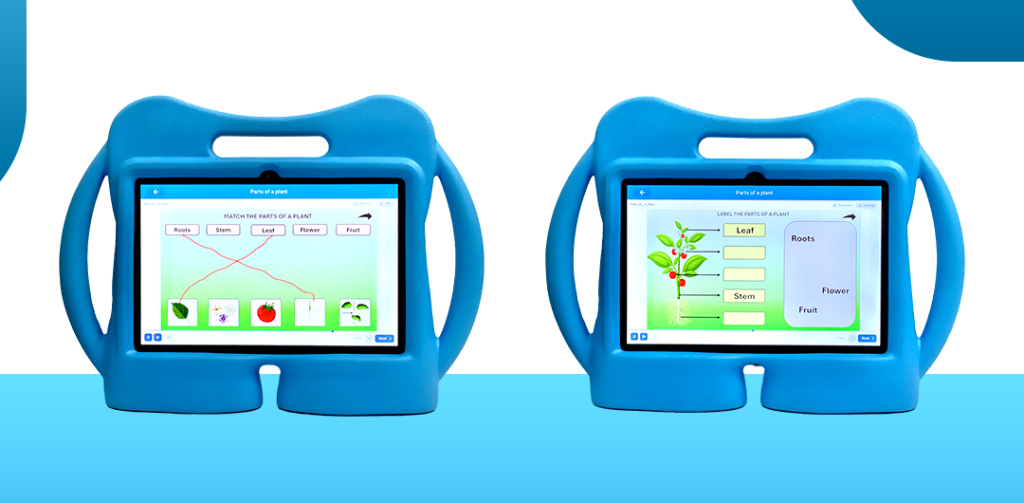
Interactive plant-learning activity on VergeTAB – designed for hands-on, distraction-free learning.

Key Concepts  

  • Life Cycles: Seed → Plant → Flower → Seed
  • Basic Needs: Sunlight, water, air, food
  • Habitats: Forests, deserts, oceans, grasslands

Why it Matters  

Studying plants and animals helps children:

  • Develop responsibility: Caring for plants or observing animals teaches nurturing.
  • Enhance observation skills: Tracking growth and behaviour promotes attention to detail.
  • Understand environmental awareness: Introduces children to ecosystems and conservation.

VergeTAB Activities  

  • Life Cycle Sequencing:
    • Arrange images of seed → sprout → plant → flower in order.
    • Strengthens understanding of growth and progression.
  • Habitat Match:
    • Drag animals to their correct habitats (e.g., camel → desert, fish → ocean).
    • Connects animal behaviour with environmental context.
  • Food Chain Puzzles:
    • Identify connections between plants, herbivores, and predators.
    • Enhances critical thinking and cause-and-effect understanding.

Impact: Children learn the relationships between living things, build vocabulary, and develop observation and analytical skills in a playful, interactive manner.

3. Water & Weather  

Key Concepts  

  • Water Cycle: Evaporation, condensation, precipitation
  • Rain, Clouds, Temperature: Understanding patterns in nature
  • Seasons: Hot, cold, rainy, dry

Why it Matters  

Understanding water and weather concepts helps children:

  • Comprehend daily life: Recognize how the weather affects routines.
  • Promote water conservation: Learn the importance of protecting natural resources.
  • Develop observation skills: Encourage noticing changes in the environment.

VergeTAB Activities  

  • Water Cycle Simulation:
    • Interactive digital cycle showing evaporation, condensation, and precipitation.
    • Students observe transformations in real-time.
  • Weather Matching:
    • Match weather icons (sun, clouds, rain) to real-life situations.
    • Reinforces comprehension and vocabulary.
  • Temperature Sorting:
    • Sort objects or days into hot vs. cold categories.
    • Develops cause-and-effect reasoning and classification skills.

Impact: These activities make abstract meteorological concepts understandable, promote environmental awareness, and improve cognitive reasoning.

4. Materials and Their Properties  

Key Concepts  

  • Physical Properties: Hard vs soft, rough vs smooth
  • Functional Properties: Waterproof vs absorbent, heavy vs light

Why it Matters  

Exploring materials helps children:

  • Make practical decisions: Recognize which materials are safe or useful.
  • Enhance tactile learning: Hands-on interaction improves sensory processing.
  • Support safety awareness: Understanding properties helps prevent accidents.

VergeTAB Activities  

  • Material Sorting Game:
    • Classify objects based on texture, hardness, or durability.
    • Encourages categorization and observation skills.
  • Waterproof Test Simulation:
    • Test objects digitally to see which float, absorb water, or resist moisture.
    • Builds understanding of cause-and-effect and experimentation.
  • Everyday Object Classification:
    • Relate materials to common household items (e.g., cotton → soft, metal → hard).
    • Encourages real-life application of concepts.

Impact: Children can safely explore materials’ properties and understand practical applications, enhancing both cognitive and sensory development.

5. Forces, Motion, Light, and Sound  

Key Concepts  

  • Forces: Push, pull, gravity
  • Motion: Direction, speed, cause-and-effect relationships
  • Light: Reflection, shadows
  • Sound: Vibrations, pitch, source identification

Why it Matters  

Understanding these concepts helps children:

  • Develop cause-and-effect reasoning: Recognize how actions produce results.
  • Enhance movement understanding: Explore physical interaction with objects.
  • Increase sensory awareness: Engage sight, sound, and touch in learning.

VergeTAB Activities  

  • Push and Pull Experiments:
    • Drag objects to see effects of force and motion.
    • Observe how mass and surface affect movement.
  • Light and Shadow Game:
    • Match objects to their shadows or reflect light with mirrors.
    • Teaches basic optics and observation skills.
  • Sound Identification:
    • Match vibrating sources (e.g., drum, string, bell) to their sounds.
    • Enhances auditory discrimination and attention skills.

Impact: These activities give children opportunities to explore physics concepts in a fun, safe, and interactive environment. They boost analytical thinking, sensory processing, and problem-solving.

In real classroom and therapy environments, science concepts are reinforced using VergeTAB in a controlled, distraction-free setup designed specifically for special education and therapy use. Schools and clinics use VergeTAB along with XceptionalLEARNING to help children repeatedly observe, interact with, and understand scientific ideas through guided visual activities.
See how VergeTAB works in real sessions

Overcoming Challenges in Teaching Science to Special Education Learners  

Teaching science to children with special needs comes with unique challenges:

  • Short Attention Spans: Use brief, engaging activities; alternate hands-on experiments with digital simulations.
  • Abstract Thinking Difficulties: Make concepts concrete and visual using real-life examples and VergeTAB.
  • Limited Fine Motor Skills: Adapt experiments for larger movements; use digital tools to reduce manual handling.
  • Varied Learning Paces: Provide individualized, self-paced activities on VergeTAB for mastery before moving forward.

Tips for Educators and Therapists  

To maximize the benefits of VergeTAB in teaching science:

  • Plan: Prepare a sequence of topics and experiments
  • Start simple: Introduce one concept at a time
  • Incorporate visuals and digital tools: Combine hands-on and VergeTAB simulations
  • Encourage exploration: Allow children to experiment freely within structured guidance
  • Track progress: Use the Platform’s analytics to track progress and skill development

Conclusion

Science is all around us—from the water we drink to the air we breathe and the plants that grow in our gardens. For children in special education, understanding these concepts can feel daunting without the right tools. VergeTAB, a Digital Therapy Activity Device integrated with the interactive platform XceptionalLEARNING, transforms abstract concepts into hands-on, engaging, and meaningful learning experiences.

By combining:

  • Multisensory approaches
  • Personalized digital activities
  • Gamified learning
  • Real-life applications

educators and therapists can make science accessible, enjoyable, and memorable for every child. Science is no longer a distant subject; it has become a part of daily exploration, wonder, and discovery. 

Empower every child in special education to experience science like never before — real, interactive, and uniquely theirs with VergeTAB.

If your school or clinic is looking for a practical way to make science concepts easier to understand using a dedicated therapy device, VergeTAB provides a safe, guided, and distraction-free digital environment built specifically for special education and therapy.
Request a VergeTAB Demo
Talk to our team on WhatsApp for institutional enquiries

Children Not Applying What They Learn? How VergeTAB Builds Concept Generalization

Reading Time: 5 minutes

Clinically Reviewed by

Shilna S

Hybrid Rehabilitation Social Worker

In classrooms and therapy sessions, educators often notice that children can perform an activity correctly during practice but fail to apply the same concept in a different situation. This difficulty in concept generalization is a common challenge for children with learning and developmental difficulties.

Worksheets and isolated exercises may help children complete tasks, but they do not always help children transfer learning to real-life situations.

VergeTAB, used together with the XceptionalLEARNING platform, is implemented in schools and therapy centers to provide distraction-free, goal-based digital activities that help children practice concepts in multiple formats, improving their ability to apply learning across situations.
Talk to our team on WhatsApp

What Is Concept Generalisation?

Simply put, concept generalisation means using what a child has learned in one place across different people, situations, and materials.

Examples:

  • A child who learns about fruits during therapy should recognise fruits in a picture book, at the market, or at lunch.
  • A student practising turn-taking during a digital activity should use that skill while playing with friends.

This transfer of learning is what makes therapy truly effective. Yet, it’s often the hardest goal to achieve — especially for children with autism, ADHD, developmental delays, or communication difficulties. They may learn well within structured sessions but need extra support to connect lessons to daily life.

VergeTAB bridges this gap — linking digital learning to real-world understanding.
Chat with our team on WhatsApp for guidance

How VergeTAB Builds Concept Generalisation: Step by Step

1. Introducing Concepts in a Fun, Visual Way

Learning starts with engagement. VergeTAB uses interactive visuals and sounds to introduce new ideas.

Example: Teaching Colours

  • The therapist opens a digital activity with colourful fruits, shapes, and toys.
  • When the child taps the correct colour, VergeTAB gives cheerful feedback: “That’s red! Well done!”

Practical Application:
After the digital activity, the therapist asks the child to point out red objects in the room — a red chair, pencil, or apple. This simple step connects digital recognition with real-world identification.

2. Strengthening Concepts Across Different Contexts

VergeTAB lets children see the same concept in multiple ways, helping them generalise naturally.

Example: Learning About Animals

  • On VergeTAB, the child matches animal sounds with pictures.
  • Later, they watch real-life clips of the same animals.
  • During playtime, soft toys or flashcards are used to test recall.

Each step introduces a new context, ensuring the child isn’t just memorising — they’re truly understanding.

3. Multi-Sensory Engagement for Deeper Understanding

Children learn best when multiple senses are involved. VergeTAB combines sight, sound, and touch to form stronger brain connections.

Example: Shapes Activity

  • The child drags a triangle into its matching outline.
  • A gentle vibration signals an incorrect move; applause plays on success.
  • Afterwards, they identify triangles in the classroom — perhaps a sandwich slice or a signboard.

This approach makes abstract ideas concrete and easier to remember.

4. Repetition Through Variety

Repetition is crucial, but it doesn’t have to be boring. VergeTAB presents the same concept in fresh, creative ways.

Example: Concept – Big and Small

  • Day 1: Sort big and small fruits on VergeTAB.
  • Day 2: Compare real objects in therapy.
  • Day 3: Watch a story animation with big and small animals.

By the end of the week, the child begins to use “big” and “small” naturally in conversation.

5. Applying Learning in Real-Life Scenarios

The ultimate goal of concept generalisation is real-world application. VergeTAB prepares children for this transition.

Example: Learning About Emotions

  • VergeTAB shows animated faces displaying happiness, anger, or sadness.
  • The therapist asks the child to imitate each expression.
  • During play or class, the child identifies the same emotions in peers.

When digital learning translates into daily emotional awareness, true concept generalisation is achieved.

Practical Case Examples

Case 1: Arjun, Age 5 — Learning “Opposites”

Challenge: Arjun understood “up” and “down” in therapy but not during play.
VergeTAB Activity: “Up-Down Balloon Game” — tap balloons to move up or down.
Real-Life Integration: The therapist asked Arjun to lift and drop blocks, saying “up” and “down.”
Result: After a week, Arjun used “up” and “down” spontaneously at home.

Case 2: Riya, Age 7 — Learning “Same and Different”

Challenge: Riya could match identical pictures but not objects in her environment.
VergeTAB Activity: Activities showing slightly different objects (colours, patterns).
Follow-Up: Therapist used her lunch box and toys for comparison.
Result: Within 10 sessions, Riya categorised toys and clothes by “same/different” without cues.

Key Takeaway: VergeTAB turns abstract language into action-based understanding.

In real therapy and classroom environments, concept generalization skills are practiced using VergeTAB in a controlled, distraction-free setup designed specifically for special education and therapy use. Schools and clinics use VergeTAB along with XceptionalLEARNING to ensure structured skill development and measurable progress.
See how VergeTAB works in real sessions

Practical Tips for Therapists Using VergeTAB

  • Start Digital, Then Shift to Real Life: Introduce concepts on VergeTAB, follow with physical activities.
  • Use In-Built Rewards: Sounds, visuals, and star rewards keep children motivated.
  • Involve Parents: Parents can access activities at home via XceptionalLEARNING for consistent practice.
  • Plan Gradual Difficulty Levels: Begin with identification, then classification, then real-world use.
  • Integrate Across Therapies: Speech + OT, Behavioural + Academic, Special Education goals — all can be linked digitally.

Benefits of VergeTAB  

  • Structured, Distraction-Free Learning: No random apps or ads to disrupt focus.
  • Personalised Sessions: Tailor activities to each child’s learning needs.
  • Improved Engagement: Interactive feedback makes therapy fun.
  • Continuity Across Home and School: Seamless integration via XceptionalLEARNING.
  • Accurate Progress Tracking: Data-backed insights guide therapy decisions.

Maximising Concept Generalisation  

  • Introduce a concept digitally, then apply it in real life.
  • Use multiple examples to strengthen understanding.
  • Encourage verbal labelling during digital activities.
  • Vary materials, people, and settings.
  • Record post-session observations to track skill use outside therapy.

VergeTAB and the XceptionalLEARNING Ecosystem

The real power of VergeTAB comes from its integration with XceptionalLEARNING, which provides:

  • Goal-linked therapy sessions across speech, occupational, and behavioural domains.
  • Performance analytics to measure concept retention and transfer.
  • Therapist-parent collaboration tools for consistent support.
  • Digital Therapy Activities designed for concept learning, sensory skills, and communication.

Together, they create a digital bridge between therapy sessions and everyday life.

The Future of Learning and Therapy

Concept generalization used to be one of the toughest milestones in therapy. But with VergeTAB, therapists now have a tool that makes it practical, measurable, and engaging.

As digital therapy becomes the new normal, VergeTAB ensures children aren’t just learning on screens — they’re learning for life. It’s not about replacing traditional methods but enhancing them through interactive technology that strengthens real-world understanding.

Conclusion

VergeTAB, powered by XceptionalLEARNING, is changing how children learn and generalise concepts. It transforms therapy into an exploration journey, where digital learning seamlessly connects with real-world skills.
For therapists, educators, and parents who want more meaningful therapy outcomes, VergeTAB is the next step forward. If your school or clinic is looking for a practical way to help children apply what they learn across different situations using a dedicated therapy device, VergeTAB provides a safe, guided, and distraction-free digital environment built specifically for special education and therapy.
Request a VergeTAB Demo
Talk to our team on WhatsApp for institutional enquiries

Solid, Liquid, or Gas? How VergeTAB Helps Children Understand States of Matter Through Real-Life Activities

Reading Time: 6 minutes

Clinically Reviewed by

Ann Mary Jose

Special Educator

In classrooms and therapy sessions, educators often find that children struggle to understand abstract science concepts like solids, liquids, and gases. These ideas can be difficult to grasp through textbook explanations alone, especially for children who need visual, experiential, and guided learning.

Traditional teaching methods may explain the theory, but children often fail to connect these concepts with real-life understanding and observation.

VergeTAB, used together with the XceptionalLEARNING platform, is implemented in schools and therapy clinics to provide distraction-free, goal-based digital activities that help children explore and understand states of matter through structured, visual, and real-life learning experiences.
Talk to our team on WhatsApp

1. Solids — The World We Can Hold

Everyday Story

Imagine a child playing with building blocks. The blocks stay the same shape whether they’re stacked, lined up, or scattered. This simple play activity introduces the concept of solids—objects that have a fixed shape and volume.

Explanation in Simple Terms

Solids don’t change shape on their own. You can hold them, touch them, and move them, but unless you break or reshape them, they remain the same. Examples include toys, furniture, food items, and even your own body.

VergeTAB Experience

On VergeTAB, students can:

  • Drag and drop objects into categories (solid vs. not solid).
  • Use 3D visuals of ice cubes, chairs, and pencils to identify real-world solids.
  • Play interactive sorting games where they distinguish between things that keep their shape and things that don’t.

Real-Life Connection

From brushing teeth with a toothbrush to eating a biscuit, solids dominate daily routines. Linking science to these tasks helps children integrate the concept.

Skills Developed

  • Observation: Spotting solid objects in different environments.
  • Categorization: Sorting items correctly.
  • Fine motor control: Drag-and-drop tasks on VergeTAB encourage motor coordination.

Higher-Order Thinking

  • Analysis: Why does a chair remain the same shape, but water doesn’t?
  • Application: Predicting which objects will break or bend under force.

2. Liquids — The World That Flows

Everyday Story

At breakfast, a child pours milk into a glass. The milk takes the shape of the glass, unlike a biscuit that keeps its shape on the plate. This is a perfect example of a liquid.

Explanation in Simple Terms

Liquids don’t have a fixed shape—they flow and take the shape of the container.
But they do have a fixed volume: a glass of water will always remain the same amount, no matter what container it’s in.

VergeTAB Experience

On VergeTAB, learners can:

  • Explore animated simulations of water being poured into different containers.
  • Compare liquids like juice, oil, and milk through interactive visuals.
  • Experiment virtually with “What happens if…?” scenarios: What if you freeze juice? What if you spill water?

Real-Life Connection

Whether drinking juice, washing hands, or watching rain fall, liquids are everywhere. Children quickly see how liquids shape everyday experiences.

Skills Developed

  • Comparative thinking: Seeing how liquids differ from solids.
  • Prediction: Guessing what will happen when a liquid is poured or frozen.
  • Scientific curiosity: Observing cause-and-effect.

Higher-Order Thinking

  • Evaluation: Which container is best for storing water—an open bowl or a closed bottle?
  • Application: Designing a simple experiment at home (e.g., freezing different liquids).

3. Gases — The World We Breathe

Everyday Story

Picture a birthday party where balloons are being blown up. At first, the balloon is flat, but as air is blown in, it expands. That invisible air is a gas.

Explanation in Simple Terms

Gases have no fixed shape and no fixed volume. They spread out to fill any space. We can’t see them most of the time, but we can feel their effects—like when the wind blows or when we breathe.

VergeTAB Experience

With VergeTAB, children can:

  • Watch simulations of balloons inflating and deflating.
  • See animations of steam rising from hot water.
  • Play “Guess the Gas” games, learning about oxygen, carbon dioxide, and everyday gases.

Real-Life Connection

From blowing bubbles to riding in a car, gases are part of daily experiences. Even something as ordinary as breathing becomes a science lesson when framed correctly.

Skills Developed

  • Imaginative reasoning: Visualizing invisible gases.
  • Connection-making: Linking gases to breathing and weather.
  • Critical observation: Identifying evidence of gases in action (steam, balloons, bubbles).

Higher-Order Thinking

  • Analysis: Why does a balloon burst when overfilled?
  • Evaluation: What happens if there’s no oxygen?
  • Application: Relating air pressure to weather changes.

4. Linking All Three — The Water Story

The best way to tie solids, liquids, and gases together is through water:

  • As ice, it’s a solid.
  • As liquid water, it’s a liquid.
  • As steam, it’s a gas.

VergeTAB Activity

Learners can explore the water cycle interactively: freezing, melting, evaporating, and condensing. This cycle connects all three states in a way children can visualize and remember.

Skills Developed

  • Sequencing: Understanding transformation steps.
  • Problem-solving: Predicting what happens under heat or cold.
  • Concept integration: Linking three separate concepts into one framework.

Higher-Order Thinking

  • Synthesis: Combining knowledge of solids, liquids, and gases to explain weather.
  • Evaluation: Judging why states change under temperature conditions.

Classroom and Home Applications

  • In Schools: Teachers can guide group experiments with VergeTAB, like categorizing lunchbox items into solid/liquid.
  • At Home: Parents can use everyday cooking (rice boiling, juice pouring) and then connect it with the interactive VergeTAB lesson.
    This blended approach makes learning continuous and natural.

In real therapy and classroom environments, real-life concepts observed in nature are reinforced using VergeTAB in a controlled, distraction-free setup designed specifically for special education and therapy use. Schools and clinics use VergeTAB along with XceptionalLEARNING to ensure structured skill development and measurable progress.
See how VergeTAB works in real sessions

Interactive Challenges and Practice

VergeTAB doesn’t stop at explanations—it builds learning through practice. Some examples include:

  • Challenge 1: Sort 20 everyday items into solids, liquids, or gases.
  • Challenge 2: Predict what will happen if you freeze juice, heat butter, or blow into a balloon.
  • Challenge 3: Interactive quiz—match each state of matter with a real-world example.

These challenges ensure learners don’t just memorize facts but apply them actively.

Reflection & Cognitive Skills

After activities, children are guided to reflect:

  • What did I learn about solids, liquids, and gases?
  • Where do I see them in my own life?
  • How can I explain these concepts to someone else?

This reflection helps deepen cognitive skills like memory, communication, and critical thinking.

Cognitive Skills Developed

  • Memory recall (facts and definitions).
  • Critical thinking (evaluating examples).
  • Problem-solving (predicting transformations).
  • Communication (explaining concepts in their own words).

Higher-Order Thinking in Action

By the end, children don’t just recognize states of matter—they understand how and why they change, and can transfer this knowledge to new situations.

Cross-Curricular Links

VergeTAB lessons don’t stop at science—they connect across subjects:

  • Mathematics → Measuring liquids in liters or milliliters.
  • Geography → Understanding the water cycle—evaporation (gas), condensation (liquid), precipitation (solid/liquid).
  • Art → Sculpting clay (solid) or mixing paints (liquid).
  • Art + Science → Drawing steam rising to show air movement.

This makes learning integrated and practical, giving children multiple ways to connect with the same concept.

VergeTAB for Diverse Learners

Every child learns differently. VergeTAB’s digital activities, interactive quizzes, and step-by-step visuals ensure accessibility for:

  • Children with speech delays who benefit from voice-activated prompts.
  • Learners with attention difficulties, who thrive with gamified activities.
  • Children with special needs, who rely on repetition, visuals, and tactile engagement.

This ensures no learner is left behind—each can experience success at their own pace.

Mini Case Study: Learning in Action

At a special education classroom, students struggled to grasp why air “takes up space.” Using VergeTAB, the teacher demonstrated inflating balloons. One student exclaimed, “The balloon is full, so air is real!”—a breakthrough moment only possible through interactive, visualized learning.

The Science Behind the Fun

Children discover that air is matter because it takes up space and can be observed through simple changes—like watching a balloon inflate.

STEM (Science, Technology, Engineering, and Mathematics) Connection

This activity ties directly to science and everyday learning, helping students see how classroom concepts connect with real-world understanding.

Quick Recap with a Visual Anchor

The balloon becomes a memory clue—whenever students see or use a balloon, they recall that “air is real.”

Future Explorations

Once children master solids, liquids, and gases, VergeTAB sparks curiosity for more:

  • Plasma: The glowing matter in stars and lightning.
  • Mixtures: Milkshakes, fog, and butter—everyday examples of multiple states.
  • Changes of state: Freezing water into ice or boiling it into steam.

This keeps the journey open-ended, inviting learners to see science everywhere.

Conclusion

In conclusion, understanding solids, liquids, and gases isn’t just a school lesson—it’s a life skill. When children recognize the science in their food, play, weather, and breathing, the world becomes their classroom. VergeTAB brings this transformation alive with its interactive, multisensory, and personalized approach to learning. With every drag-and-drop game, animated simulation, or real-life connection, students gain not only knowledge but also skills that support independence, problem-solving, and critical thinking. Science stops being abstract and becomes a lived experience—one that children can see, touch, and apply every day.

If your school or clinic is looking for a practical way to help children understand states of matter through guided digital activities using a dedicated therapy device, VergeTAB provides a safe, structured, and distraction-free environment built specifically for special education and therapy.
Request a VergeTAB Demo
Talk to our team on WhatsApp for institutional enquiries
Tracking Developmental Milestones in Therapy: How Schools and Therapists Use VergeTAB for Measurable Progress

Reading Time: 6 minutes

Clinically Reviewed by

Rakshitha S

Consultant Speech Swallow pathologist, Digital practitioner -SLP

In therapy rooms and special education classrooms, one of the biggest challenges educators and therapists face is tracking developmental milestones in a way that is clear, consistent, and measurable. Many children show progress in small steps, but traditional methods make it difficult to document, compare, and evaluate these improvements over time.

Paper records, observation notes, and scattered activity sheets often fail to give a structured view of how a child is actually progressing across cognitive, language, motor, and behavioral skills.

VergeTAB, used together with the XceptionalLEARNING platform, is implemented in schools and therapy clinics to deliver distraction-free, goal-based digital activities while automatically helping professionals track developmental milestones through structured practice and measurable outcomes.
Talk to our team on WhatsApp

Visualizing Developmental Milestone Tracking Dashboard in Action

Why Traditional Dashboards are Not Enough

Dashboards typically show:

  • Overall progress percentages
  • Skill completion rates
  • Average performance over time

Limitations:

  • No insight into micro-milestones
  • Cannot pinpoint exact skill gaps
  • Lacks actionable guidance for next steps
  • Ignores session-to-session variations

For example, a child might show 70% accuracy in a fine motor task on a dashboard—but which part of the task they struggle with, how long it takes, and which strategies they use remain unknown. 

This is where VergeTAB’s structured developmental milestones assessment (powered by XceptionalLEARNING platform) comes in. Using activities like memory games, tracing letters, and sorting, children can practice core skills in cognitive, motor, speech, social, emotional, sensory, and executive function domains, and parents, therapists, and educators get observable insights to support learning.
Chat with our team on WhatsApp for guidance

What is the Structured Developmental Milestones Assessment?  

A systematic approach to tracking skills in actionable increments.

Core Principles:

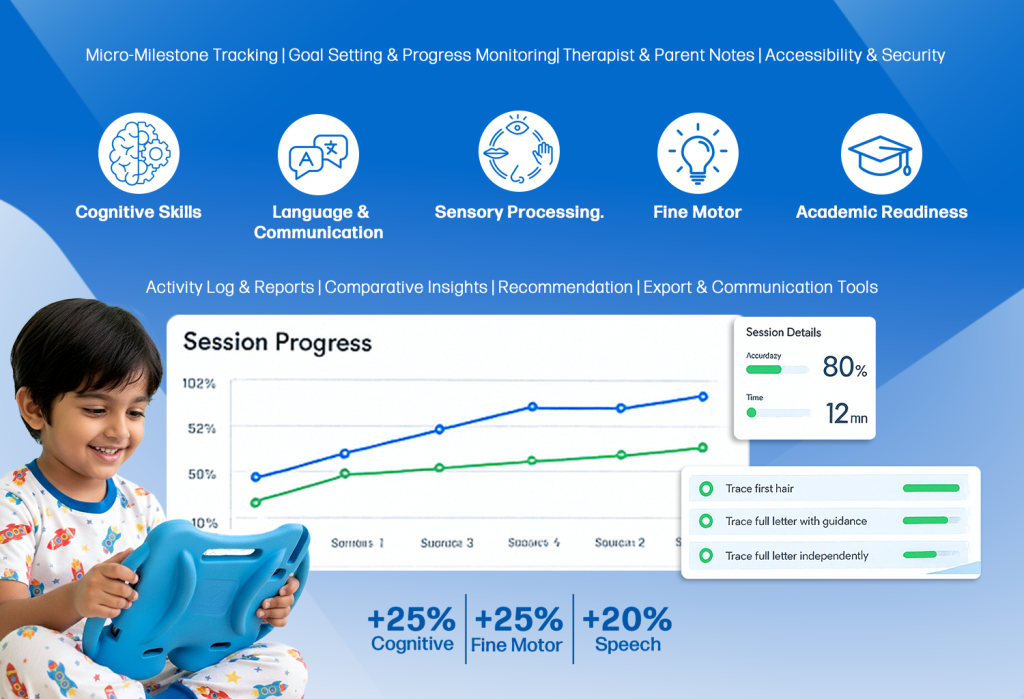
  • Micro-Milestone Tracking: Break skills into smaller steps (e.g., tracing one letter before a full word).
  • Domain-Specific Observation: Track 8 domains: Cognitive, Speech & Language, Fine Motor, Social-Emotional, Gross Motor, Adaptive, Sensory, Executive Functioning.
  • Actionable Insights: Identify strengths, gaps, and next steps to drive effective action.
  • Dynamic Adjustment: Tailor learning paths based on real performance.
  • Collaborative Reporting: Share structured insights with therapists, educators, and parents.

Step 1: Establish Baseline Performance  

How to:

  • Observe the child without guidance or prompts.
  • Note accuracy, completion time, hesitation, and strategies.
  • Repeat the activity over 2–3 sessions to capture fluctuations.

Example:

During a 3-step sequencing activity:

  • Step 1: The child arranges two steps correctly → Success.
  • Step 2: Hesitation on the third piece → Partial understanding.
  • Step 3: Requires prompt or visual cue → Support needed.

Outcome: Clear understanding of strengths, weaknesses, and attention patterns.

Step 2: Select Domain-Specific Activities  

  • Objective: Cover all 8 developmental domains for holistic assessment.
  • Domains and Example Activities:
    • Cognitive Skills: Memory matching, sequencing, problem-solving, puzzles
    • Speech & Language Skills: Vocabulary repetition, sentence formation, storytelling
    • Fine Motor Skills: Tracing, stacking blocks, drag-and-drop tasks
    • Social-Emotional Skills: Emotion recognition games, turn-taking activities
    • Gross Motor Skills: Hopping, balance exercises, obstacle courses
    • Adaptive Skills: Dressing, hygiene routines, pouring tasks
    • Sensory Skills: Tactile sorting, sound discrimination, colour/shape sorting
    • Executive Functioning: Multi-step tasks, sorting and organizing, planning exercises

Example: During a cognitive session, a child may complete memory matching correctly but takes excessive time sequencing steps. This reveals processing speed vs. memory capacity differences.

Outcome: Identify which domains need reinforcement and tailor learning paths accordingly.

Step 3: Track Micro-Milestones  

  • Objective: With VergeTAB activities powered by the XL Platform, progress becomes easy to observe and interpret.
  • Method: Break every skill into tiny, achievable steps.
  • Example – Fine Motor Skills (Tracing Letters):
    • Step 1: Trace the first half of the letter → Support required.
    • Step 2: Trace the full letter with guidance → Improvement noted.
    • Step 3: Trace the full letter independently → Goal achieved.
    • Step 4: Trace letters in sequence to form a word → Skill generalization.
  • Example Tracking Insights (via XL Platform):
    • Accuracy at each step
    • Time taken
    • Errors or repeated attempts
    • Need for assistance

The XL integration captures progress data such as accuracy, timing, and completion rates, while therapists observe engagement and consistency.

Outcome: Insight into attention, fatigue, and readiness for increased task complexity.

Step 4: Analyze Patterns and Trends  

  • Objective: Turn observations into actionable insight.
  • Observation Focus:
    • Which skills consistently improve
    • Which skills slow down
    • How attention, fatigue, or motivation affects performance

Scenario Examples:

  • During fine motor sessions, a child may trace letters accurately in the morning but struggle in the afternoon. This highlights attention and fatigue patterns, guiding therapists to schedule challenging tasks during peak focus hours.
  • In a social-emotional activity, a child may struggle during group play but engage confidently in one-on-one interactions. This reveals social processing sensitivity and suggests a gradual approach to group participation.
  • In speech therapy, a child may pronounce words clearly during repetition exercises but lose articulation when forming full sentences. This highlights challenges in linguistic integration, guiding focus toward structured sentence-building tasks.

Outcome: Smarter scheduling, tailored strategies, and data-driven insights.

Step 5: Adjust Learning Paths Dynamically  

  • Objective: VergeTAB activities allow flexible adaptation based on how children perform.
  • Methods:
    • Increase difficulty for mastered skills
    • Provide additional scaffolding for lagging skills
    • Adjust the mix of activities per session based on attention and engagement

Example: If sequencing tasks are challenging, start with simpler patterns before progressing. If fine motor control lags, integrate tactile tracing activities.

Outcome: Dynamic, personalized learning paths that evolve with the child.

Step 6: Share Structured Reports for Collaborative Intervention  

  • Objective: When VergeTAB is used alongside the XL Platform, progress reports can be shared with therapists, educators, and parents to ensure cohesive support.
  • Report Components:
    • Step-by-step skill mastery
    • Session-by-session performance metrics
    • Suggested next steps for each domain

Scenario Examples:

  • A child shows plateauing in executive function tasks → therapists can implement focused planning exercises in therapy sessions.
  • Parents notice attention dips in multi-step cognitive tasks → adjust home sessions for shorter, frequent practice.
  • Social-emotional challenges in group settings → teachers can provide structured peer interactions.

Tip: Schedule weekly or monthly review sessions with educators and therapists to align strategies and track progress collaboratively.

Outcome: Everyone supporting the child is coordinated and informed, interventions are cohesive across home, therapy, and school, and child growth is measurable and actionable.

Step 7: Involve Parents in Ongoing Development  

Objective:

Parents play a vital role in reinforcing therapy outcomes. With VergeTAB, they can continue structured learning at home, ensuring that progress made during sessions extends into daily routines.

Observation & Involvement:

Through the XceptionalLEARNING (XL) Platform, parents can view session highlights, track micro-milestones, and observe behaviour or attention patterns. They’re encouraged to record contextual insights — such as the time of day, environment, or mood — that may influence their child’s performance.

Scenario Examples:

  • A parent notices their child’s focus drops after meals. Therapists use this insight to adjust session timing for improved attention.
  • A child demonstrates strong memory recall but hesitates with fine motor tasks. Parents include short, guided exercises at home to strengthen coordination.
  • During weekend social play, a child struggles with turn-taking. Parents coordinate with teachers to practice similar activities at school, reinforcing social-emotional growth.

Tip: Parents can submit weekly observations through the XceptionalLEARNING Platform, allowing therapists and educators to review real-life insights and adapt upcoming sessions.

Outcome: Therapy becomes personalized, consistent, and family-centered, minimizing regression and accelerating developmental progress by bridging home and classroom learning.

Step 8: Turning Data into Development  

The integration of VergeTAB with XceptionalLEARNING transforms daily learning into measurable developmental progress. Each activity — from sequencing puzzles to tracing letters — captures growth across eight developmental domains: Cognitive, Motor, Speech, Social, Emotional, Sensory, Behavioural, and Academic.

Structured assessments reveal:

  • Which domains show the fastest improvement?
  • Areas that require additional support
  • Patterns of long-term developmental growth

Example: Three-Month Progress Snapshot

  • Cognitive Skills: +25% accuracy in sequencing puzzles
  • Fine Motor Skills: +30% improvement in tracing tasks
  • Social-Emotional Growth: Better turn-taking and peer collaboration
  • Speech Fluency: +28% improvement in sentence formation
  • Memory Retention: +18% increase in recall during sequencing activities

Outcome: Therapists and educators can design evidence-based, data-driven developmental plans that respond to real-world performance, not just dashboard numbers.

In real therapy and classroom environments, these skills are practiced using VergeTAB in a controlled, distraction-free setup designed specifically for special education and therapy use. Schools and clinics use VergeTAB along with XceptionalLEARNING to ensure structured skill development and measurable progress.
See how VergeTAB works in real sessions

Why This Approach Works  

By using this structured, observation-driven model:

  • Children gain measurable progress across all 8 developmental domains.
  • Parents and educators receive actionable insights into learning behaviours and gaps.
  • Interventions are personalized, goal-directed, and adaptive.
  • Consistent tracking ensures targeted growth rather than generalized progress.

Real Example: A child who once struggled with multi-step cognitive tasks can now complete 4–5 steps independently — confidently participating in group learning and activities.

Practical Tips for Milestone Tracking  

  • Break skills into micro-milestones (e.g., tracing letters before full words)
  • Track progress session by session in XL, not just weekly
  • Focus separately on strengths and gaps for each domain
  • Adjust learning paths based on actual performance
  • Share milestone reports with therapists or educators for integrated intervention

Next Steps & Contact  

If your school or clinic is looking for a practical way to track developmental milestones while building essential skills using a dedicated therapy device, VergeTAB provides a safe, guided, and distraction-free digital environment built specifically for special education and therapy.
Request a VergeTAB Demo
Talk to our team on WhatsApp for institutional enquiries

How VergeTAB Builds Self-Directed Learning Skills in Therapy Sessions 

Reading Time: 4 minutes

Clinically Reviewed by

Meha P Parekh

Special Educator, Digital Practitioner – SPED

In therapy sessions and special education classrooms, therapists and educators often notice that children struggle to learn independently. Many children wait for constant instructions, lose focus quickly, or depend heavily on adult guidance to complete even simple tasks.

Traditional worksheets and generic learning apps do not effectively build self-directed learning because they lack structure, guided progression, and measurable reinforcement.

VergeTAB, used together with the XceptionalLEARNING platform, is implemented in schools and therapy clinics to deliver distraction-free, goal-based digital activities that help children gradually develop self-directed learning skills through structured practice and guided independence.
Talk to our team on WhatsApp

Why Self-Directed Learning is Essential for Children  

The traditional teacher-centered approach often limits children’s ability to engage meaningfully with learning materials. In contrast, self-directed learning empowers children to:

  • Take ownership of their learning
  • Build decision-making and problem-solving skills
  • Enhance curiosity and a love for learning
  • Develop confidence and self-reliance
  • Reflect on progress and self-evaluate

Research in child development shows that children who engage in SDL are more likely to demonstrate better academic performance, improved social skills, and enhanced emotional regulation. SDL prepares children not just for classroom success, but for everyday challenges.

VergeTAB: The Ideal Tool for Self-Directed Learning 

VergeTAB, combined with the XceptionalLEARNING platform, offers a unique, streamlined learning environment that eliminates common distractions found on traditional tablets. It provides:

  • Customizable therapy activities tailored to individual needs
  • Real-time progress tracking and feedback
  • Limits how long and how often a child can do each activity.
  • Goal-setting and achievement markers.
  • No access to other apps and websites.
  • Integration with Individualized Education Programs (IEPs)

By shifting from an instructor-led approach to a child-led experience, VergeTAB transforms therapy sessions into interactive, self-paced, and rewarding learning journeys.
Chat with our team on WhatsApp for guidance

Innovative Self-Directed Learning Activities with VergeTAB 

1. Challenge Wheel: Spin and Learn  

In this fun and spontaneous activity, children spin a virtual challenge wheel to select from a variety of tasks such as language puzzles, fine motor challenges, memory games, or academic exercises. The randomness of the wheel adds excitement and unpredictability to learning.

Skills Developed:

  • Spontaneous decision-making
  • Adaptability and flexibility
  • Self-motivation

Therapist Tip: Customize the sections of the wheel according to the child’s developmental goals, making it versatile for different therapy domains.

2. Skill Adventure Maps  

Children use an adventure map where they can click or tap on fun places like Memory Mountain or Language Lake. Each place has different games or challenges just for them, making learning playful and easy to follow.

Skills Developed:

  • Sequential planning
  • Long-term goal setting
  • Self-paced progression

Bonus: Children earn virtual badges as they complete challenges, encouraging them to seek continuous improvement.

3. Build-Your-Day Planners  

Children manage their own therapy schedule by choosing activities like speech tasks, occupational exercises, academic games, and sensory breaks. They decide how much time to spend on each, giving them control over their daily learning routine

Skills Developed:

  • Time management
  • Self-organization
  • Responsibility for personal routines

Parental Involvement: This activity can be extended to home routines, helping children plan their daily activities independently.

4. Choice-Based Story Adventures  

In this activity, children help guide a story by making choices for the characters at important moments. For example, they might decide if a character helps a friend or finishes a task first, and the story changes based on what they pick

Skills Developed:

  • Consequential thinking
  • Moral reasoning
  • Empathy development

Therapist Tip: Engage children in post-story discussions, encouraging them to reflect on their choices and outcomes.

5. Do-It-Yourself Reward Designer

Children create their personalized reward system by choosing their virtual incentives, such as activating new themes, customizing avatars, or accessing fun mini-games after completing goals.

Skills Developed:

  • Personal goal ownership
  • Motivation reinforcement
  • Delayed gratification

Therapist Tip: Guide children to set realistic, achievable goals and select meaningful rewards that align with their interests.

6. Independent Exploration Zones  

VergeTAB provides open-ended exploration areas where children can engage in unstructured learning activities like digital drawing, sound exploration, or sensory interactions. These zones encourage curiosity and creativity.

Skills Developed:

  • Creative expression
  • Exploratory learning
  • Independent engagement

Parental Use: Parents can use these zones during free play at home to promote autonomous exploration.

7. Self-Paced Mastery Levels  

Children work through progressively challenging levels within a specific skill set, such as phonics, sequencing, or maths facts. They determine when they are ready to advance to the next level, promoting self-assessment.

Skills Developed:

  • Self-evaluation
  • Confidence in skill mastery
  • Personal goal progression

Bonus Feature: Reflection checkpoints encourage children to articulate their readiness to advance, promoting metacognitive skills.

8. Reflection Galleries  

Children compile a digital portfolio showcasing their proud moments, favourite tasks, and successful completions. This gallery can include screenshots, audio clips, and drawings.

Skills Developed:

  • Self-recognition
  • Reflective thinking
  • Confidence boosting

Therapist Tip: Review the Reflection Gallery periodically to celebrate progress and set new targets.

In real therapy and classroom environments, these skills are practiced using VergeTAB in a controlled, distraction-free setup designed specifically for special education and therapy use. Schools and clinics use VergeTAB along with XceptionalLEARNING to ensure structured skill development and measurable progress.
See how VergeTAB works in real sessions

Extending Self-Directed Learning Beyond Therapy  

The skills children develop through SDL activities on VergeTAB translate seamlessly into real-life situations:

  • Academic Skills: Children transfer time management and planning to school assignments.
  • Daily Routines: Self-planning and sequencing skills help with morning routines and household chores.
  • Social Development: Choice-making and reflective thinking improve interpersonal relationships.

Families and educators can use VergeTAB to foster consistency across home, school, and therapy settings, ensuring that children apply SDL strategies in multiple environments.

The Therapist’s Role: Guiding, Not Directing  

In the SDL model, therapists shift from traditional directive roles to facilitators of learning. They:

  • Guide children through goal-setting
  • Offer choices and encourage autonomy
  • Prompt self-reflection and self-monitoring
  • Celebrate child-led achievements

This approach increases therapy engagement, reduces frustration, and empowers children to take charge of their progress.

Conclusion 

Therapy becomes more meaningful when children lead the way. If your school or clinic is looking for a practical way to build self-directed learning skills using a dedicated therapy device, VergeTAB provides a safe, guided, and distraction-free digital environment built specifically for special education and therapy.
Request a VergeTAB Demo
Talk to our team on WhatsApp for institutional enquiries

Algebra Is Confusing for Many Students—How VergeTAB Makes It Visual and Easy to Understand

Reading Time: 6 minutes

Clinically Reviewed by

Ann Mary Jose

Special Educator

In classrooms and therapy sessions, many children struggle to understand algebra because it feels abstract, symbolic, and disconnected from real-life meaning. Letters, variables, and equations can easily confuse learners, especially those with learning difficulties.

Traditional teaching methods often rely on memorization rather than helping children see how algebra works, which leads to frustration and low confidence.

VergeTAB, used together with the XceptionalLEARNING platform, is implemented in schools and therapy centers to provide distraction-free, goal-based digital activities that make algebra visual, interactive, and easier to understand through guided practice.
Talk to our team on WhatsApp

Why Algebra Matters 

  • Builds reasoning by helping children understand relationships between numbers.
  • Encourages problem-solving through breaking complex problems into steps.
  • Supports higher learning and real-world applications.
  • Develops abstract thinking beyond counting to working with unknowns.

Below, we explore how algebraic concepts can be taught step by step, moving from traditional problem-solving methods to VergeTAB’s unique visual approach, thus ensuring children not only solve problems but also understand and apply concepts in daily life. 

Why Visualization Matters in Special Education Mathematics

Children with special needs often process information differently. Visualization helps them connect concepts, repeat learning safely, and gain confidence.

  • Makes abstract concrete
    • Numbers and symbols become stories, objects, and interactive activities.
    • Patterns appear as colourful sequences that children can move, hear, or build.
    • Algebra shifts into balance puzzles rather than intimidating equations.
  • Reduces mathematical-related anxiety
    • Learning feels like discovery and play instead of pressure.
    • Mistakes are reframed as learning opportunities, not failures.
  • Supports therapy goals
    • Strengthens attention, sequencing, memory, and problem-solving.
    • Builds confidence in parallel with academic skills.

Skills like attention to detail, conceptual understanding, confidence with abstract ideas, step-by-step reasoning, and growing independence are strengthened through this process.

Why VergeTAB Stands Out 

  • Blank Tablet, Focused Learning: No distractions, only therapy-based activities.
  • Therapy-First Design: Integrates with XceptionalLEARNING platform, aligned with developmental goals.
  • Safe Environment: Children learn at their own pace, gaining confidence with instant visual feedback.

With VergeTAB, children can approach and solve algebraic problems more effectively and independently, supported by visualization and therapy-aligned design.
Chat with our team on WhatsApp for guidance

1. Understanding Algebraic Thinking Through Patterns 

Standard Mathematical Approach (Paper Method)  
  •  Complete the sequence 3, 6, 9, __, 15.
    • Step A — Observe: Difference between terms is +3.
    • Step B — Rule Formation: Each number increases by 3.
    • Step C — Solve: 9 + 3 = 12. The missing term is 12.
How VergeTAB Makes It Visual  
  • Initial Presentation:
    • Activity “Hop by Three” shows tiles 3, 6, 9, __, 15.
    • Audio prompt: “What number comes next if we keep adding three?”
  • Scaffolding:
    • Model Rule: Animation highlights +3 hops with voice cues.
    • Guided Attempt: Child drags candidate tiles (10, 12, 13). Wrong choice = gentle feedback.
    • Self-Correction: Correct answer (12) reinforced with sparkle and audio.
Generalization Example:
  • Problem: Start at 4 and add three—find the next three numbers.
    • Paper solution: 4, 7, 10, 13.
    • On VergeTAB:
      • Animation hops +3 from 4 onward.
      • The child fills in the missing tiles step by step.
      • Device logs accuracy and time for therapist review.

Skills Developed: sequencing, pattern recognition, attention, and rule extension

2. Introducing Variables in Simple Algebra  

Standard Mathematical Approach (Paper Method)  
  • Problem Example: Solve x + 4 = 7.
    • Step A: Unknown + 4 =7.
    • Step B: Subtract 4 from both sides → x = 3.
How VergeTAB Makes It Visual  
  • Initial Presentation:
    • Blank slot shows equation: □ + 4 = 7.
    • Audio prompt: “What number should go here to make seven?”
  • Scaffolding:
    • Concrete Visuals: 7 objects shown; 4 highlighted; gap remains.
    • Guided Attempt: Options (2, 3, 5). Wrong = mismatch animation.
    • Self-Correction: Correct choice (3) completes the set with reinforcement.
Generalization Example:
  • Problem: Solve x + 5 = 9.
    • Paper method: 9 – 5 =4, so x = 4.
    • On VergeTAB:
      • The basket shows 9 fruits, 5 highlighted, 4 missing.
      • Child drags 4 into a blank tile.
Complex Problem (10–12 yrs):
  • Problem: Solve x – 7 =15.
    • Paper method: Add 7 to both sides → x = 22.
    • On VergeTAB:
      • Shows 15 objects + missing section labeled “7 more.”
      • Child explores until the total = 22.

Skills Developed: balancing, logical reasoning, and fluency with basic equations

3. Applying Algebra to Real-World Word Problems  

Standard Mathematical Approach (Paper Method)  
  • Sara has 5 apples. She buys x more. Now she has 8. How many did she buy?
    • Step A: 5 + x = 8.
    • Step B: Solve → x = 3.
How VergeTAB Makes It Visual  
  • Initial Presentation:
    • Sara’s basket has 5 apples; the target basket shows 8.
    • Blank slot for missing apples.
  • Scaffolding:
    • Model: Animation adds apples.
    • Guided Attempt: Options 2, 3, 4. Wrong = incomplete basket.
    • Self-Correction: Correct = 3 apples, audio reinforcement.
Generalization Example:
  • Problem: Tom has 10 balloons, gives away y, now he has 6. How many did he give away?
    • Paper method: 10 – y = 6 → y = 4.
    • On VergeTAB: Balloons disappear one by one until 6 remain; the child fills in the missing value.
Complex Problem (10–12 yrs):
  • Problem: A toy costs 25. You pay with a 50 note. How much change do you get? Represent with algebra.
    • Paper method: 50 – x = 25 → x = 25.
    • On VergeTAB:
      • Coins animate dropping into slots.
      • Child drags “25” as the missing change.

Skills Developed: bridges real-life problem-solving with algebra, strengthens symbolic thinking, and builds practical independence.

4. Building Multi-Step Algebraic Reasoning  

Standard Mathematical Approach (Paper Method)  
  • Solve 2x + 3 = 9.
    • Step A: Subtract 3 → 2x = 6.
    • Step B: Divide by 2 → x = 3.
How VergeTAB Makes It Visual  
  • Initial Presentation:
    • Shows two baskets + 3 =9 total.
    • Audio: “What number in each basket makes this true?”
  • Scaffolding:
    • Model: Visual objects split across two baskets + extras.
    • Guided Attempt: Options for x (2, 3, 4). Wrong = mismatch.
    • Self-Correction: Correct = x = 3, animation confirms.
Generalization Example:
  • Solve 3x + 2 = 11.
    • Paper method: 3x = 9 → x = 3.
    • On VergeTAB:
      • Three baskets + 2 extra = 11.
      • The child distributes objects equally.
Complex Problem (10–12 yrs):
  • Solve 4x – 5 = 15.
    • Paper method: 4x = 20 → x = 5.
    • On VergeTAB:
      • The visual shows 4 groups with 5 removed.
      • Child adjusts until balanced at 15.

Skills Developed: multi-step reasoning, abstract manipulation, and confidence with symbolic equations.

In real therapy and classroom environments, algebra concepts are practiced using VergeTAB in a controlled, distraction-free setup designed specifically for special education and therapy use. Schools and clinics use VergeTAB along with XceptionalLEARNING to ensure structured skill development and measurable progress.
See how VergeTAB works in real sessions

Real-Life Applications of Algebra for Children with Special Needs  

  • Budgeting: Counting how much money is needed if an item costs x and they already have some money.
  • Time Management: Solving “If school starts in 30 minutes and it takes y minutes to get ready, how much time is left?”
  • Social Skills: Predicting outcomes like “If three friends each bring x toys, how many toys are there in total?”
  • Daily Routines: Understanding sequences: “If brushing takes 5 minutes and breakfast takes x minutes, the total is 20. How long is breakfast?”

Makes algebra functional by connecting problem-solving to everyday independence, confidence, and adaptive skills.

Practical Tips for Parents, Educators, and Therapists  

  • Start small, progress gradually.
    • Begin with colours, shapes, or toys before introducing numbers and letters.
  • Use VergeTAB daily in short sessions.
    • 10–15 minutes of focused activity every day is more effective than occasional long sessions.
  • Encourage exploration over correctness.
    • Mistakes are valuable learning opportunities. VergeTAB’s feedback is gentle and non-judgmental.
  • Blend offline and digital.
    • Reinforce skills with real-life objects like blocks, fruits, or beads alongside VergeTAB activities.
  • Collaborate with therapists
    • The XceptionalLEARNING Platform ensures that progress can be shared and tracked by professionals, making therapy more effective.

Why This Matters for Special Needs Learners  

  • Children with developmental delays often need multiple ways to understand the same idea.
  • By solving the problem first with real-life objects or verbal reasoning, and then visualizing it on VergeTAB, they link thinking to doing.
  • This not only makes mathematics easier but also reduces frustration and builds confidence.

A Tool for Therapists, Educators, and Parents  

VergeTAB does not replace human teaching—it enhances it.

  • For Therapists: Activities are therapy-aligned, reinforcing goals in occupational, speech, or developmental sessions.
  • For Educators: Mathematics lessons come alive, making classroom participation easier for children with delays.
  • For Parents: Families can use VergeTAB at home to practice what was learned in therapy, turning daily life into a learning opportunity.

With XceptionalLEARNING integration, everyone stays connected—progress can be tracked, shared, and celebrated across home, school, and therapy sessions.

Conclusion

Algebra is more than solving equations—it is a way of seeing patterns, balancing relationships, and making sense of the world. If your school or clinic is looking for a practical way to help children understand algebra using a dedicated therapy device, VergeTAB provides a safe, guided, and distraction-free digital environment built specifically for special education and therapy.
Request a VergeTAB Demo
Talk to our team on WhatsApp for institutional enquiries

Using Nature to Teach Real-Life Concepts: How Schools Reinforce Learning with VergeTAB

Reading Time: 10 minutes

Clinically Reviewed by

Ann Mary Jose

Special Educator

Outdoor learning excites children. A walk through the garden, observing leaves, insects, shadows, and soil can spark curiosity in ways a classroom sometimes cannot. But for many children—especially those with learning challenges—the experience stays as a moment of enjoyment rather than turning into retained understanding.

The real challenge for schools and therapists is this: How do you convert what a child sees in nature into concepts they can recognize, recall, and apply later inside the classroom?

This is where VergeTAB becomes part of the learning process. After nature-based activities, schools use VergeTAB with XceptionalLEARNING to guide children through structured, visual activities that reconnect those real-life observations to classroom concepts in a focused, distraction-free environment.
Talk to our team on WhatsApp

Nature + VergeTAB: Real-Life Learning

1. Mathematics

Nature is a natural classroom for numeracy. Therapists and educators can use outdoor exploration to introduce mathematical concepts in a meaningful, hands-on way—and then reinforce them digitally using VergeTAB. 

Step 1: Nature Exploration

Children can explore numbers and patterns through the world around them:

  • Counting & Quantities: Count petals on a flower, stones in a collection jar, or the number of steps from one tree to another. These activities also build spatial awareness and early arithmetic skills.
  • Sorting & Grouping: Group leaves or flowers by color, size, or texture. Then compare—Which group has more? Which has less?
  • Patterns & Sequences in Nature: Identify repeating patterns in leaf veins, petal arrangements, or bark textures. Explore sequences, such as ordering stones from smallest to largest or tracking the stages of a plant’s growth (seed → sprout → flower).
  • Measurement & Estimation: Compare the length of sticks or leaves, estimate the distance between two trees, or measure the length of shadows throughout the day. Children can also make predictions—like which plant will grow taller over the week—and record daily growth.

Step 2: Digital Reinforcement on VergeTAB  

VergeTAB allows therapists to extend these real-life experiences into structured learning:

  • Photo-Based Activities: Use the child’s own photos of nature objects to create number-matching games or visual math problems.
  • Interactive Sorting: Drag and drop pictures of leaves or stones collected outdoors into categories (by size, shape, or color).
  • Pattern Recognition: Build digital replicas of patterns seen in nature using interactive tiles or drawing tools.
  • Measurement Logs: Children can record measurements they took outdoors (like plant height or shadow length) and track changes over time using charts or digital journals.

By grounding math concepts in the real world, VergeTAB helps children internalize abstract ideas through concrete experiences—bridging exploration and learning in a way that’s both intuitive and enjoyable.
Chat with our team on WhatsApp for guidance

2. Science

Science begins with curiosity—and nature provides endless opportunities to spark it. Children naturally observe, question, and explore when they’re outdoors. With gentle guidance, these spontaneous discoveries can lead to foundational scientific thinking.

Step 1: Nature Exploration

Outdoor science activities help children develop observation, inquiry, and reasoning skills:

  • Observation & Recording: Watch a caterpillar crawl, follow an ant trail, or notice how leaves change color. Children can take photos or make simple sketches to track changes in size, shape, or position over time.
  • Tracking Changes: Measure plant growth each day, observe shadow movement, or monitor how rain affects soil or puddles. Children begin to notice patterns and cycles in the natural world.
  • Cause & Effect: Compare plant growth in sunlight vs. shade. Water one plant and leave another dry. Talk about why one grows faster—building an early understanding of scientific reasoning.
  • Environmental Awareness: Observe how animals react to sound, how weather affects behavior, or how plants change with the seasons—nurturing awareness of interconnected systems.

Step 2: Digital Reinforcement on VergeTAB

VergeTAB helps turn field observations into structured, meaningful learning:

  • Sequencing with Personal Media: Use photos taken by the child to arrange life cycles (e.g., seed → sprout → plant → flower) or daily changes in a tracked plant.
  • Categorization Activities: Sort leaves, insects, or rocks by type, color, or texture using interactive drag-and-drop tools based on what the child collected or observed.
  • Reflection & Review: Rewatch videos of insect behavior or time-lapse recordings of plant growth. Add voice notes to describe what was seen—encouraging expressive language and reasoning.
  • Scientific Journaling: Children can maintain a digital nature journal—adding photos, short captions, and drawings to document and reflect on their discoveries.
  • Prediction & Hypothesis Practice: Engage in guided activities that ask, “What do you think will happen next?” based on their past outdoor observations.

With VergeTAB, science is not limited to a textbook—it becomes a cycle of seeing, thinking, recording, and reflecting, all grounded in the child’s lived experiences in nature.

3. Language & Communication

Nature is full of language opportunities—if we know how to pause and listen. Outdoor experiences naturally spark conversations, storytelling, and non-verbal communication, making them an ideal environment for building language skills.

Step 1: Nature Exploration

In a natural setting, children are surrounded by rich sensory input that fuels vocabulary development and expressive language:

  • Learning Environmental Words: Identify and name things like birds, trees, clouds, flowers, and textures (“soft leaf,” “smooth rock,” “buzzing bee”).
  • Describing Sensory Experiences: Talk about what they hear, see, and feel—“The bird is chirping,” “The wind is strong,” or “The water is cold.”
  • Labeling & Expressing Preferences: During play or walks, children can label what they collect (“This is a red flower”) and express likes/dislikes (“I like the tall tree”).
  • Asking Questions & Storytelling: Encourage children to ask and answer questions about their surroundings—“Why is the leaf brown?”—or build simple nature-based stories.
  • Non-Verbal & Gestural Communication: Pointing, signing, imitating animal sounds, or using facial expressions to show surprise or joy all contribute to early communication, especially for children with limited verbal skills.

Step 2: Digital Reinforcement on VergeTAB  

VergeTAB builds on these natural language moments by turning them into interactive, personalized learning tools:

  • AAC Support (Augmentative & Alternative Communication): For children with limited verbal skills, VergeTAB supports image-based communication. Children can match symbols to real-life objects they saw outside, or build short phrases like “big red flower” using voice-output tools.
  • Photo-Prompted Vocabulary Practice: Use the child’s own photos from outdoor exploration to label objects, describe settings, and practice new words—making vocabulary learning meaningful and contextual.
  • Story Creation Tools: Build simple digital storybooks using pictures or videos taken during nature walks. Children can narrate or caption their experiences (“First, I found a leaf. Then I saw a butterfly.”).
  • Sentence Building Activities: With therapist-guided prompts, children can practice constructing descriptive or sequential sentences using real-life visuals (“The ant is crawling under the leaf”).
  • Reflective Language Practice: Children can revisit their nature experiences through voice recordings or written reflections, strengthening memory, comprehension, and expressive language.

By anchoring language learning in real-world exploration and reinforcing it digitally, VergeTAB helps children build communication skills that are functional, expressive, and rooted in personal experience—not just rote vocabulary.

4. Life Skills  

Outdoor environments offer the perfect setting for children to practice everyday responsibilities in a low-pressure, engaging way. These real-life tasks help children develop independence, self-regulation, and confidence—especially when reinforced consistently across settings.

Step 1: Practical Outdoor Tasks

Simple daily activities in nature can become powerful learning experiences:

  • Gardening & Plant Care: Watering plants, weeding, or harvesting herbs teaches responsibility and routine.
  • Outdoor Clean-Up: Tidying up after play—returning toys, collecting litter, or putting tools away—builds organization and task completion.
  • Safety Skills: Learning to stay on paths, avoid hazards, or follow directions in a park reinforces safety awareness.
  • Routine Awareness: Activities like taking turns on a swing or waiting during group walks encourage patience and social cooperation.
  • Sorting & Organizing: Grouping collected leaves, stones, or sticks by size or color fosters categorization, planning, and attention to detail.

Step 2: Digital Support on VergeTAB

VergeTAB helps children track and reinforce these real-world life skills through structured, visual tools:

  • Visual Schedules & Checklists: Use customizable visual guides to help children follow multi-step outdoor routines (e.g., “Water plants → Wipe hands → Put away tools”).
  • Task Logging & Reflection: After completing a task, children (or adults with them) can log it using photos or icons—creating a digital record of consistency and effort.
  • Motivational Tools: Award stars, badges, or visual tokens for milestones like completing a full garden routine or following safety rules independently.
  • Therapist & Caregiver Prompts: Professionals can set up reminders, rewards, or step-by-step visual aids to encourage repetition and support mastery over time.
  • Progress Tracking: Over days and weeks, both caregivers and children can look back at completed tasks, reinforcing a sense of achievement and routine.

With VergeTAB, life skills become visible, repeatable, and rewarding—bridging the gap between doing something once outdoors and making it part of a consistent daily habit.

5. Social & Emotional Learning (SEL)  

Nature naturally creates moments that help children understand themselves and others. Whether it’s sharing a discovery, waiting for a turn, or feeling joy at spotting a butterfly—these moments are opportunities to build social and emotional skills that last.

Step 1: Peer Interaction & Emotional Awareness in Nature

Outdoor play provides space for social learning in a relaxed and less structured setting:

  • Sharing & Cooperation: Children can collect leaves or stones together, take turns in nature games, or help each other on uneven ground—fostering teamwork and collaboration.
  • Reading Emotions: In open play, children begin to notice and respond to peers’ facial expressions, body language, and tone of voice—learning social cues naturally.
  • Conflict Resolution: Disagreements over toys or turns offer chances to practice expressing needs, using calming strategies, or asking for help.
  • Self-Awareness & Regulation: Children may recognize their own emotional triggers (e.g., feeling overwhelmed by noise or excited by discovery) and use nature’s calming elements—like listening to birds or watching leaves move—to self-soothe.
  • Empathy & Perspective-Taking: Watching a friend struggle or succeed allows children to practice responding kindly and understand how actions affect others.

Step 2: Digital Reinforcement on VergeTAB

VergeTAB offers gentle, structured ways to reflect on and reinforce these emotional and social experiences:

  • Mood Journals with Visual Aids: Children can log how they felt during specific moments outdoors using emojis, colors, or simple icons. A photo of the moment (e.g., sharing a toy) can be paired with a feeling word (“happy,” “calm,” “frustrated”).
  • Reflective Storytelling: Use videos or photos from outdoor activities to talk about what happened, how it made them feel, and how they responded—encouraging self-awareness and emotional expression.
  • Guided Prompts for Social Skills: Therapists or caregivers can create digital prompts tied to real events—“What did you do when your friend was sad?” or “How did you feel when you had to wait your turn?”
  • Empathy-Building Activities: Role-play scenarios or emotion-matching games using images from actual peer interactions help reinforce understanding of others’ feelings.
  • Calming Strategy Libraries: Build a personalized collection of nature-based strategies (e.g., “look at the sky,” “deep breaths near the tree,” “sit quietly and listen to birds”) that children can access anytime as part of their self-regulation toolkit.

Through this blend of natural exploration and digital reflection, children develop not only the language to talk about their emotions but also the tools to manage them—and connect more meaningfully with others.

6. Creative Arts: Expression Through Nature

Nature fuels imagination. For children with special needs, outdoor play isn’t just a break from routine—it’s a chance to explore creativity through touch, sound, movement, and storytelling.

Step 1: Creative Exploration in Nature

Natural materials and open spaces invite artistic expression in organic, unstructured ways: 

  • Imaginative Play: Children can collect leaves, stones, or flowers to create characters, props, or settings. Mimicking bird calls or the sound of the wind can evolve into stories or dramatic play.
  • Sensory Engagement: Nature offers a rich palette of colors, textures, and sounds. Children can trace leaves in dirt, sort petals by color, or arrange stones into shapes—stimulating fine motor skills and sensory processing.
  • Storytelling through Movement: Children can act out scenes with found objects, perform spontaneous skits, or even use natural elements to inspire movement-based expression like dance or rhythm play.

Step 2: Digital Art & Storytelling on VergeTAB

VergeTAB allows children to capture, reflect on, and expand their creative experiences through multimedia expression: 

  • Nature-Inspired Drawing & Sketching: Using a stylus or finger, children can sketch the leaves or objects they collected outside, or recreate scenes from their imaginative play. Colors and textures from nature become digital art prompts.
  • Digital Storybooks & Comics: Children can build simple storyboards or visual narratives using their own photos from outdoor adventures—adding drawings, captions, or voice recordings to tell their story.
  • Environmental Sound Collages: Record bird songs, rustling leaves, or water dripping from plants. Children can combine these with images or drawings to create sensory-rich digital collages or music clips.
  • Therapist-Guided Creative Prompts: Therapists can assign storytelling themes like “A Day in the Forest” or “My Leaf Collection’s Adventure,” helping children express thoughts, feelings, and ideas in an imaginative context.

Through VergeTAB, creative expression becomes more than a moment of play—it becomes a structured, meaningful part of therapy. Children explore language, emotion, motor coordination, and storytelling in a way that’s uniquely their own, supported by both nature and technology.

Nature + VergeTAB Integration: Daily Plan

This simple daily routine blends outdoor exploration with digital reinforcement, making therapy feel natural, engaging, and continuous.

  • Morning Exploration
    • Head outdoors to collect leaves, stones, or flowers. This builds sensory tolerance, sparks curiosity, and provides the foundation for later learning.
  • Digital Sorting
    • Take photos of collected objects and sort them on VergeTAB by size, color, or type—reinforcing math, organization, and visual discrimination.
  • Language Practice
    • Encourage the child to record a sentence about what they found (e.g., “This is a big green leaf”)—supporting vocabulary development and sentence building.
  • Creative Expression
    • Use digital tools to trace, color, or draw the collected objects—building fine motor skills and creative confidence.
  • Social-Emotional Reflection
    • Use emojis or simple icons to log how the child felt during the activity—enhancing emotional awareness and self-regulation.

Nature + VergeTAB Integration: Weekly Plan

A week-long schedule helps create rhythm and consistency in learning while keeping each day fresh and varied.

  • Monday: Math & Counting
    • Count stones or leaves during a nature walk → Practice addition or comparison on VergeTAB using photos.
  • Tuesday: Science Observation
    • Watch a caterpillar or plant grow → Log observations and create a digital growth timeline.
  • Wednesday: Language Building
    • Look up at the sky and describe what you see → Record voice notes to build descriptive language.
  • Thursday: Life Skills
    • Water the garden or clean up after outdoor play → Use a digital checklist to mark completed tasks.
  • Friday: Social-Emotional Learning
    • Play with peers or siblings outdoors → Use VergeTAB’s Mood Journal to reflect on feelings and interactions.
  • Saturday: Creative Arts
    • Choose a leaf, flower, or stone to sketch → Create a digital art project inspired by nature.
In a Nutshell

Children with special needs thrive on meaningful, hands-on experiences—but for progress to last, those experiences need structure, consistency, and reinforcement. This is exactly where the Nature + VergeTAB model excels.

  • Therapy feels natural: Outdoor experiences provide motivation and variety; VergeTAB turns them into guided learning opportunities.
  • Consistency matters: Whether at home, school, or in therapy, the same goals are reinforced across settings.
  • IEP goals stay central: Every digital activity can be tailored to support the child’s individualized learning plan.
  • Engagement stays high: Nature stimulates curiosity; VergeTAB helps channel it into meaningful tasks.
  • Progress is visible: Parents, teachers, and therapists can track development over time—making learning transparent and measurable.

Instead of separating play from therapy, this approach blends them—turning everyday moments into stepping stones for communication, regulation, cognition, and creativity. With the right support, every day becomes an opportunity—not just to learn, but to grow with confidence.

Nature creates curiosity. Structured reinforcement creates learning.

By combining outdoor experiences with VergeTAB’s focused digital activities, schools and therapy centers ensure that children don’t just enjoy real-world exploration—they understand it, remember it, and apply it in academic and daily life skills.

If you’re looking for a practical way to bridge real-life learning with structured skill development in special education, VergeTAB offers a purpose-built digital therapy environment designed for exactly this need.
Request a VergeTAB Demo
Talk to our team on WhatsApp for institutional enquiries

Difficulty With Logical Thinking? How VergeTAB Builds Deductive Reasoning in Children

Reading Time: 6 minutes

Clinically Reviewed by

Meha P Parekh

Special Educator, Digital Practitioner – SPED

Many schools and therapy centers face challenges when helping children with learning difficulties develop deductive reasoning and problem-solving skills in a way that is structured, engaging, and measurable.

Traditional tools like worksheets, paper tasks, or general tablets often don’t provide the consistency, focus, or objective tracking that these higher-order thinking skills require.

VergeTAB, used together with the XceptionalLEARNING platform, allows educators and therapists to deliver distraction-free, goal-oriented digital activities specifically designed to strengthen deductive reasoning. This structured environment helps children practice reasoning skills with real-time feedback and consistent session support.
Talk to our team on WhatsApp

Understanding Deductive Reasoning in Special Needs Therapy  

What Is Deductive Reasoning?  

Deductive reasoning allows children to use broad concepts or rules to solve specific problems and make clear conclusions.

Example:

  • General Rule: All mangoes are fruits.
  • Specific Fact: Alphonso is a mango.
  • Conclusion: Therefore, Alphonso is a fruit.

It supports essential thinking skills such as:

  • Pattern matching
  • If-then logic solving
  • Cause-and-effect reasoning
  • Rule-based object sorting

Why Children with Learning Difficulties Struggle

Children with ADHD, Autism, or Processing Delays often face challenges such as:

  • Difficulty linking rules to outcomes
  • Struggles with sequencing and organizing thoughts
  • Feeling overwhelmed by verbal or abstract tasks

How VergeTAB Helps

VergeTAB bridges these gaps through interactive, scaffolded, and visually driven activities, making learning structured, engaging, and accessible.
Chat with our team on WhatsApp for guidance

VergeTAB + XceptionalLEARNING: A Smart Solution  

What Is VergeTAB?  

VergeTAB is a distraction-free therapy tablet that connects seamlessly with XceptionalLEARNING for more focused and engaging sessions. It doesn’t have random games or internet browsing—it is activated only through structured therapy modules.

This lets therapists control:

  • Type of activity
  • Pacing of instruction
  • Visual complexity
  • Positive reinforcement style

Why VergeTAB Works for Reasoning Development  

With VergeTAB:

  • Activities are customizable to reasoning levels
  • Real-time prompts guide logical thinking
  • Progress is tracked for therapist insights
  • Multi-sensory options (visuals, audio, touch) make abstract reasoning accessible

In real therapy and classroom environments, deductive reasoning and problem-solving skills are practiced using VergeTAB in a controlled, distraction-free setup designed specifically for special education and therapy use. Schools and clinics use VergeTAB along with XceptionalLEARNING to ensure structured skill development and measurable progress.
See how VergeTAB works in real sessions

Developing Deductive Reasoning Skills in Therapy Sessions with VergeTAB

Activity 1: Rule-Based Sorting

Goal:

  • Help children identify, apply, and verbalize logical rules through engaging sorting tasks.

How It Works:

  • Children use drag-and-drop activities on VergeTAB to group objects, animals, or shapes into logical categories like “Can fly,” “Lives in water,” or “Has four legs.”

Set up on VergeTAB:

  • Drag-and-drop module with clear visuals.
  • Two to three sorting baskets labeled with simple rule-based categories.
  • Instant feedback after each attempt.

Task Flow:

  • Display 10–12 colourful images on screen.
  • Each basket has a rule label.
  • The child sorts each image based on the rule, with visual and audio prompts.

Benefits:

  • Builds classification skills.
  • Teaches rule application to examples.
  • Develops verbal reasoning through explanations.

Therapy Domains:

  • Speech Therapy: Improves categorization and expressive language.
  • Occupational Therapy: Builds visual-motor coordination and fine motor skills.
  • Special Education: Supports academic logic and classification skills.
  • Behavioral Therapy: Promotes focus and attention to the task.

Therapist Tip: Encourage children to explain their choices aloud, reinforcing verbal reasoning and language use.

Activity 2: Find the Missing Link  

Goal:

  • Improve sequential reasoning by identifying missing steps in sequences.

How It Works:

  • Children complete sequences like life cycles, daily routines, or historical events by identifying the missing step.

Set up on VergeTAB:

  • Drag-and-drop sequence builder with visual storyboards.
  • Multiple-choice or visual options to choose the correct missing step.

Task Flow:

  • Display a 5–7 step sequence with one blank space.
  • Children identify and place the correct missing piece.

Benefits:

  • Strengthens step-by-step reasoning.
  • Develops pattern recognition and predictive thinking.

Therapy Domains:

  • Speech Therapy: Enhances story retelling and sequencing.
  • Behavioral Therapy: Builds logical planning.
  • Special Education: Supports academic sequencing in subjects like science and history.
  • Occupational Therapy: Improves sequential task execution.

Therapist Tip: After finding the missing link, have the child retell the full sequence aloud to reinforce verbal sequencing.

Activity 3: Logic Riddles with Visual Cues  

Goal:

  • Strengthen conditional reasoning using simple if-then logic.

How It Works:

  • Children answer basic logical riddles supported by visual cues.

Set up on VergeTAB:

  • Text and visual riddles with yes/no or multiple-choice answers.
  • Adaptive feedback based on answers.

Task Flow:

  • Present 7–10 riddles.
  • Children select the correct answer and receive immediate feedback.

Benefits:

  • Builds abstract reasoning skills.
  • Trains logical connections between facts.

Therapy Domains:

  • Speech Therapy: Enhances reasoning in verbal responses.
  • Behavioral Therapy: Promotes decision-making skills.
  • Academic Skills: Supports mathematical and scientific logic development.
  • Occupational Therapy: Improves cognitive processing speed.

Therapist Tip: Encourage the child to think aloud before selecting answers to understand their reasoning process.

Activity 4: What Doesn’t Belong?  

Goal:

  • Strengthen comparative reasoning by identifying outliers.

How It Works:

  • Children use logical reasoning to pick the odd one out from four options.

Set up on VergeTAB:

  • Visual cards featuring objects, animals, and items from different categories.

Task Flow:

  • Display four options with one logically inconsistent item.
  • Child selects and explains reasoning.

Benefits:

  • Improves categorization and discrimination skills.
  • Boosts logical reasoning and explanation abilities.

Therapy Domains:

  • Speech Therapy: Supports verbal reasoning and descriptive language.
  • Occupational Therapy: Enhances visual discrimination and scanning.
  • Special Education: Builds logical classification skills.
  • Behavioral Therapy: Encourages self-correction and monitoring.

Therapist Tip: Use prompting questions like “Why is it different?” to build expressive reasoning.

Activity 5: Decision-Based Digital Games

Goal:

  • Teach cause-and-effect relationships through interactive game play.

How It Works:

  • Children make decisions within adventure games where actions affect outcomes.

Set up on VergeTAB:

  • Simple scenario games with choice points leading to varied consequences.

Task Flow:

  • Children play through a scenario, making choices at key points.
  • Immediate feedback shows the results of decisions.

Benefits:

  • Builds decision-making skills.
  • Encourages strategic reasoning and problem solving.

Therapy Domains:

  • Speech Therapy: Encourages verbal reflection on choices.
  • Behavioral Therapy: Promotes responsibility in decision-making.
  • Occupational Therapy: Supports executive functioning and planning.
  • Academic Skills: Reinforces logic in social studies or economics contexts.

Therapist Tip: Pause before decisions and ask, “What do you think will happen?” to train predictive reasoning.

Activity 6: Cause and Effect Scenarios  

Goal:

  • Strengthen real-life predictive reasoning skills.

How It Works:

  • Children watch animated clips of daily situations and select the most logical consequence.

Set up on VergeTAB:

  • Visual-based situations like “forgetting an umbrella” or “running on a wet floor” have multiple-choice answers.

Task Flow:

  • Children select the likely consequence from options and receive corrective feedback.

Benefits:

  • Builds cause-and-effect reasoning.
  • Connects logic to real-life problem-solving.

Therapy Domains:

  • Speech Therapy: Supports cause-and-effect sentence structures.
  • Behavioral Therapy: Trains anticipation of consequences.
  • Occupational Therapy: Reinforces task reasoning for daily routines.
  • Special Education: Links reasoning with social and academic content.

Therapist Tip: Discuss both correct and incorrect options after each response to build critical thinking.

Activity 7: Build-a-Story with Logic Blocks  

Goal:

  • Develop organized thinking through story creation.

How It Works:

  • Children use visual tiles to build simple, logical stories with clear sequence flow.

Set up on VergeTAB:

  • Drag-and-drop story tiles with characters, actions, settings, and endings.

Task Flow:

  • Arrange story blocks in the correct sequence and optionally narrate the story.

Benefits:

  • Boosts story planning, sequencing skills, and creative expression.

Therapy Domains:

  • Speech Therapy: Builds narrative and storytelling skills.
  • Behavioral Therapy: Supports structured thought flow.
  • Academic Skills: Reinforces language arts goals.
  • Occupational Therapy: Develops organizational thinking patterns.

Therapist Tip: Start with guided templates and slowly shift to open-ended storytelling as confidence improves.

Activity 8: Predict the Outcome – Interactive Situations  

Goal:

  • Build practical reasoning about daily decisions.

How It Works:

  • Children explore typical daily situations and choose the correct outcome from options.

Set up on VergeTAB:

  • Visual scenarios like “spending all pocket money on one day” or “staying up too late”.

Task Flow:

  • Scenario shown with options.
  • The child selects an outcome and receives feedback with a reasoning explanation.

Benefits:

  • Enhances decision-making and life skills reasoning.
  • Connects logic to personal responsibility.

Therapy Domains:

  • Speech Therapy: Supports reasoning-based verbal communication.
  • Behavioral Therapy: Guides responsible behavior.
  • Occupational Therapy: Strengthens practical thinking in routines.
  • Special Education: Builds confidence for independent choices in daily life.

Therapist Tip: Use personalized examples from the child’s life to make the reasoning more relevant.

Real-Life Application of Reasoning Skills  

Consistent use of VergeTAB shows improvements across daily environments:

  • At Home: Better routine management and problem-solving.
  • At School, Improved comprehension, sequencing, and academic performance.
  • In Social Settings: Smarter social decision-making and better relationship management.

Tracking Progress: The Role of XceptionalLEARNING  

Each of these VergeTAB activities becomes a data point when linked to XceptionalLEARNING:

  • Real-time scoring for logic accuracy
  • Adaptive level adjustments as reasoning improves
  • Therapist dashboard with visual analytics
  • Parent reports showing cognitive growth

This turns reasoning development into a measurable, iterative process, which is essential for children with learning delays.

Embedding VergeTAB into Daily Therapy Routines  

VergeTAB isn’t just for occasional use—it can be embedded into:

  • Speech sessions: reasoning behind communication.
  • Occupational therapy sessions: logic-based ADL routines.
  • Academic remediation: bridging gaps in logic-based subjects.
  • Behavior sessions: structured reasoning for behavior regulation.

Its flexible interface allows therapists to schedule activities by theme, assign homework, and even go hybrid for remote therapy.

Want to explore how VergeTAB enhances therapy sessions?

Watch our video: Revolutionizing Engaged Learning and Therapy for Children!

Focus Areas / Skills Developed:

  • Engaged learning through interactive digital activities
  • Structured reasoning via step-by-step visual routines
  • Cognitive development including attention, memory, and logic skills

Watch our video: Discover How a Digital Activity Book is Making a Difference in Special Needs Education | ft VergeTAB

Focus Areas / Skills Developed:

  • Self-paced learning with child-led exploration
  • Cognitive engagement using animation and feedback
  • Problem-solving through matching, sorting, and decision-making activities

These features show how VergeTAB boosts reasoning and supports independent learning for children with special needs.

Conclusion: Building Practical Thinking Skills for Life

If your school or clinic is looking for a practical way to build deductive reasoning and analytical thinking skills using a dedicated therapy device, VergeTAB provides a safe, guided, and distraction-free digital environment built specifically for special education and therapy.

Used together with XceptionalLEARNING, VergeTAB helps professionals deliver measurable, goal-oriented digital therapy and learning sessions.
Request a VergeTAB Demo
Talk to our team on WhatsApp for institutional enquiries

Teaching the Five Senses Through Digital Exploration on VergeTAB

Reading Time: 6 minutes

Clinically Reviewed by

Rosmy Saju

Special Educator

Children explore and learn through their five sensessight, sound, touch, taste, and smell—shaping how they think, feel, and communicate. For early learners and children with special needs, sensory experiences are crucial. Traditional methods depend on physical materials, but VergeTAB offers a modern solution. As a blank digital device powered by the XceptionalLEARNING (XL) platform, it delivers focused, therapist-guided sensory activities without distractions. With no built-in apps or games, VergeTAB becomes a fully customizable tool for structured, meaningful sensory learning. Let’s explore how VergeTAB and XL make the five senses come alive while supporting real-world skill acquisition.

Understanding the Five Senses in Early Education  

Before entering into digital tools, it’s important to grasp how each of the five senses plays a vital role in early development:

  1. Sight (Vision) – Crucial for recognizing shapes, colors, objects, faces, and spatial relationships.
  2. Hearing (Auditory) – Helps in language development, emotional tone recognition, and safety awareness.
  3. Touch (Tactile) – To perceive physical contact with our environment through specialized nerve endings in the skin. It encompasses a variety of sensations including pressure, temperature, vibration, and pain.
  4. Taste (Gustatory) –The sense of taste, also known as gustation, is one of the five traditional senses that allows us to perceive flavours in food and other substances.
  5. Smell (Olfactory) – The ability to detect and discriminate between different odors.

Traditional methods rely on direct experience. However, children with sensory processing issues, autism spectrum disorders, or speech and language delays often need modified, repetitive, and guided versions of these experiences. That’s where VergeTAB + XL makes the difference.

1. Sight (Visual Exploration)  

Seeing the World: Helping Kids Make Visual Connections  

Sight is essential for recognition, learning, and navigation. Using VergeTAB, educators can display vibrant images, simple animations, and comparison tasks to help children visually engage with the world around them.

Interactive Activities

  • Color Safari: Show digital images of colourful objects. Ask the child to find something similar in their environment.
  • What’s Missing?: Present two nearly identical pictures. The child identifies what’s changed or is missing.
  • Shape Match: Children drag or point to matching shapes on the screen or in the room.

Practical Use and Applications  

  • Enhances early vocabulary through visual labelling
  • Encourages object recognition and memory recall
  • Develops descriptive language and storytelling skills
  • Promotes participation in classroom routines guided by visuals

Skills Developed  

  • Visual attention, categorization, tracking, and matching

Therapy Domains  

  • Occupational Therapy – for fine motor and perceptual development
  • Visual Perception Therapy – to support object, space, and pattern recognition
  • Speech-Language Therapy – boosting receptive and expressive vocabulary
  • Autism Support Programs – visual cueing to reduce anxiety and support routines

Customizing Visual Learning on VergeTAB  

  • Create “Color Days” where all activities revolve around red, blue, or yellow
  • Build “Shape Explorers” folders to focus on triangles, circles, etc.
  • Use real-world photos submitted by families or therapists for personalized engagement.

VergeTAB helps children see with clarity and purpose, building a strong base for lifelong cognitive growth.

2. Hearing (Auditory Exploration)  

Helping Kids Tune in and Respond to the World Around Them

Sound helps children interpret meaning, follow instructions, and develop language. Through the XL platform, VergeTAB delivers audio clips and sound-based activities that support auditory growth.

Interactive Activities

  • Sound Match Game: Play a sound (like a dog barking) and show a few image options. The child chooses the matching picture.
  • Repeat the Rhythm: Use digital clapping or tapping sounds and ask the child to copy the pattern.
  • Name That Sounds: Play familiar daily sounds and discuss their source and purpose.

Practical Use and Applications

  • Supports understanding of classroom directions and routines
  • Strengthens responses to important cues like alarms or names
  • Improves speech clarity and rhythm in communication

Skills Developed

  • Auditory discrimination, sound categorization, vocabulary development, rhythm imitation, listening comprehension

Therapy Domains

  • Speech-Language Therapy – improving listening and speaking
  • Auditory Integration Therapy – processing and organizing sound
  • Music and Rhythm Therapy – regulating tempo, beat, and pitch recognition

Customizing Auditory Learning on VergeTAB

  • Create folders for “Animal Sounds,” “Household Noises,” or “Outdoor Echoes”
  • Personalize sound activities with voice recordings from parents or teachers
  • Use sound-based storytelling to enhance comprehension and engagement

VergeTAB turns sound into a skill-building experience, helping children develop listening, language, and communication abilities through guided digital exploration.

3. Touch (Tactile Exploration)  

Helping Children Feel Confident with Hands-On Learning

While VergeTAB doesn’t offer tactile feedback, it can guide real-world tactile exploration using visual prompts and activity videos.

Interactive Activities

  • Texture Detective: Show images of bumpy, smooth, or fuzzy items. Provide real samples for the child to touch and describe.
  • Touch & Tell Story: Share a visual story and pause for children to explore related textures (e.g., sand, fabric).
  • Digital Clue, Real Feel: Ask children to find something in the room that feels like the item shown on the screen.

Practical Use and Applications

  • Prepares for handling classroom materials
  • Improves comfort with clothing, food textures, and social touch
  • Builds independence in self-care (e.g., dressing, grooming)

Skills Developed

  • Texture recognition, sensory vocabulary, fine motor coordination, sensory regulation, real-world tactile awareness

Therapy Domains

  • Occupational Therapy – supporting sensory processing and self-help skills
  • Sensory Integration Therapy – developing tolerance and adaptability
  • Developmental Therapy – guiding exploration and self-awareness

Customizing Tactile Learning on VergeTAB

  • Build “Texture Trails” with paired videos and real objects
  • Use themes like “Soft vs. Rough” or “Wet and Dry” for exploration
  • Include family input for familiar tactile experiences like blankets or favourite toys.

VergeTAB bridges the digital and physical, helping children build confident tactile responses and sensory understanding.

4. Taste (Gustatory Exploration)  

Preparing for New Tastes Through Digital Priming

Taste experiences can be intimidating for children with feeding difficulties or sensory sensitivities. VergeTAB helps prepare them by providing visual and emotional context.

Interactive Activities

  • Flavour Explorer: Show digital pictures of food items. Discuss taste profiles—sweet, salty, sour.
  • My Snack Menu: Let the child pick from a digital menu, then match it with real snacks.
  • Taste Talk: Watch a video of someone eating and reacting—discuss how it might taste.

Practical Use and Applications

  • Prepares for trying new foods in therapy or school
  • Encourages food choices and meal planning
  • Reduces picky eating and food-related anxiety

Skills Developed

  • Taste identification, food categorization, vocabulary building (sweet, spicy, crunchy), emotional regulation during meals, independent food choices

Therapy Domains

  • Feeding Therapy – increasing food tolerance and variety
  • Behavioural Therapy – building positive eating habits
  • Speech-Language Therapy – describing food properties and preferences

Customizing Taste Activities on VergeTAB

  • Create themed menus for “Snack Day” or “Fruit Tasting”
  • Use parent-submitted food images for familiarity
  • Pair food videos with reaction-based discussions

VergeTAB makes taste exploration less overwhelming and more engaging, turning mealtime into a structured learning opportunity.

5. Smell (Olfactory Exploration)  

Using Visual Cues to Trigger Olfactory Learning

The smell is closely linked to memory and emotion. While it can’t be experienced directly through a screen, VergeTAB offers visual and narrative cues to guide real-world scent activities.

Interactive Activities

  • Scent & Scene: Show an image (e.g., flowers or coffee) and offer a matching scent to sniff and describe.
  • Memory Smell Game: Display a scene like a kitchen and ask what smells they remember.
  • Guess the Smell: Pair visuals with real scent samples and ask the child to identify them.

Practical Use and Applications

  • Enhances recognition of important smells (e.g., smoke, spoiled food)
  • Builds comfort with daily scents like shampoo, soap, or meals
  • Supports hygiene awareness and safety

Skills Developed

  • Scent identification, memory association, sensory vocabulary, environmental awareness, emotional connection to smells

Therapy Domains

  • Cognitive Therapy – connecting scents to memory
  • Sensory Integration Therapy – improving tolerance and comfort
  • Narrative Therapy – using scents for storytelling and communication

Customizing Olfactory Learning on VergeTAB

  • Use folders like “Kitchen Smells” or “Garden Scents”
  • Include family or cultural scent references
  • Combine with sensory journals to track preferences and emotions

Even abstract senses like smell become meaningful and teachable with VergeTAB—helping children connect scent, memory, and language in a sensory-rich journey.

Weekly Sensory Plan Using VergeTAB + XL
With the XL platform, therapists can create a structured sensory curriculum that aligns with therapy goals:

DaySenseDigital Activities
MondaySightImage puzzles, color games
TuesdayHearingSound ID, musical rhythms
WednesdayTouchTexture hunts, matching prompts
ThursdayTasteDigital food menus, taste talk
FridaySmellScent match, story scents
Weekly Digital Sensory Schedule with VergeTAB + XL Platform

Benefits of Using VergeTAB with XL Platform for Sensory Education
Here’s why VergeTAB + XL stands out:

FeatureBenefit
Distraction-Free TabFocused sessions with no games or external browsing
Custom ContentTherapist-designed for individual therapy goals
Skill-Based LearningTracks progress across sensory and developmental milestones
Remote & Onsite UseIdeal for school, clinic, or home-based therapy
Reusable Digital ModulesCost-effective, sustainable for long-term learning
Key Features of VergeTAB + XL Platform for Therapy Success

Conclusion: Building Senses, Skills, and Confidence Digitally  

Children don’t just learn through listening or watching—they learn through experience. VergeTAB, though a blank device on its own, becomes a rich, engaging sensory learning system when paired with the XceptionalLEARNING platform. From helping a child name colors to encouraging them to try new foods, the combined power of VergeTAB + XL supports:

  • Multi-sensory engagement
  • Cross-domain skill building
  • Personalized, child-centered therapy

Looking to transform sensory learning for your child or students? VergeTAB, an Interactive Learning Device for Children, paired with the XceptionalLEARNING platform, offers a focused, Affordable Therapy Device for skill-building. Contact us today to schedule a demo and see how it fits into your home, clinic, or classroom.

Child Confused with Time, Money, and Measurement? How VergeTAB Makes These Concepts Easy

Reading Time: 5 minutes

Clinically Reviewed by

Meha P Parekh

Special Educator, Digital Practitioner – SPED

In classrooms and therapy sessions, many children struggle to understand everyday concepts like time, money, and measurement. These abstract ideas are difficult to grasp through worksheets or verbal explanations alone, especially for children with learning difficulties.

Without practical, visual, and guided practice, children often memorize without truly understanding how these concepts apply in real life.

VergeTAB, used together with the XceptionalLEARNING platform, is implemented in schools and therapy centers to provide distraction-free, goal-based digital activities that help children visually learn and practice time, money, and measurement concepts in a structured way.
Talk to our team on WhatsApp

Why Time, Money, and Measurement Matter in Life Skills Education  

In traditional education, time, money, and measurement are often introduced as part of the maths curriculum. However, in special education, these topics assume a more functional role—they’re not just academic; they’re life skills.

  • Time helps students understand routines, and schedules, and manage transitions.
  • Money supports budgeting, shopping, and value comparison.
  • Measurement is critical in tasks like cooking, crafting, or gauging distance and size.

VergeTAB gives teachers and therapists a customizable, technology-driven approach to make these concepts visual, interactive, and practical.

What is VergeTAB and Why Is It Effective?  

VergeTAB is a blank tablet designed exclusively to run activities through the XceptionalLEARNING Platform. This means:

  • No external distractions (no open internet/apps).
  • Fully customizable learning environment.
  • Designed by therapists and educators.
  • Supports multisensory learning—visual, auditory, and tactile.

VergeTAB becomes a bridge between digital learning and therapy goals, enabling skills practice in classroom, clinic, or home settings.
Chat with our team on WhatsApp for guidance

Let’s break down how VergeTAB supports each concept with real-world applications.

1. Mastering TIME with VergeTAB

1.1 Routine Management Through Visual Schedules
Tool Used: VergeTAB Visual Planner
Students develop daily structure and routine management using:

  • Drag-and-drop schedule boards with real-life icons.
  • Color-coded time blocks for morning/afternoon/evening activities.
  • Voice alerts for task transitions.
  • Countdown timers to support smooth shifting between activities.

Activity Example:

  • Create a daily routine such as:
    • 8:00 AM – Brush Teeth
    • 10:00 AM – Therapy Session
    • 2:00 PM – Lunch
    • 6:00 PM – Free Play

Skill Focus: Time structuring, self-management
Therapy Integration: Improves planning and sequencing in Cognitive Therapy, supports routine-building in Special Education

1.2 Interactive Clock Activities
Tool Used: Analog-Digital Clock Simulator
Students practice understanding clock formats using:

  • Side-by-side analog and digital clocks
  • Drag-to-set time hands
  • Tap-to-match quizzes
  • Voice prompts for “o’clock,” “half-past,” and “quarter to” concepts

Activity Example:

  • Match 3:30 PM on both analog and digital clocks
  • Set the clock for your next activity.

Skill Focus: Time reading, concept of hour/minutes
Therapy Integration: Supports visual-spatial reasoning in Cognitive Therapy and reinforces daily time understanding in Special Education

1.3 Elapsed Time Challenges
Tool Used: Timeline Builder
Students learn to calculate durations between tasks using:

  • Timeline visuals to map start and end points
  • Drag-and-fill blocks to measure time gaps
  • Story-based prompts (e.g., “Your session starts at 1:00 PM and ends at 1:45 PM”)

Activity Example:

  • Plan your school day and calculate how long each subject lasts.

Skill Focus: Time estimation, working memory
Therapy Integration: Builds executive function and time management in Cognitive and Psychological Therapy

In real therapy and classroom environments, time, money, and measurement skills are practiced using VergeTAB in a controlled, distraction-free setup designed specifically for special education and therapy use. Schools and clinics use VergeTAB along with XceptionalLEARNING to ensure structured skill development and measurable progress.
See how VergeTAB works in real sessions

2. Mastering MONEY with VergeTAB

2.1 Coin and Currency Recognition
Tool Used: Digital Currency Flashcards
Students learn real-world currency concepts with:

  • High-resolution images of coins and notes
  • Tap-to-hear labels and values
  • Sorting and matching games
  • Drag coins to correct value boxes

Activity Example:

  • Sort ₹1, ₹5, ₹10 coins or match ₹100 notes with items of equivalent value.

Skill Focus: Number-value identification, auditory memory
Therapy Integration: Supports vocabulary development in Speech Therapy and visual matching in Occupational Therapy

2.2 Virtual Shopping & Role Play
Tool Used: VergeTAB Digital Storefront
Students simulate shopping tasks using:

  • Customizable item lists with prices
  • Drag currency to complete payments
  • Balance-checking and change-calculation tools
  • Story-based prompts: “You want a sandwich that costs ₹30…”

Activity Example:

  • Buy a toy for ₹60 and a snack for ₹20. Pay ₹100 and calculate the change.

Skill Focus: Mental maths, real-life decision-making
Therapy Integration: Enhances social interaction in Speech Therapy, maths fluency in Special Education

2.3 Budgeting Games
Tool Used: Allowance Tracker
Students practice managing weekly money by:

  • Setting spending limits (e.g., ₹200/week)
  • Choosing from a list of needs and wants
  • Tracking savings and expenses visually

Activity Example:

  • Plan a ₹200 weekly budget: buy a toy, and snacks, and save ₹50.

Skill Focus: Prioritizing, goal planning
Therapy Integration: Reinforces executive control in Cognitive Therapy and money management in Occupational Therapy

3. Mastering MEASUREMENT with VergeTAB

3.1 Comparing Sizes, Weights, and Volumes
Tool Used: Digital Measurement Lab
Students explore measurement using:

  • Interactive rulers, beakers, and digital scales
  • Drag-and-drop objects for weight and size comparison
  • Touch-based responses (“Which is heavier?”)

Activity Example:

  • Measure the weight of a watermelon vs. apple or compare the length of a pencil and crayon.

Skill Focus: Estimation, comparison, sensorimotor response
Therapy Integration: Supports fine motor control in OT, descriptive language in Speech Therapy

3.2 Cooking and Recipe-Based Measurement
Tool Used: Kitchen Maths Simulator
Students follow step-by-step recipes using:

  • Measuring cup visuals (e.g., 250ml milk)
  • Ingredient sequencing
  • Conversions between units (g to kg, ml to L)

Activity Example:

  • Make a sandwich using 2 slices of bread, 10g of butter, and 1 cup of filling.

Skill Focus: Measurement accuracy, step-by-step execution
Therapy Integration: Develops motor planning in Occupational Therapy, sequencing in Cognitive Therapy

3.3 Environmental and Spatial Measurement
Tool Used: Room & Body Measurement Tool
Students apply measurement to surroundings using:

  • Room layout simulations
  • Distance measurement prompts (“How far from your table to the door?”)
  • Height and width estimation of classroom objects

Activity Example:

  • Use digital tape to measure your desk and compare it to your chair.

Skill Focus: Spatial reasoning, observational comparison
Therapy Integration: Strengthens visual-spatial skills in Cognitive Therapy and language structuring in Speech Therapy

Using VergeTAB in Structured Learning Environments  

In Special Schools:  

  • Used to meet IEP-aligned learning and therapy goals.
  • Offers individualized digital activities for skill generalization.
  • Supports both pull-out therapy and group instruction using visual, interactive tools.

In Therapy Clinics:                                                                                                                    

  • Used in Occupational Therapy for fine motor and measurement tasks.
  • Used in Speech Therapy for vocabulary, sequencing, and expressive communication.
  • Used in Psychological Counseling to support planning, self-awareness, and decision-making.

At Home:  

  • Parents can follow structured digital activities assigned by the therapist to extend therapy.
  • The simple interface allows non-verbal or speech-delayed children to engage independently.
  • Reinforces real-life tasks like cooking, money handling, and organization through guided modules.

Benefits of Practical Learning with VergeTAB  

  • Multisensory engagement – touch, sound, visuals.
  • Builds independence and self-confidence.
  • Facilitates real-life application, not just academic mastery.
  • Effortlessly adaptable to match each student’s unique learning speed and capabilities.
  • Fully integrated with XceptionalLEARNING’s therapy-aligned activities.

Sample Weekly Skill Plan with VergeTAB

DayFocus AreaActivityTherapy DomainsSkills Targeted
MonTimeVisual Daily PlannerCognitive, Special EdSequencing, planning
TueMoneyCoin Identification GameSpeech, OTValue recognition
WedMeasurementCompare Object SizesOT, CognitiveEstimation, comparison
ThuTimeElapsed Time TimelinePsychology, CognitiveTime calculation
FriMoneyGrocery Budget SimulationSpecial Ed, SpeechTransaction skills
SatMeasurementRecipe Following TaskOT, CognitiveUnit understanding
SunMixedQuiz + Role-PlayAllGeneralization, mastery
Daily Activities for Skill Growth

Therapist & Educator Tips for Maximizing VergeTAB  

  • Customize regularly: Use the XceptionalLEARNING platform to upload familiar items, routines, or currencies.
  • Use it across subjects: Integrate time/money/measurement into literacy, art, or movement activities.
  • Involve families: Encourage parents to follow up on tablet activities at home.

Conclusion: Building Independence Through Practical Learning

Time, money, and measurement aren’t just academic—they’re vital life tools. With VergeTAB and the XceptionalLEARNING Platform, students with special needs don’t just learn—they experience, interact, and apply. Whether used in therapy centers, schools, or homes, VergeTAB bridges the gap between concept and application. Whether it’s telling time, using money, or measuring ingredients, children develop life-ready skills through immersive, structured activities designed by professionals. By supporting multiple therapy domains VergeTAB becomes more than a device. It’s a tool for building confidence, independence, and real-world readiness.

If your school or clinic is looking for a practical way to help children understand time, money, and measurement using a dedicated therapy device, VergeTAB provides a safe, guided, and distraction-free digital environment built specifically for special education and therapy.
Request a VergeTAB Demo
Talk to our team on WhatsApp for institutional enquiries