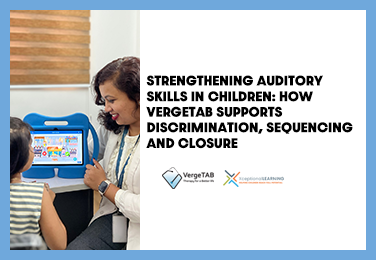
Strengthening Auditory Skills in Children: How VergeTAB Supports Discrimination, Sequencing and Closure
12 Dec 2025

If you spend time in a therapy room, you’ll notice something quickly: children don’t struggle because they’re “not listening”—they struggle because their auditory system is still developing. These skills grow slowly, through guided, repeated experiences.
This is where VergeTAB truly stands out.
Not because it’s flashy.
Not because it’s filled with apps.
It’s the opposite—a blank, distraction-free therapy tablet designed to work only with the XceptionalLEARNING platform.
With structured, therapist-guided activities and no interruptions, VergeTAB supports real auditory progress—not passive screen time.
For many children, developing Auditory Discrimination, Auditory Sequencing, and Auditory Closure can feel like trying to untangle sounds in a noisy world. This blog explores how VergeTAB helps strengthen these essential skills in a clear, practical, and child-friendly way.
The Three Core Auditory Processing Skills
Why Auditory Skills Matter More Than We Realize
Children don’t listen with their ears—they listen with their brains.
And that brain needs structured practice to process sound correctly.
They use three foundational auditory processing skills:
- Auditory Discrimination
The ability to tell similar sounds apart—like p–b or s–sh—and identify everyday noises. - Auditory Sequencing
Understanding the order of words or directions, such as “Pick up the red car and place it on the box.” - Auditory Closure
Filling in missing parts of words, for example “Ba__oon” → balloon.
When these skills are weak, children struggle with:
- unclear speech
- difficulty following instructions
- reading and spelling challenges
- mixing similar words
- frustration during communication
These abilities don’t grow automatically—they strengthen through practice, structure, and repetition. This is exactly where VergeTAB helps, offering a distraction-free, therapist-guided way to build strong auditory processing skills.
Developing Auditory Discrimination with VergeTAB
Auditory discrimination is one of the first areas therapists target because it affects articulation, comprehension, reading, and overall communication.
Many children hear sounds but cannot differentiate between them — which is why they may say “tat” for “cat” or “doap” for “soap.”
VergeTAB strengthens this skill through a clear three-level structure:
Level 1: Environmental & Everyday Sounds
Children begin with familiar real-world sounds:
- animal sounds
- vehicle sounds
- object sounds (bell, whistle, water, tapping)
Why this works:
Kids often identify real sounds more easily than speech sounds. It builds confidence and anchors listening.
Example VergeTAB activity:
“Tap the picture that matches the sound.”
A cow moos → child selects the cow.
Example:
A 5-year-old with autism who rarely responded to spoken words started identifying 8 out of 10 environmental sounds by week three. This small win made him far more attentive during verbal tasks later.
Level 2: Speech-Sound Identification
Children work with minimal pairs such as:
- p / b
- k / t
- s / sh
- f / th
Minimal pairs make children active listeners, not passive hearers.
Therapists frequently observe that once children can hear the difference, their speech clarity improves automatically.
Level 3: Word & Phrase-Level Discrimination
Activities include:
- “Tap the word you heard.”
- “Choose the correct sentence.”
- “Match the phrase to the picture.”
Example improvement:
Week 1: Riya scored 3/10 on “ship–sheep.”
Week 4: She scored 8/10, with better spontaneous speech.
This is the kind of progress therapists love because it reflects real-world changes.
Strengthening Auditory Sequencing with VergeTAB
Auditory sequencing is like building a train—each word is a carriage. If children can’t connect them in order, the message falls apart.
VergeTAB helps children follow instructions, tell stories, and understand routines through structured levels.
Level 1: 1-Step Listening Tasks
Examples:
- “Touch the cat.”
- “Open the door.”
- “Drag the circle.”
These tasks are perfect for early learners or children with short attention spans.
Why this works:
It builds trust — children begin to understand that listening leads to success, which boosts willingness to participate.
Level 2: 2–3 Step Directions
Examples:
- “Touch the apple, then drag the sun.”
- “Circle the dog after you tap the tree.”
The activities provide visual support, helping children match the order of instructions with the order of actions.
Parent feedback:
“This was the first time my daughter didn’t argue during listening tasks. Because VergeTAB feels like play, she didn’t resist.”
Level 3: Complex Verbal Sequences
These tasks include:
- longer instructions
- multiple actions
- spatial concepts
- timing words
Examples:
- “Before touching the flower, drag the kite. After that, circle the duck.”
- “First tap the boy, then the school bag, and finally the bus.”
Therapists frequently see dramatic improvements in classroom participation once children reach this level.
Building Auditory Closure Using VergeTAB
Auditory closure is the brain’s ability to “fill in the blanks.”
Children who struggle with it often:
- get stuck on long/unfamiliar words
- miss meaning in stories
- ask “What?” repeatedly
- seem inattentive (even when trying hard)
VergeTAB strengthens auditory closure through structured, sound-focused tasks.
Level 1: Filling Missing Sounds
Example activities:
- Listen to “ca_” → choose cat
- “_og” → choose dog
VergeTAB reinforces learning through repetition without monotony.
Every activity includes visual support but remains sound-led, ensuring children truly listen and process the missing piece.
Level 2: Word Completion & Prediction
Examples:
- “The story says: ‘The boy ate a man__’. Choose the missing picture.”
- “The girl is flying a k__. What is it?”
These tasks gently strengthen language processing, helping children predict words using both sound clues and meaning.
Level 3: Sentence Prediction
Activities include:
- “At night, we see the s___.”
- “To write, we use a p___.”
This builds practical, day-to-day listening confidence — the type children need in classrooms, conversations, and story time.
Therapist note:
A 7-year-old who previously relied on lip-reading began decoding partial sentences independently after doing closure tasks 3 times a week.
This is the kind of functional, real-world progress VergeTAB consistently supports.
Troubleshooting & Misuse Prevention
Even with strong tools like VergeTAB, progress depends on how the device is used. Here are simple guidelines to prevent misuse and keep therapy effective.
Parents — Avoid:
- letting VergeTAB become an entertainment device
- long, unsupervised sessions
- pushing too hard when frustration appears
- skipping levels too quickly
Therapists — Avoid:
- continuous auditory tasks without breaks
- jumping difficulty levels
- repeating one activity for too long
Ideal Session Length
- Age 3–5: 10–15 minutes
- Age 6–8: 15–20 minutes
- Age 9+: 20–25 minutes
Shorter sessions lead to better retention and lower fatigue, especially for children with auditory processing challenges.
Why VergeTAB Makes Auditory Therapy More Effective
Traditional therapy challenges:
- Children lose interest quickly
- Worksheets lack immediate feedback
- Manual repetition exhausts therapists
- Tracking progress is time-consuming
VergeTAB solves this through structured digital therapy.
What VergeTAB + XceptionalLEARNING Offers
- Auditory Discrimination Modules
- Speech-Sound Minimal Pair Libraries
- Environmental Sound Identification
- Sequencing Pathways
- Auditory Closure Games
- Real-time scores & progress insights
- Customizable sessions
- No ads, no external apps, no distractions
For therapists: reduced workload and clear data.
For children: stable routines and high engagement.
For parents: manageable, structured home practice.
Final Thoughts
Auditory skills don’t develop overnight. But with the right approach—structured, calm, predictable—they grow beautifully.
VergeTAB, an Interactive Learning Device for Children and a Digital Therapy Activity Device paired with XceptionalLEARNING, gives therapists and parents a simple, distraction-free way to build auditory discrimination, sequencing, and closure with real results—not just theory.
Children don’t need more screens.
They need purposeful screens—the kind that support learning, focus, and confidence.
If you’re working with children who struggle to process speech, follow instructions, or stay attentive during sessions, VergeTAB can make therapy smoother and more effective—precisely because it focuses on what matters most: the child, the skill, and the connection between them.
For families and schools looking for the Best Therapy Services With Tab or wanting to explore structured digital therapy tools, our team is here to help.
Contact us to learn more, get guidance, or request a demo.