Digital Storytelling with VergeTAB: Supporting Language and Communication Skills
08 Sep 2026

Written By Keerthy Joselin C
Special Educator
Quick Summary
Digital storytelling can be more than presenting a story through pictures, audio, and a screen. When used purposefully, it can create structured opportunities for children to communicate.
Using VergeTAB, a special educator can build communication moments into a story that encourage learners to choose, request, reject, ask for help, comment, initiate, and respond. Participation does not always have to be verbal — depending on the learner’s abilities, it may happen through words, gestures, pointing, pictures, or augmentative and alternative communication (AAC).
The important question is not simply, “Did the child understand the story?” It is:
“Did the story give the child a meaningful reason to communicate?”
What Is VergeTAB?
VergeTAB is a structured digital learning and therapy device designed to support educators, therapists, and caregivers in delivering purposeful digital activities for children. When integrated with the XceptionalLEARNING platform, VergeTAB can be used with structured visual and interactive activities that support individual learning and communication goals. During a session, the educator or therapist controls the pace, pauses at meaningful moments, observes the learner’s response, and provides support based on the learner’s needs.
A Story Is Playing—but Is the Child Communicating?
During a small-group session in a special school, an educator presents a digital story using VergeTAB. Instead of moving quickly from one page to the next, she pauses at meaningful moments and gives the learners time to respond.
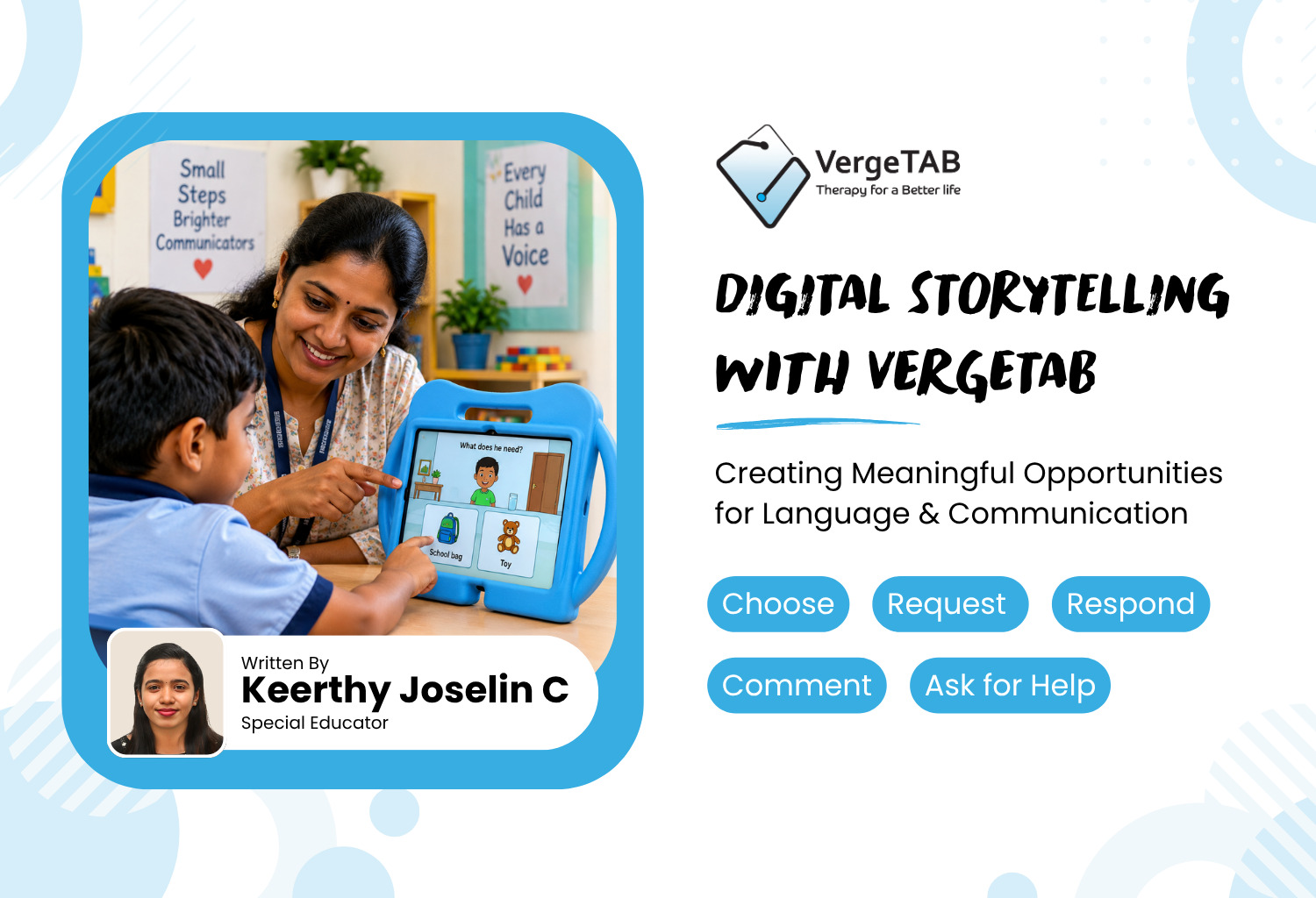
When a school bag and a toy appear on the screen, she asks, “What does he need?” One learner answers verbally, another points to the school bag, and a learner with limited speech touches the correct picture. Later, when the character cannot open a door, the educator pauses and waits. One learner says, “Help,” while another uses a gesture.
Their responses are different, but each learner is actively participating. The story is no longer something they simply watch. It becomes a meaningful communication experience.
What Makes Digital Storytelling Interactive?
Animation and audio alone do not make a story interactive. A child can watch an entire animated story without communicating once.
For digital storytelling to support communication, learners need opportunities to respond to or influence what is happening. A story can intentionally create moments for:
- Requesting — Asking for something they want
- Rejecting — Expressing “no,” “stop,” or “not that”
- Choice-making — Selecting between meaningful options
- Asking for help — Seeking assistance when a problem occurs
- Commenting — Sharing a reaction or observation
- Initiating — Communicating without first being questioned
- Responding — Answering another person’s communication
These are functional reasons people communicate in everyday life. The story provides a structured context for practicing different communication functions, rather than guaranteeing that any single skill will develop.
Start With the Communication Goal, Not the Story
Before choosing a story, the educator should identify the communication skill to be encouraged:
- For requesting, create a situation in which a character needs an object.
- For choice-making, present two meaningful options.
- For asking for help, include a simple problem the character cannot solve alone.
- For rejecting, offer both a preferred and an unsuitable option.
This approach makes the activity purposeful. The story is not the final learning goal — it becomes the context in which communication can happen naturally.
One Story, Different Communication Opportunities
A short VergeTAB story about a child visiting a juice shop can support several of the communication functions above, without changing the story itself:
| Moment in story | Communication function targeted |
|---|---|
| Show two drinks, learner selects one | Choice-making |
| Keep the chosen drink visible, wait | Requesting |
| Offer the wrong drink | Rejecting |
| Show a bottle that won’t open, pause | Asking for help |
| Introduce an unexpected event (e.g., spilled juice) and wait for the learner to communicate | Commenting / Initiating |
One simple story can therefore provide several meaningful reasons to communicate, without requiring every learner to respond in the same way.
Why Pausing and Giving Time Matter
Some children need additional time to understand a situation, decide what they want to communicate, and choose how to respond. Repeating questions or providing immediate prompts can interrupt this process.
A simple interaction sequence can help:
01 Create → 02 Pause → 03 Wait → 04 Observe → 05 Respond
- Create — Introduce a meaningful situation that encourages communication.
- Pause — Avoid completing the interaction for the learner.
- Wait — Give the learner enough processing time.
- Observe — Notice words, gestures, pointing, eye gaze, pictures, or AAC responses.
- Respond — Acknowledge and naturally expand the learner’s message.
For example, if a learner says “Help,” the educator can respond, “You need help. I’ll help you.” This demonstrates that the learner’s communication has been noticed, understood, and responded to.
Educators should avoid immediately repeating questions or adding unnecessary prompts. Additional support, such as a visual choice, verbal model, or gesture cue, can be introduced only when needed. The aim is to provide the minimum support required and gradually reduce prompts as the learner becomes more independent.
This approach is consistent with broader principles of responsive and naturalistic communication teaching, including providing meaningful communication opportunities, allowing processing time, and responding to learner-initiated communication.
One Goal, Different Ways to Respond
Learners in a special school may express the same message in different ways. When asking for help, a learner may:
- Say, “Can you help me?”
- Use a single word such as “Help.”
- Point toward the educator
- Hand over a HELP picture
- Select HELP using an AAC device
Although these responses look different, they serve the same communication purpose. The goal is not to expect every learner to produce the same sentence, but to recognize and understand each learner’s message — then gradually expand the response according to their individual communication goals.
How VergeTAB Supports Interaction
VergeTAB provides a structured digital environment in which educators can present selected visuals, audio, prompts, and response opportunities while observing learner participation.
For example, when a picture shows a child unable to reach a toy:
- The image creates the situation.
- The educator’s pause creates the opportunity.
- The learner responds through speech, a gesture, a picture, pointing, or AAC.
- The educator acknowledges the response and gives it meaning.
VergeTAB supports the activity, but meaningful communication develops through the educator’s guidance. The special educator remains essential in deciding when to pause, how much support to provide, and how to respond.
Explore VergeTAB Solutions
See how VergeTAB can support structured digital activities across special education, therapy, and intervention settings.
Digital Storytelling in Speech and Communication Activities
Digital storytelling with VergeTAB can be incorporated into structured speech and communication activities planned by speech-language professionals and special educators. Depending on the learner’s individual goals, a story may provide opportunities to practice functional vocabulary, requesting, choice-making, responding, commenting, turn-taking, following directions, or initiating communication.
The activity can be adjusted according to the learner’s communication level, with responses accepted through speech, gestures, pointing, pictures, or AAC. The educator or therapist can then observe how independently the learner communicates and adjust prompts and support accordingly.
Story Completion vs. Communication Opportunity
The success of a digital storytelling session should not be measured only by the number of pages completed.
Story-completion focus
Communication-opportunity focus
A learner may complete many screens with continuous prompting but still require significant communication support. In contrast, a learner who independently says “Help” or communicates a meaningful choice may demonstrate an important communication skill — even if fewer pages are completed.
What Can the Special Educator Observe?
During interactive digital storytelling, educators can observe:
- Initiation — Does the learner communicate without being directly asked?
- Choice-making — Can the learner show a clear preference?
- Requesting — Does the learner ask for something they want?
- Rejection — Can the learner appropriately express “no” or “stop”?
- Help-seeking — Does the learner ask for assistance when needed?
- Response mode — Does the learner use speech, gestures, pictures, pointing, or AAC?
- Prompt dependence — How much support is required?
These observations show not only what learners understand, but also how independently and effectively they communicate.
A Practical Planning Checklist
Before beginning a VergeTAB digital story, educators can use this checklist:
☐ Choose one communication goal (requesting, rejecting, choosing, or asking for help)
☐ Create a meaningful situation that naturally encourages the learner to communicate
☐ Accept different response modes (speech, gestures, pointing, pictures, AAC)
☐ Plan suitable pause points and allow enough processing time
☐ Use the minimum support required (visual choice, verbal model, gesture cue)
☐ Respond naturally so the learner experiences a meaningful result from communicating
☐ Gradually reduce prompts as the learner becomes more independent
This keeps the session focused on meaningful interaction rather than simply completing the story.
Frequently Asked Questions
Conclusion: Design the Opportunity, Not Just the Story
The most useful question in interactive digital storytelling is:
“What reason will this story give the learner to communicate?”
VergeTAB provides a structured environment for presenting the story, while the special educator creates meaningful opportunities by knowing when to pause, wait, support, and listen.
Through these interactions, learners discover that they can make choices, reject unwanted options, ask for help, express their needs, and receive a meaningful response from others. This is what transforms a digital story from screen-based content into a practical strategy for developing functional and independent communication.
See VergeTAB in Action
Explore how VergeTAB can support structured digital activities for communication, language, and special education. See how educators and therapists can use purposeful digital content to create meaningful learning and communication opportunities.