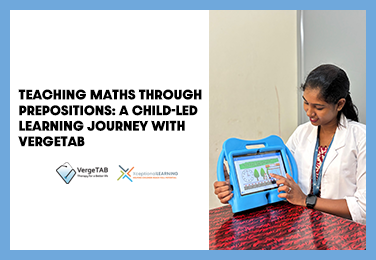
Teaching Maths Through Prepositions: How Children Learn “In, On and Under” with VergeTAB
06 Jan 2026
Children don’t first learn maths through numbers — they learn it through space.
Before a child can add or subtract, they must understand where things are, how objects move, and how they relate in space: in, on, under, left, right, before, and between.
For children with autism, developmental delays, ADHD, speech delays, and learning disabilities, these concepts must be taught slowly, visually, and through touch.
This is where VergeTAB, powered by XceptionalLEARNING, becomes more than a device. It becomes a calm, interactive device, helping children understand early maths concepts through experience—not pressure.
How Children Naturally Build Maths Through Prepositions
Why prepositions matter
- They form the base of spatial reasoning.
- Spatial reasoning becomes early maths.
- Early maths later becomes number sense, geometry, measurement, and logic.
VergeTAB supports this natural flow by using movement, visual cues, and child-led exploration.
The Journey Begins: Moving From Space to Meaning
Every session starts simply.
A clean screen. A shape. A gentle instruction:
“Put the circle in the box.”
This small action does more than build language.
When the child moves the circle inside the box, they experience containment—a core spatial concept used later in geometry, measurement, and even reading.
And just like that, the learning journey begins.
1. Number Lines: The Child’s First Exploration of Distance
As the child becomes comfortable, the therapist introduces early number concepts—not with equations, but with movement.
A number line appears on VergeTAB. Numbers animate from left to right.
Instead of saying “Find the midpoint,” the therapist gently prompts:
“Look at the jump from 2 to 5. Can we make the same jump on the other side?”
The child sees a dotted line appear.
VergeTAB highlights the three-step distance:
2 → 3 → 4 → 5 (3 steps)
They drag a +3 arrow to match it.
This leads them to discover:
- equal intervals
- distance on a number line
- spatial reasoning through numbers
When the arrow lands on 8, a soft glow confirms the answer.
This is Activity 1—transformed into a moment of discovery, not a worksheet.
2. Range Understanding Appears Naturally
Once the idea of a number line feels comfortable, the therapist expands the exploration:
A glowing section appears between 12 and 20.
The prompt is simple:
“Pick any number between these two.”
This is Activity 2, but presented in a child-led style.
There is no memorization. The child visually experiences ranges.
The glowing band becomes a self-correcting zone.
A tap on 15, 17, or 13 is all it takes.
The concept of greater than, less than, and in-between starts settling into the child’s mind—not as rules, but as intuitive visual knowledge.
3. Shapes Become Mathematical Actors
After working with numbers, we shift to shapes—not by teaching formulas, but by placing them in meaningful spaces.
A square appears with 36 cm² written below it. It fills the entire screen so the child can see an area, not imagine it.
Then a triangle fades inside the square.
The instruction doesn’t sound like a maths problem. It sounds like an interactive story:
“This triangle is part of the square. Move the slider to show how much space it uses.”
As the child slides to ½, the triangle highlights 18 cm².
This moment—Activity 3—teaches:
- fractions,
- inside–outside,
- area understanding,
- proportional reasoning.
But the child only feels like they’re adjusting a slider.
4. Side-by-Side Shapes Strengthen Spatial Logic
Now shapes appear next to each other.
Rectangle A fills 15 cm².
Rectangle B is empty.
The therapist asks:
“Rectangle B wants to be next to A but bigger. Can you make it double?”
The child types 30 or picks it from options.
Without any memorized formula, they learn:
- doubling
- comparing size
- “next to” spatial language
This experience is Activity 4, but it feels like creative problem-solving.
5. Fractions Strengthen Top/Bottom Concepts
From the area, the child moves to something more familiar—a chocolate bar.
It appears to be split into 8 blocks.
The top 3 pieces turn gold.
The bottom 5 remain untouched.
A warm prompt asks:
“How much is on the top row?”
This is Activity 5—fraction identification blended with prepositions.
The child picks 3/8, but deeper learning happens:
- they visualize fractions,
- understand placement words (top vs. under),
- develop early comparison skills.
There is no rush, no scoring—just exploration.
6. Between Two Fractions: Visualising Invisible Spaces
Another scene slowly transitions onto the screen: a measuring cup half-filled with water.
The water line moves slightly—floating between ¼ and ½.
The therapist asks:
“Can you pick a fraction that fits between these two?”
The child scans options like 1/3 or 3/8 and selects one.
This is Activity 6, but instead of a maths exercise, it becomes a sensory-friendly observation task.
Children with autism especially love this because the movement of water feels soothing while teaching comparison.
7. Grids Introduce “Above” and Directionality
Next, the screen shifts to a grid—clean, structured, predictable. Many special needs children respond well to grids because they reduce visual chaos.
A point appears at (4,2).
A soft arrow rises upward as the therapist narrates:
“Above means up. Can you move Point B three steps above A?”
The child drags a point upward until it rests at (4,5).
This is Activity 7, introducing:
- coordinate geometry
- direction (+Y)
- visual–motor alignment
The child doesn’t feel like they’re solving coordinates. They feel like they’re moving a dot upward.
8. Left–Right Mastery Strengthens Early Maths Orientation
Now a point appears at (6,3).
This time, the arrow moves left.
A ghost circle shows the expected destination—an OT-inspired visual scaffold.
The therapist asks:
“Move N to the spot that is left of M by four steps.”
The child shifts the point to (2,3).
This is Activity 8, teaching:
- negative X movement
- orientation
- horizontal number sense
It builds the mental mapping skills needed later for number lines, bar models, and geometry.
9. Queue-Based Logic: Everyday Maths Through People
The scene now shifts away from numbers and graphs to something human and familiar—a queue of children.
Ajay stands 4th.
Meera is placed behind him.
Ravi must stand in front of Meera but not ahead of Ajay.
The child must reason:
- Meera is somewhere from 5th to 10th
- Ravi must be before her
- But it cannot be 4th or earlier
The child chooses any of the first three positions.
This is Activity 9, but it becomes real-world problem-solving:
- sequencing
- before/after
- positional reasoning
- everyday logic
Children feel like they are arranging students in line, not completing a worksheet.
10. Real-World Maths: Measuring Over and Under
The final transition is a river scene—calming blue water flowing across the screen.
The river width is labelled 15 m.
A bridge appears over the river.
The therapist asks:
“Make the walkway twice as wide as the river.”
When the child chooses 30 m, the bridge widens gracefully.
This is Activity 10, strengthening:
- multiplication
- measurement
- over/under spatial concepts
And with this, the child completes a seamless learning journey through all core maths-preposition concepts—without ever feeling overwhelmed.
Why This Natural Flow Works for Special Needs Learners
Activities progress from concrete → visual → abstract
Children begin with simple spatial placements like in, on, and under, and gradually move into comparisons, fractions, and even coordinates.
Each concept blends smoothly into the next.
There are no hard chapters or jumps—every idea transitions naturally, helping the child stay regulated and engaged.
Visual scaffolds support children with motor and cognitive delays
- dotted guides
- glowing zones
- sliding bars
- ghost positions
- step-by-step animations
These elements make learning clear, predictable, and stress-free.
Touch interactions build motor planning and praxis
Dragging, tapping, and sliding are purposeful OT-aligned movements that strengthen coordination and planning.
Prepositions become functional, not memorized.
Children perform the actions instead of merely hearing the words—making understanding deeper, practical, and long-lasting.
Conclusion
When maths and prepositions are taught through natural, flowing interactions—as experienced on VergeTAB—children with special needs build foundational reasoning skills that last a lifetime. Each activity, from number lines to shapes, fractions, and coordinates, becomes a meaningful experience rather than a structured lesson. With XceptionalLEARNING powering the Digital Activity Book modules, educators can effortlessly guide children through concepts such as “between,” “under,” “above,” and “next to,” while also strengthening number sense, visual-motor planning, and logical thinking. VergeTAB’s distraction-free, therapy-focused environment ensures that every child learns through exploration, touch, and visual support at their own pace.
To experience this natural learning flow firsthand, contact us today for a free demo and explore how VergeTAB, an Interactive Learning Device for Children, and the Digital Therapy Activity Device can transform maths learning for children with developmental needs.