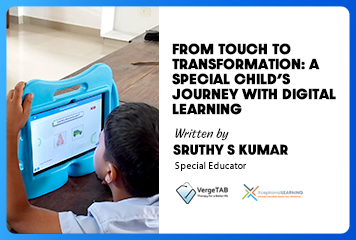
From Touch to Transformation: A Special Child’s Journey with Digital Learning
15 Jan 2026

Watch Antony’s journey in our YouTube Shorts, “Small Steps, Big Change: Antony’s Journey Through Digital Learning,” to see how structured digital routines supported his progress in the classroom. If you’d like to explore how similar support can be created in your school or therapy setting, feel free to connect with our team on WhatsApp for guidance.
When Learning Takes a New Path
Every Small Step Matters
Working with children with special needs teaches us a truth that cannot be learned from textbooks alone, the progress does not always come in big, visible milestones. Sometimes, it comes quietly, hidden inside moments that only a teacher’s heart truly understands. A child sitting for a few extra minutes, responding to a call, or showing interest in learning may seem small to the outside world, but in special education, these moments carry deep meaning.
I work as a Digital Specialist – Special Educator at XceptionalLEARNING, where my role involves visiting special schools and training teachers to use our Digital Activity Book. This is a tablet-based learning tool designed specifically for children with diverse learning needs. It includes movable and draggable activities, digital flashcards, structured tasks, and interactive content that supports attention, routine, and engagement.
One particular school visit reminded me why this work truly matters—not just as a professional responsibility, but as a deeply human experience.
When Routine Met the Right Tool
During a visit to Thiruhirdyanivas Sevanikethan Special School, Changanacherry, I met a child named Antony. This was not our first meeting. I already knew Antony from a therapy centre where I had previously worked, and seeing him again brought back many memories—some difficult, some hopeful.
Antony is a child with Autism. He is non-verbal, communicates through a few sounds, and shows a strong interest in music. During his earlier therapy days, Antony faced significant challenges. He displayed hyperactivity, head banging, spitting, aggression, and had a strong attachment to one specific teacher. Sitting tolerance was very low, and emotional regulation was complicated for him.
He attended occupational therapy, speech therapy, and behaviour therapy, and while consistent efforts were made, progress was slow and limited. One of the occupational therapy strategies used was wrapping with a bed sheet, aimed at providing deep pressure input to help with sensory regulation. Initially, Antony strongly resisted this intervention—crying intensely and showing aggressive behaviour. However, with consistency, he slowly began to tolerate it. Though he continued to cry, the intensity of aggression reduced, showing that Antony could adapt when a routine was followed regularly.
This understanding—that routine plays a crucial role in Antony’s regulation, became showing that routine and consistency helped him regulate himself.
A New Setting, Familiar Challenges
After Antony joined school along with continued therapy support, his challenges did not disappear overnight. In the school environment, he continued to show aggression, loud crying, difficulty settling in class, and poor sitting tolerance. Transitions were hard, and classroom expectations often overwhelmed him.
As part of my role, I visited the school to provide training to teachers on digital learning strategies. When I saw Antony in the school, he did not recognize me, which was expected. However, when I noticed his name listed under the digital classroom, I felt a mix of emotions—genuine happiness and quiet doubt stayed with me. I wondered whether he could sit in a digital classroom, whether the tablet might overstimulate him, and whether his aggression would increase in this new learning environment.
When the digital sessions began, my doubts seemed valid. In the initial days, Antony struggled. He ran out of the classroom, picked up objects from the environment, showed resistance to activities, and found it hard to stay seated. Teachers attempted to show him pictures and activities from the Digital Activity Book, but he did not cooperate.
Still, the teachers did not give up.
Teacher’s Intervention: Patience, Structure, and Support
From the teacher’s perspective, Antony’s case required gentle handling, patience, and realistic expectations. Instead of forcing participation, the teachers focused on consistency and emotional safety.
The key interventions included:
- Following a fixed routine for the digital classroom
- Using simple, clear instructions
- Providing verbal reassurance and calm prompts
- Allowing Antony to observe before participating
- Offering continuous teacher support and guidance
The Digital Activity Book was not introduced as a demand, but as an invitation. Teachers allowed Antony to explore the tablet at his own pace, creating a safe and pressure-free learning environment. Knowing his love for music, sound-based activities were introduced first to capture his interest. Draggable and movable activities were carefully selected to match his attention level, and there was no expectation for him to complete tasks independently, as continuous teacher support and guidance were provided throughout.
As one teacher shared later,
“Our focus was not on perfection. It was on helping him feel safe and accepted in the learning space.”
The Turning Point
Almost two months later, something unexpected happened—something no one had forced or planned.
One day, Antony gently pushed his teacher and led her towards the digital classroom. This small action spoke volumes. He was choosing the space on his own.He entered the classroom, sat down, and stayed. When he became distracted by books in the room and moved away, the teacher said, “Antony, come and sit here.”
And he did. That small moment filled my heart.
From that point onward, gradual but meaningful changes were observed. Antony’s sitting tolerance improved, and he began staying seated for longer periods. He started listening to instructions, responding when called, and returning to his seat when guided. His attention span increased, and eye contact improved during sessions.
He is not yet an expert in using digital activities independently, but he listens, observes, and attempts tasks with teacher support and guidance. He taps the screen, explores draggable elements, and looks to the teacher for reassurance and direction.These were not dramatic changes but they were real.
Growth Through Connection
After one session, I called out to Antony, and he came toward me. When I asked for a high-five, he responded, and when I asked for a kiss, he gave that too. In that moment, I did not see a diagnosis or a case file—I saw a child learning to trust, connect, and respond.
Later, we compared the older condition of Antony showing intense aggression with the recent condition of his calm participation in the digital classroom. The difference was vast.
When I shared this with his teacher, she smiled with visible emotion and said,
“He loves coming to the digital class. His attention has improved, his eye contact is better, and he listens to commands more now.”
There were sparkles in her eyes—not because the journey was complete, but because the effort was finally showing results. Each small step motivates her to continue with patience and belief. For her, Antony’s progress is a reminder that consistent intervention and structured digital learning truly make a difference.
Hope of Every Child
This journey matters because what may seem like a small change to the world can be a life-changing achievement for a special child. Antony’s story reminds us that progress is not always fast or obvious—it grows through structured support, consistent routines, and teachers who continue to believe, even when change takes time.
It also highlights an important truth: when used thoughtfully, digital tools are not distractions. They become powerful learning supports that help children improve attention, manage behaviour, and engage with content in ways that traditional methods may not always reach. Through XceptionalLEARNING, these tools are used with care to create meaningful and accessible learning experiences for every child.
For children like Antony, every small step forward is a victory.
For teachers, it confirms that patience and effort truly matter.
For parents, it brings hope.
For me, as a special educator, this journey is a reminder that routine, patience, belief, and the right support can open new pathways for learning. Through XceptionalLEARNING, support becomes more than a session—it becomes a continuous process of care, connection, and possibility woven into everyday life.
Antony’s journey reminds us that progress in special education is not always loud or immediate. It grows quietly through routine, patience, and the belief of teachers who continue to show up every day.
What may seem like a small step to others can be a life-changing achievement for a child. With the right support, structure, and understanding, children begin to feel safe, connected, and ready to learn.
For educators, it reaffirms that consistency matters. For parents, it brings hope. And for me, it is a reminder that meaningful learning happens when care, belief, and the right tools come together in everyday moments.