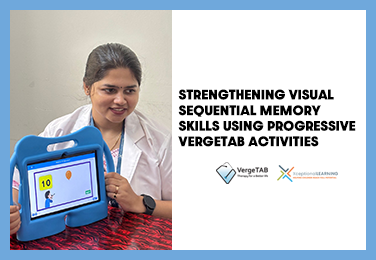
Forgetting Sequences Easily? How VergeTAB Strengthens Visual Sequential Memory
16 Dec 2025

Many schools and therapy centers find it challenging to help children develop strong visual sequential memory skills — the ability to remember and reproduce ordered visual information — in a structured and engaging way.
Traditional methods like flashcards or paper drills often lack interactivity and fail to hold attention, especially for learners with special needs.
VergeTAB, used together with the XceptionalLEARNING platform, allows educators and therapists to deliver distraction-free, goal-oriented digital activities designed specifically to build visual sequential memory. This structured environment helps children practice sequencing, recall, and pattern recognition with real-time feedback and measurable progress.
Talk to our team on WhatsApp
Why Visual Sequential Memory Matters for Children
Strong visual sequential memory helps children:
- Track words across a page without skipping
- Copy classwork efficiently
- Follow multi-step instructions
- Understand patterns, directions, and sequences
- Strengthen working memory
- Improve organization and attention
- Build confidence in classroom tasks
These are foundational skills—and VergeTAB creates a therapist-controlled environment where all visuals are precisely timed, high-contrast, and adaptable, making memory training far more effective.
Chat with our team on WhatsApp for guidance
LEVEL 1: Deepening Basic Visual Order Awareness
Focus Area: Basic visual order & encoding
Goal: Stabilize attention, process short sequences, and build visual consistency.
1. Rapid Flash Order Recall
A sequence of icons appears for fractions of a second (e.g., 400–600 ms). The learner reconstructs the order.
- Why it works: It strengthens visual encoding speed — especially helpful for children who lose place while reading.
- Example: Arun often forgets the first image he saw. With this activity, he learns to visually “lock in” what appears, even when fast.
2. Colour–Motion Trace Sequences
Colours move across the screen (slide → bounce → fade). Learners recall order and movement type.
- Benefits: Dual-channel recall, eye tracking, and expanded attention span.
3. Shape–Orientation Recall
Shapes appear in specific orientations (tilted, rotated). Children recreate the sequence accurately.
- Helps with: Letter directionality (b/d, p/q), noticing small changes in visual details
Level 1 Summary: Builds accuracy, attention, and visual detail memory — foundation for advanced tasks.
LEVEL 2: Expanding Capacity & Complex Recall
Focus Area: Longer sequences + spatial patterns
Goal: Handle longer sequences with multiple attributes and spatial patterns.
1. Progressive Multi-Attribute Chains
Items appear with two attributes (colour + shape). The child recalls both in order.
- Targets: Higher-level visual binding, spelling, and maths patterns
2. Grid-Based Sequential Reveal
An 8–12 block grid reveals items sequentially. After the grid blanks, the child selects each tile in order.
- Targets: Spatial memory, sequential scanning, mapping skills
3. Vanishing Path Patterns
A dot path (zig-zag, arc, spiral) lights up then vanishes. Learner redraws by connecting dots.
- Targets: Pre-writing motor planning, visual direction-following
Mini Example:
Riya, who struggled to copy from the board without skipping lines, showed drastic improvement after grid sequencing tasks.
Level 2 Summary: Builds visual endurance, multi-attribute recall, and spatial sequencing.
LEVEL 3: Working Memory Transformation Skills
Focus Area: Mental transformation
Goal: Transform sequences mentally under rules, delays, and distractions.
1. Sequence Transformer Mode
After a sequence, VergeTAB prompts: “Swap 1 and 4” / “Insert this at step 3.”
- Skills strengthened: Executive function, cognitive flexibility, mental manipulation.
2. Delayed Reverse Recall
Sequence appears → short blank → child recalls in reverse.
- Supports: Working memory under delay, focus maintenance, and inhibition of impulsive recall
3. Distractor-Proof Sequencing
The main sequence plays with distractor images flashing randomly. The learner remembers only the target sequence.
- Targets: Selective attention, filtering irrelevant visual noise
Level 3 Summary: Builds advanced working memory, handling complexity, delays, and interference.
LEVEL 4: Real-World Sequencing & Visual Reasoning Mastery
Focus Area: Real-world sequencing
Goal: Apply sequencing to narratives, logic, prediction, and real-life scenarios.
1. Micro-Story Visual Sequencing
A short animation plays (e.g., girl opens bag → drops pencil → picks it back). The child arranges 6–8 frames to recreate the story.
- Skills: Event sequencing, visual logic, real-world comprehension
2. Complex Pattern Restoration
A structured pattern is shown, scrambled, and rebuilt by the child.
- Helps with: Pattern logic, visual organization, STEM readiness
3. Predict-the-Next Visual Rule
A sequence follows a visual rule (outline → half colour → full colour → ?).
- Benefits: Prediction, pattern abstraction, reasoning
Level 4 Summary: Children apply sequencing to stories, logic, prediction, and classroom behaviour.
Skill Progression Table
| Stage | Focus Area | Child Gains |
|---|---|---|
| Stage 1 | Basic visual order & encoding | Attention, accuracy, early sequencing |
| Stage 2 | Longer sequences + spatial patterns | Working memory endurance, attribute binding |
| Stage 3 | Mental transformation | Cognitive flexibility, inhibition, updating |
| Stage 4 | Real-world sequencing | Visual reasoning, prediction, narrative understanding |
In real therapy and classroom environments, visual sequential memory activities are practiced using VergeTAB in a controlled, distraction-free setup designed specifically for special education and therapy use. Schools and clinics use VergeTAB along with XceptionalLEARNING to ensure structured skill development and measurable progress.
See how VergeTAB works in real sessions
Why VergeTAB + XceptionalLEARNING Make These Activities Clinically Superior
VergeTAB is not a typical tablet — it is a clinical-grade Digital Activity Book Device designed exclusively for therapy.
Why does it work better than regular devices
- No external apps
- No pop-ups
- No multitasking
- No distractions or ads
- High-contrast, clean therapy visuals
Therapist Advantages
- Adjustable sequence length & speed
- Custom sequence creation
- Precision-controlled visual timing
- Real-time progress graphs
- Automatic data logging via XceptionalLEARNING
This ensures every activity is purposeful, structured, and measurable.
Conclusion
Visual sequential memory is a critical foundation for academic and daily success. If your school or clinic is looking for a practical way to strengthen visual sequential memory and recall skills using a dedicated therapy device, VergeTAB provides a safe, guided, and distraction-free digital environment built specifically for special education and therapy.
Used together with XceptionalLEARNING, VergeTAB helps professionals deliver measurable, goal-oriented digital therapy and learning sessions.
Request a VergeTAB Demo
Talk to our team on WhatsApp for institutional enquiries