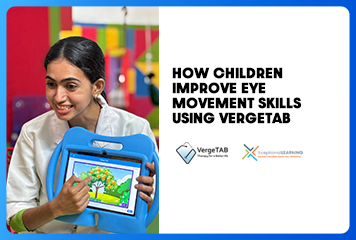
How Children Improve Eye Movement Skills Using VergeTAB
10 Mar 2026

Have you noticed your child skipping lines while reading, struggling to follow a moving ball, or losing focus during drawing or play? Many parents first notice these signs as small concerns, often assuming the child is distracted or careless. In reality, these behaviours may point to challenges in ocular motor development—the set of eye movement skills that support reading, writing, coordination, and sustained attention.
The encouraging news is this: with early support, consistent practice, and the right tools, children can strengthen these skills naturally. When therapy is engaging and suited to a child’s level, progress becomes not only possible but enjoyable.
VergeTAB, a digital therapy tablet powered by the XceptionalLEARNING Platform, is designed with this exact goal in mind. It transforms ocular motor exercises into interactive, adaptive, and engaging activities that help children improve eye movement, coordination, and focus while keeping therapy motivating and structured. In this blog, we explore what ocular motor development really means, why it matters, and how VergeTAB supports meaningful, real-world progress.
Want to learn how VergeTAB helps children improve eye-tracking and visual focus skills?
Connect with our team on WhatsApp to get quick guidance, learn more about the activities, and request a demo.
Understanding Ocular Motor Development
Ocular motor development refers to how a child learns to move their eyes accurately and efficiently to gather visual information. These skills allow the eyes to work together smoothly, helping children interact confidently with their surroundings.
Strong ocular motor skills form the foundation for everyday activities such as:
- Reading and writing with ease
- Catching, throwing, or tracking a ball
- Drawing, colouring, and completing puzzles
- Navigating classrooms and play environments confidently
When these skills are underdeveloped, even simple learning tasks can feel tiring or frustrating for a child.
Key Components of Ocular Motor Skills
Ocular motor development is made up of several interconnected skills:
- Fixation – The skill of keeping the eyes steadily focused on one target for a period of time
- Saccades – Quick, accurate eye movements between two points
- Smooth Pursuits – Following a moving object smoothly
- Convergence – Turning both eyes inward to focus on near objects
- Divergence – Shifting focus from near to far objects
- Accommodation – Adjusting focus clearly across different distances
These skills develop gradually during early childhood and continue to be refined with practice and experience.
Why Ocular Motor Skills Matter
Children with well-developed ocular motor skills often find learning more comfortable and enjoyable. They are better able to:
- Read fluently without losing their place
- Copy from the board or a book accurately
- Participate confidently in sports and play
- Maintain attention for longer periods without eye strain
On the other hand, children with weaker ocular motor control may experience:
- Skipping lines or words while reading
- Messy handwriting or difficulty copying
- Headaches, eye fatigue, or avoidance of visual tasks
- Reduced confidence in classroom or play situations
Even mild challenges can quietly affect motivation, self-esteem, and participation if left unaddressed.
Who May Struggle with Ocular Motor Skills?
Some children are more likely to experience ocular motor difficulties, including those with:
- Developmental delays or learning difficulties
- Autism Spectrum Disorder (ASD) or ADHD
- Sensory processing differences
- Vision conditions such as lazy eye or eye alignment issues
- A history of premature birth or neurological conditions
Therapists often notice signs such as:
- Avoidance of puzzles, drawing, or reading
- Losing place frequently while reading
- Appearing clumsy or poorly coordinated
- Becoming tired or frustrated quickly during visual tasks
These early signs are important. Timely intervention can make a significant difference in long-term outcomes.
Traditional Approaches – And Their Limitations
Occupational therapists, vision specialists, and special educators commonly use approaches such as:
- Tracking objects with the eyes
- Pencil push-ups for convergence
- Eye–hand coordination games
- Visual guides during reading tasks
While these methods are effective, they can sometimes feel repetitive or difficult to sustain—especially for young children. Progress may be hard to measure, and maintaining motivation over time can be challenging.
This is where technology, when used thoughtfully, can enhance therapy rather than replace it.
Introducing VergeTAB – How It Works
VergeTAB is a blank tablet designed to work exclusively with the XceptionalLEARNING Platform. On its own, it contains no distracting content. When paired with the platform, it becomes a focused, personalized therapy tool tailored to each child’s needs.
Through interactive activities, VergeTAB supports:
- Fixation and visual attention
- Saccades and scanning
- Smooth pursuits
- Convergence and depth awareness
Key Features
- Customizable Activities – Exercises adapt to the child’s current skill level
- Engaging Visuals – Bright, child-friendly designs that encourage participation
- Progress Tracking –Session-based insights help therapists monitor improvement and refine goals.
- Minimal Distractions – A safe, focused environment designed for therapy
VergeTAB allows therapy sessions to remain consistent, measurable, and enjoyable—for children, therapists, and parents alike.
Practical Strategies for Ocular Motor Development Using VergeTAB
Below are four core strategies commonly used in therapy sessions, supported by VergeTAB activities and real-life observations.
1. Tracking and Smooth Pursuits
Objective: Improve the child’s ability to follow moving objects smoothly.
VergeTAB Activities:
- Follow-the-line exercises
- Animated shape tracking and tap challenges
Tips for Success:
- Begin with slow-moving targets
- Gradually increase speed as control improves
- Keep early sessions short (5–10 minutes)
Everyday Practice:
- Watching birds, cars, or moving toys
- Tracing lines with a finger while reading
Therapy Insight: Children who initially lose track of moving shapes often begin to follow them more confidently within a few weeks. This improvement commonly transfers to smoother reading and better participation in ball games.
2. Saccades and Rapid Eye Movements
Objective: Strengthen quick and accurate eye shifts between targets.
VergeTAB Activities:
- Spot-to-spot challenges
- Interactive number or word scanning tasks
Tips for Success:
- Start with simple layouts
- Increase complexity gradually
- Celebrate small improvements
Everyday Practice:
- Playing visual search games like “I Spy.”
- Practising scanning letters or numbers during homework
Therapy Insight: With repeated, playful practice, children who once struggled to shift their gaze begin scanning text and environments more efficiently, supporting classroom learning.
3. Convergence and Divergence Exercises
Objective: Improve focus on objects at different distances.
VergeTAB Activities:
- Zoom-in and zoom-out tracking tasks
- Near–far focus games
Tips for Success:
- Use slow, predictable movements
- Reinforce concepts with simple verbal cues like “near” and “far.”
Everyday Practice:
- Reading from books and then looking up at the board
- Playing catch to encourage depth perception
Therapy Insight: Children gradually show better control when shifting focus between near and far objects, leading to improved classroom engagement and smoother play interactions.
4. Visual Fixation and Sustained Attention
Objective: Build the ability to maintain gaze and attention on a task.
VergeTAB Activities:
- Timed focus games
- Pattern and visual memory tasks
Tips for Success:
- Begin with short focus durations
- Increase time gradually as tolerance improves
- Use storytelling or challenges to keep interest high
Everyday Practice:
- Completing puzzles or drawing for short periods
- Encouraging distraction-free focus during simple tasks
Therapy Insight: Children with limited attention spans often show noticeable improvements in task completion, homework tolerance, and classroom focus after consistent practice.
Want to explore more guided activities like these?
Watch VergeTAB therapy videos to see how structured digital exercises help children improve eye movement skills step-by-step while building better focus, tracking, and coordination.
Overcoming Common Challenges
Even with the right tools, progress may vary. Common challenges include:
- Short attention spans – Keep sessions brief and varied
- Frustration or resistance – Use positive reinforcement and gamified tasks
- Eye fatigue – Schedule breaks between activities
- Slow progress – Adjust difficulty gradually and celebrate effort
Every child’s journey is unique. VergeTAB allows therapy to be adapted without pressure, supporting steady, confidence-building progress.
Therapist–Parent Collaboration
The most effective outcomes occur when therapists and families work together. With VergeTAB, collaboration becomes easier through:
- Baseline assessments of ocular motor skills
- Customized exercise plans via XceptionalLEARNING
- Progress monitoring and data-informed adjustments
- Simple home strategies shared with parents
Even small daily practices at home can reinforce therapy gains and build confidence.
Benefits Beyond Therapy
Strengthening ocular motor skills offers long-term benefits that extend beyond therapy sessions:
- Improved reading fluency and academic performance
- Better coordination in sports and creative activities
- Increased confidence and motivation
- A stronger foundation for future learning
Therapists often observe smoother classroom participation, reduced visual fatigue, and greater independence as children progress.
Conclusion
Ocular motor development plays a vital role in how children learn, play, and engage with the world. When these skills are supported early through structured, engaging strategies, children gain not only stronger visual abilities but also greater confidence and enjoyment in learning.
With VergeTAB, powered by the XceptionalLEARNING Platform, therapy becomes more structured, engaging, and personalized. As a Digital Therapy Device for Special Education, it helps therapists deliver goal-based activities while also strengthening the role of parents in therapy through guided practice at home.
Through structured activities and progress tracking, VergeTAB also helps families and therapists better understand how digital therapy works, supporting children’s development in a clear and measurable way.
To learn how VergeTAB can support your child or therapy practice, contact us today or connect with our team on WhatsApp for quick guidance and a free demo.