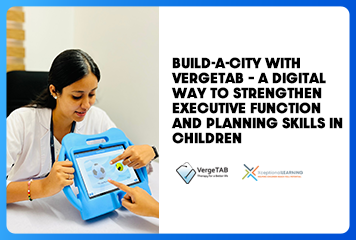
Build-a-City with VergeTAB – A Digital Way to Strengthen Executive Function and Planning Skills in Children
13 Jan 2026

Children naturally learn through play — they explore, imagine, and create. But what if play could also strengthen essential life skills like planning, sequencing, and executive function?
That’s exactly what Build-a-City on VergeTAB, powered by the XceptionalLEARNING (XL) Platform, achieves. VergeTAB, a blank tablet by itself, becomes a powerful digital therapy companion when integrated with XL. Together, they transform screen time into goal-oriented play — every action contributing to developmental growth.
The Concept: What Is Build-a-City?
Build-a-City is a digital therapy adventure designed for children with developmental delays or special education needs. Using VergeTAB, children become “city planners” — designing roads, houses, parks, and schools.
Each drag, drop, and decision aligns with therapy goals, helping children develop sequencing, attention, problem-solving, and planning abilities through immersive play.
Key Features
- Interactive Design: Children build and organize their own city layouts.
- Adaptive Difficulty: The game adjusts to each child’s age and ability.
- Therapy Missions: Structured tasks with clear objectives (e.g., “Build a park near the school”).
- Visual Engagement: Colourful visuals, animations, and voice prompts keep children focused.
Through play, children learn to think, plan, and adapt while therapists track measurable progress.
Core Skills Developed Through Build-a-City
- Cognitive Skills: Builds logical thinking, sequencing, and problem-solving as children plan and correct their city designs.
- Motor Skills: Enhances fine motor precision, hand–eye coordination, and motor planning through tapping, dragging, and rotating objects.
- Language Skills: Expands vocabulary, comprehension, and sentence formation as children name and describe city elements.
- Social-Emotional Skills: Supports cooperation, empathy, and self-regulation through community building and shared play.
- Executive Functioning: Strengthens planning, flexibility, prioritization, and self-monitoring during structured game challenges.
Each skill develops naturally through play, helping children learn, create, and grow while therapists track meaningful progress.
Why Build-a-City Works in Therapy
- Active Learning: Children make decisions, solve problems, and self-correct — not just watch.
- Intrinsic Motivation: They’re proud of their creations, increasing engagement.
- Cognitive + Emotional Integration: Combines visuals, sound, and reasoning.
- Therapist Control: XL lets therapists adjust difficulty, track data, and give real-time feedback.
Practical Therapy Benefits
- Planning & Sequencing: Children learn to think ahead. For example, roads must be built before vehicles can move — teaching logical sequencing.
- Executive Function: Limited “energy points” teach time and resource management.
- Visual-Motor Coordination: Dragging, resizing, and rotating objects enhances fine motor skills.
- Social Awareness: Adding schools, hospitals, and parks builds understanding of social cooperation.
- Sensory Regulation: Customizing calming backgrounds or music supports sensory comfort.
Each therapy goal is seamlessly built into gameplay, helping therapists achieve outcomes without the child feeling pressured or overwhelmed.
Real-World Skill Transfer
The benefits of Build-a-City don’t stay on the screen — they extend into daily life, helping children apply what they learn in therapy to real-world routines.
Practical Skill Transfers
- Planning routines: Children who learn to sequence building steps can apply the same logic to plan morning routines or schoolwork.
- Organizing tasks: Managing where roads or parks go builds organizational thinking for school and home chores.
- Resource management: Deciding how to use limited “energy points” teaches children time and effort management.
- Following step-by-step processes: The in-game requirement to build in sequence mirrors real-life tasks like dressing up or packing a bag.
- Understanding cooperation: Constructing community areas teaches teamwork and shared responsibility.
- Emotional regulation: Choosing calming in-game environments (like day/night themes) translates to recognising and managing emotions in real settings.
- Problem-solving: Handling obstacles in the city (like blocked roads) develops flexible thinking for unexpected real-world challenges.
Through this approach, Build-a-City helps children move from digital success to real-world independence, turning fun learning into lasting functional growth.
Classroom and Therapy Integration
For Special Education Teachers:
- Use Build-a-City to teach topics like Community Helpers, Transportation, or Directions.
- Encourage group play — students can plan different city zones collaboratively.
- Connect lessons to real-world concepts like how schools, hospitals, and parks support society.
For Therapists (OT, SLP, Developmental):
- Occupational Therapy: Improves visual-motor coordination and sequencing.
- Speech Therapy: Enhances naming, following directions, and expressive language.
- Developmental Therapy: Builds attention, flexibility, and cause-and-effect understanding.
Digital Activity Book Integration
On the XL Platform, the Digital Activity Book complements Build-a-City with both on-screen and printable worksheets, such as:
- Label city buildings.
- Count vehicles or trees.
- Match community roles (e.g., “Doctor → Hospital”).
This hybrid approach reinforces digital learning through physical and verbal exercises, improving retention and engagement.
Adaptations and Practical Session Plans
Every child’s learning profile is unique, so VergeTAB and XL offer flexible adaptations to make Build-a-City accessible for all learners.
Inclusive Adaptations:
- Simplified Layouts: Fewer buildings and slower animations for easier comprehension.
- Voice Prompts & Symbol Cues: Support for non-readers or children with language delays.
- Sensory-Friendly Settings: Muted colours and calm music reduce overstimulation.
- Therapist-Assisted Mode: Enables shared control — the child taps while the therapist guides.
Example Session Flow:
- Beginner Level: Build a park near a school using voice hints (focus: sequencing and cause-effect).
- Intermediate Level: Create connected roads and manage limited energy points (focus: planning and resource use).
- Advanced Level: Design balanced zones with challenges like blocked roads or rain (focus: flexibility and reasoning).
These progressive sessions make therapy hands-on, structured, and motivating — helping each child build focus, adaptability, and confidence step by step.
Expected Therapeutic Outcomes
After consistent sessions, children often show measurable improvements across multiple domains:
- Improved Attention Span: Longer engagement without fatigue.
- Enhanced Cause-Effect Understanding: Logical task flow recognition.
- Stronger Visual-Spatial Awareness: Better object placement and orientation.
- Better Task Persistence: Willingness to retry and complete tasks.
- Boosted Confidence: Sense of ownership and pride in creation.
- Improved Communication: Following multi-step instructions and expressing ideas clearly.
These outcomes reflect progress not only in therapy but also in everyday functional behaviour.
Why VergeTAB + XceptionalLEARNING Makes It Scalable
The VergeTAB + XL ecosystem takes therapy beyond individual sessions — it makes data-driven, collaborative intervention possible.
Practical Scalability Features
- Real-Time Progress Tracking: Each tap, drag, and decision is logged for analysis.
- Cloud-Based Reports: Accessible to therapists, teachers, and parents from any location.
- Cross-Module Integration: Works with XL’s speech, occupational, and cognitive therapy modules for holistic growth.
- Data Analytics Dashboard: Tracks accuracy, attention, and adaptability trends over time.
- Secure Synchronization: All activity data is stored safely in XL’s cloud environment.
This seamless system helps therapy centres, special schools, and parents work together — ensuring continuity of care and consistent monitoring.
Conclusion: Building Minds While Building Cities
Build-a-City is more than a digital game — it’s a therapeutic journey that turns every tap and drag into a meaningful developmental milestone.
By merging the power of VergeTAB with the intelligence of the XceptionalLEARNING platform, therapists and educators can offer children an engaging way to strengthen executive function, planning, and problem-solving — all through play.
Experience it yourself!
Discover how VergeTAB, an Interactive Learning Device for Children, powered by the XceptionalLEARNING Platform, can transform therapy sessions into creative, data-driven learning adventures. This Digital Therapy Activity Device empowers therapists and educators to make every session engaging, measurable, and goal-oriented.
Contact our team today to schedule a demo or explore our Digital Activity Book for complementary exercises that enhance every learning and therapy experience.