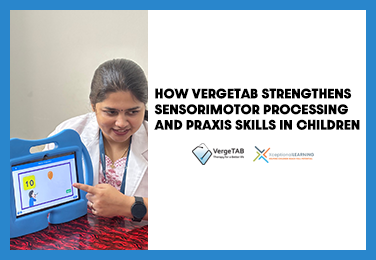
How VergeTAB Strengthens Sensorimotor Processing and Praxis Skills in Children
09 Dec 2025
An Occupational Therapist’s Experience With Two Very Different Learners
(Names and details are changed to protect privacy.)
Introduction: Two Personalities, One Underlying Developmental Need
In therapy, children walk in with very different energies.
Some come in quietly, observing the room before taking a single step.
Others rush in with excitement, ready to touch, explore, and start everything at once.
Their behaviours may look opposite, but very often, both groups struggle with the same underlying areas:
Sensorimotor processing and praxis (motor planning).
These skills affect almost everything a child does — from climbing, drawing, and dressing to paying attention and following instructions.
Two children I met six months apart made this clearer than ever: Anjali, the calm observer, and Heera, the energetic adventurer.
Both had very different personalities, yet both benefitted from VergeTAB, which works only through the structured XceptionalLEARNING platform.
Before Their Story: A Simple Explanation of Sensorimotor Processing & Praxis
What Is Sensorimotor Processing?
In simple terms, it’s how a child takes in sensory information and turns it into action.
When this system is working well, children move confidently and stay organised.
When it’s not, you may see:
- clumsiness or tripping
- difficulty sitting upright
- trouble copying shapes or patterns
- poor coordination
- slow or inconsistent responses
This explains why some children are overly cautious, while others move too fast.
What Is Praxis (Motor Planning)?
Praxis is the ability to think of an action, plan it, sequence it, and do it smoothly.
Children with weak praxis often:
- hesitate before starting tasks
- rush and skip steps
- struggle with new motor activities
- get confused with multi-step instructions
Understanding these two areas helps me choose activities that support each child at their level — not faster, not slower.
Why VergeTAB Works Only With XceptionalLEARNING
VergeTAB, on its own, is just a blank tablet.
Every structured therapy activity — from visual–motor tasks to sequencing modules — comes entirely from the XceptionalLEARNING platform.
The platform provides:
- graded levels of difficulty
- controlled pacing
- visual–motor exercises
- bilateral coordination tasks
- sequencing and planning modules
- therapist-guided structure
This structure is what makes the difference for both slow processors and fast movers.
When Anjali First Came Into My Clinic
Anjali was a gentle, quiet child.
She held her mother’s hand tightly and watched everything before participating.
Her parents described concerns such as:
- long hesitation before starting any new motor activity
- avoiding climbing, balancing, or fast movements
- difficulty copying shapes or simple patterns
- slow processing of multi-step instructions
- mild posture instability and weak visual–motor coordination
- extra time needed for planning movements
After assessing her, it was clear that she struggled with sensorimotor processing and praxis, particularly in feedforward planning.
Her strengths were sensitivity and focus — she simply needed predictable input and structured, gradual progression.
To support her, I chose VergeTAB through the XceptionalLEARNING platform because it offers a calm, predictable experience — exactly what Anjali needed.
How VergeTAB Helped Anjali (The Quiet Observer)
1. Gentle Visual–Motor Integration Training
We started with slow, error-free learning tasks:
- tracing graded paths
- controlled drag-and-drop
- dot-to-dot sequencing
- shape copying with visual cues
These activities strengthened:
- ocular–motor control
- hand–eye coordination
- sustained attention
- motor accuracy
2. Feedforward Motor Planning & Sequencing
Using modules such as:
- first → next → last sequences
- sequential placement tasks
- “Move only when highlighted” prompts
Anjali began organizing steps more confidently, developing:
- sequencing skills
- planning efficiency
- anticipatory motor control
- smoother execution
3. Bilateral Coordination & Postural Stability
Activities requiring stable hands, synchronized tapping, and left–right crossing helped improve:
- core stability
- interhemispheric integration
- midline control
Slowly, her handwriting readiness, body awareness, and initiation speed improved.
Anjali became braver — not faster — but more confident, more coordinated, and more willing to try.
Six Months Later… Heera Entered
Half a year after Anjali completed her program, another girl arrived — the complete opposite personality.
Heera rushed into the room with excitement, touching everything, talking nonstop, and ready to start before I even explained the activity.
Her parents listed concerns such as:
- impulsive movement
- frequent tripping or bumping into objects
- difficulty regulating force and speed
- rushing through tasks and leaving them incomplete
- inconsistent spatial awareness
- trouble following sequencing tasks
During my assessment, it was clear:
Heera had challenges with inhibitory control, timing regulation, spatial orientation, and sequencing within praxis.
She did not need “calming down” — she needed organized, paced sensory–motor input.
And once again, the most structured tool for her profile was VergeTAB with XceptionalLEARNING.
How VergeTAB Helped Heera (The Energetic Adventurer)
1. Timing, Rhythm & Impulse Control Activities
Her sessions focused on:
- tapping only on cue
- pausing before dragging
- following rhythmic prompts
- slow placement tasks
These helped her develop:
- inhibitory control
- pacing
- impulse regulation
- timing accuracy
2. Sequencing & Working Memory Development
She worked on:
- multi-step visual sequences
- pattern imitation
- controlled drag-and-drop chains
This improved her skills in:
- planning ahead
- self-regulation
- visual sequencing
- task completion
3. Spatial Orientation & Force Grading
Structured visuals guided her to:
- apply appropriate pressure
- judge boundaries
- avoid overshooting
- navigate space safely
Her movements became more mindful, organized, and purposeful.
Just as Anjali found courage, Heera found control.
Why VergeTAB Works for Opposite Personalities
Both children improved for the same reasons:
- no distracting apps
- therapist-controlled difficulty levels
- clear visuals that reduce cognitive load
- structured, graded activity progression
- measurable progress tracking
- supports both under-responsive and over-responsive sensory profiles
The system adapts to the child — not the other way around.
Core Sensorimotor & Praxis Skills Strengthened With VergeTAB
1. Praxis / Motor Planning
- ideation
- sequencing
- feedforward planning
- smooth execution
2. Visual–Motor Integration
Supports handwriting, copying, cutting, drawing, and classroom readiness.
3. Bilateral Coordination
Supports stability, midline crossing, body control, and learning skills.
4. Body Awareness (Proprioception)
Helps children understand their position and movement in space.
5. Timing & Rhythm Regulation
Important for impulse control, speech pacing, and sustained attention.
6. Spatial Orientation
Supports puzzle-solving, navigation, safety, and daily movement planning.
Conclusion: Different Journeys, One Path to Growth
Anjali and Heera show us one truth: no two children learn the same way — but every child learns beautifully when therapy is structured, sensory-aligned, and paced correctly.
Their personalities were opposite, but their developmental needs were similar — and their progress came from structured, consistent, therapist-guided practice.
With VergeTAB powered by XceptionalLEARNING, therapy becomes predictable, measurable, and developmentally aligned — ideal for both cautious and energetic children.
Sensorimotor processing and praxis don’t improve overnight; they grow through repetition, clarity, and the right tools. VergeTAB brings this growth into a child’s everyday learning with precision and child-centered design.
Whether a child is gentle or impulsive… slow or fast… hesitant or adventurous —
VergeTAB helps them move through the world with confidence, coordination, and self-awareness.
Take the next step
Contact us to book a free VergeTAB + XceptionalLEARNING demo, try the Digital Activity Book modules, and learn how our Interactive Learning Device for Children and Digital Therapy Activity Device can support your child’s development.
Disclaimer
The scenarios shared in this article are composite case examples created to illustrate common patterns seen in pediatric therapy. They do not describe any real individual but reflect typical sensorimotor and praxis profiles observed in clinical practice.