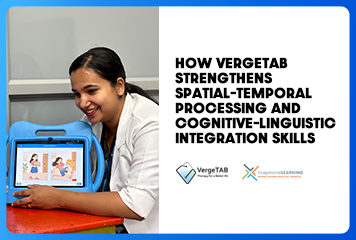
Why Some Children Struggle with Direction, Sequence, and Understanding Space — And How VergeTAB Helps
30 Dec 2025

In classrooms and therapy sessions, some children struggle to understand direction, sequence, and spatial relationships. They may confuse left and right, have difficulty following multi-step instructions, or struggle to understand how objects relate to each other in space.
These challenges affect not only learning but also reading, writing, movement, and everyday task performance.
VergeTAB, used together with the XceptionalLEARNING platform, is implemented in schools and therapy centers to provide distraction-free, goal-based digital activities that help children strengthen spatial–temporal processing and cognitive–linguistic skills through structured, visual practice.
Talk to our team on WhatsApp
1. Why These Skills Matter in a Child’s Development
Spatial–Temporal Processing
Spatial–temporal processing helps children understand:
- Where things are (spatial)
- How they move or change over time (temporal)
It supports abilities like:
- Understanding directions (under, behind, next to)
- Solving puzzles
- Following movement patterns
- Building sequences
- Completing multi-step tasks
- Navigating daily routines
Children with strong spatial–temporal skills can plan, organize, and coordinate actions more confidently.
Cognitive–Linguistic Integration
This skill combines thinking (cognitive) and language (linguistic) abilities to help children understand and express ideas.
It includes:
- Categorization
- Cause-and-effect understanding
- Prediction
- Storytelling
- Event sequencing
- Following complex instructions
- Problem-solving through language
When these systems work together, children communicate better, understand more deeply, and learn faster.
Struggling to help your child improve spatial understanding, sequencing, or language processing?
VergeTAB offers structured activities that strengthen spatial-temporal thinking and cognitive-linguistic confidence.
Chat with our team on WhatsApp for guidance
2. How VergeTAB Boosts Spatial–Temporal Processing Skills
VergeTAB provides interactive, focused activities designed to strengthen spatial–temporal abilities:
Interactive Visual Activities
With the XceptionalLEARNING Platform, children explore visual tasks such as:
- Drag-and-drop puzzles
- Shape sorting
- Object placement tasks
- Pattern matching
- Mazes and path-finding
This helps improve overall spatial awareness, strengthens core direction concepts like left/right and above/below, and builds strong visual problem-solving skills.
Sequencing and Time-Order Activities
Spatial–temporal development depends on understanding order and timing. VergeTAB supports this through:
- Picture sequencing
- First–next–last activities
- Step-by-step routines
- Pattern progression
- “What comes next?” tasks
These activities help children develop better prediction skills, strengthen logical thinking, and understand multi-step instructions more confidently.
Spatial Orientation Tasks
Children learn and practice essential spatial concepts such as:
- Left–right, top–bottom, inside–outside, far–near, over–under, turn directions
This improves body awareness, supports early maths and science learning, and helps children position their writing and classroom materials correctly.
Movement and Direction-Based Games
Through interactive movement-based tasks, children develop:
- Understanding of fast/slow, up/down, in/out
- Predicting object movement
- Following directional arrows
- Identifying changes in position
This strengthens motor planning, enhances observation, and improves overall analytical thinking related to movement and change.
Visual–Motor Integration Activities
To connect thinking, vision, and movement, VergeTAB includes:
- Tracing
- Drawing paths
- Completing outlines
- Copying patterns
- Connecting dots
Helps boost hand–eye coordination, supports writing readiness, and increases accuracy and control in fine-motor tasks.
Clutter-Free, Focused Interface
Unlike regular tablets:
- VergeTAB shows only therapy content
- No distracting apps
- No ads or pop-ups
- No accidental exits
This helps children stay focused for longer, improves attention, and creates a consistent learning environment ideal for spatial–temporal development.
In real therapy and classroom environments, spatial awareness, sequencing, and directionality skills are practiced using VergeTAB in a controlled, distraction-free setup designed specifically for special education and therapy use. Schools and clinics use VergeTAB along with XceptionalLEARNING to ensure structured skill development and measurable progress.
See how VergeTAB works in real sessions
3. How VergeTAB Supports Cognitive–Linguistic Integration
VergeTAB also enhances language and cognitive skills by pairing visual, interactive content with structured activities:
Vocabulary-Building Activities
Children interact with:
- Naming tasks
- Picture-word matching
- Category sorting
- Everyday vocabulary games
These exercises expand word knowledge, strengthen understanding of concepts, and build stronger communication skills.
Listening and Comprehension Tasks
The therapist can assign:
- Audio instructions
- Story comprehension activities
- Question-answer tasks
These tasks improve listening, enhance understanding of spoken language, boost memory, and increase attention.
Sentence Formation and Storytelling Activities
Children work on:
- Arranging words into sentences
- Selecting pictures to build a story
- Choosing the correct grammar structures
These activities strengthen expressive language, build logical thinking, and improve the organization of thoughts.
Cognitive Skill-Building Games
These include:
- Memory games
- Sorting tasks
- Attention-boosting activities
- Problem-solving puzzles
- Matching games
These games enhance working memory, improve concentration, encourage independent thinking, and support better classroom performance.
Following Multi-Step Instructions
Children complete multi-step tasks such as
- Dragging objects in a specific order
- Performing sequences based on audio prompts
This improves working memory, processing speed, language comprehension, and the ability to follow instructions independently.
4. Examples of Activities on VergeTAB for Both Skills Together
These are activities specifically designed to strengthen spatial–temporal and cognitive-linguistic skills simultaneously:
- Spatial–Linguistic Games: Learning prepositions like under, over, next to, behind, and in front of using pictures and drag-and-drop tasks.
- Sequencing With Language: Placing pictures in order while describing actions; improves order, vocabulary, time concepts, and grammar.
- Categorization and Sorting: Sorting items (fruits, animals, shapes) to strengthen thought organization, visual understanding, and language concepts.
- Story-Based Problem Solving: Digital stories where children predict next steps, choose outcomes, and answer questions; enhance reasoning, sequencing, and language skills together.
Benefits: Strengthens spatial reasoning, language comprehension, sequencing, problem-solving, and concept understanding.
5. How VergeTAB Helps Different Age Groups
- Toddlers (2–5 Years): Shape identification, simple puzzles, picture naming, and basic memory games.
Key Skills: visual recognition, early problem-solving, vocabulary, memory - Preschool & Early School Age (6–9 Years): Sequencing, grammar building, visual–motor tasks, and story comprehension.
Core Abilities: language development, sequencing, coordination, comprehension - Older Children (10–14 Years): Problem-solving, higher-order thinking, vocabulary expansion, and spatial planning tasks.
Essential Competencies: critical thinking, advanced language, spatial reasoning, planning
6. Real-Life Benefits of VergeTAB for Children
- Better Understanding of Space and Position: Improves spatial awareness, directions, and handwriting.
- Improved Order and Sequencing: Enhances planning, multi-step execution, and organizational skills.
- Enhanced Vocabulary and Language: Boosts vocabulary, sentence formation, and expressive communication.
- Stronger Thinking and Reasoning: Strengthens memory, attention, problem-solving, and logical thinking.
Case Example
Arjun, a 6-year-old with expressive language delays and sequencing difficulties, struggled during therapy.
- Week 1: Explored sequencing games, completing routines like “wake up → brush teeth → eat breakfast.”
- Week 4: Followed two-step instructions independently.
- Week 8: Told simple stories, e.g., “Boy is running. He fell. Mama helped.”
Outcome: Clear improvements in temporal understanding, expressive language, attention span, and confidence. The structured, predictable digital environment enabled Arjun to process information effectively and communicate clearly.
7. Conclusion
VergeTAB is more than just a tablet — it is a structured learning companion designed to strengthen spatial–temporal processing and cognitive–linguistic integration in children. If your school or clinic is looking for a practical way to help children improve direction, sequencing, and spatial understanding using a dedicated therapy device, VergeTAB provides a safe, guided, and distraction-free digital environment built specifically for special education and therapy.
Request a VergeTAB Demo
Talk to our team on WhatsApp for institutional enquiries