Child Struggling With Social Understanding? How VergeTAB Builds Perspective-Taking and Theory of Mind
07 Oct 2025

In classrooms and therapy sessions, educators and therapists often notice that children with autism and social communication challenges struggle to understand what others think, feel, or intend — skills known as perspective-taking and theory of mind.
Traditional social skills activities, role-plays, or paper-based scenarios can be inconsistent and hard to track, especially when trying to generalize learning across contexts.
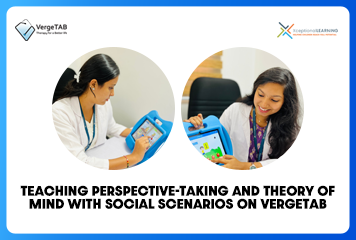
VergeTAB, used together with the XceptionalLEARNING platform, allows schools and therapists to deliver distraction-free, structured digital activities designed specifically to build perspective-taking and theory of mind. This goal-based environment helps children interact with visual social scenarios in a way that strengthens understanding of emotions, intentions, and social responses over time.
This makes VergeTAB a powerful tool for social skill development in special education and autism therapy.
Talk to our team on WhatsApp
Core Skills Developed Through VergeTAB
VergeTAB focuses on practical skill-building. Every activity is designed to target a cognitive function that serves as a building block for perspective-taking. Through guided exercises, children practice the following core competencies:
- Empathy and Emotional Recognition
- Recognizing emotions through facial expressions, gestures, and tone.
- Connecting actions with emotional consequences.
- Predictive Thinking
- Anticipating others’ reactions in social situations.
- Considering multiple possible responses and outcomes.
- Sequencing and Cause-Effect Reasoning
- Understanding the order of events in social interactions.
- Linking actions to emotional or social outcomes.
- Abstract and Symbolic Thinking
- Interpreting gestures, body language, and subtle social gestures.
- Understanding that symbols or expressions can represent thoughts and feelings.
- Decision-Making and Problem-Solving
- Choosing socially appropriate responses.
- Adapting actions based on context.
- Communication Skills
- Expressing understanding of others’ perspectives verbally.
- Building vocabulary for thoughts, emotions, and intentions.
These competencies form the foundation of Theory of Mind and prepare children for meaningful, confident participation in social life.
Have questions about your child’s social perspective-taking or understanding others’ emotions?
VergeTAB offers structured activities that build social reasoning and confidence.
Chat with our team on WhatsApp for guidance
Using Social Scenarios to Teach Perspective-Taking
VergeTAB’s greatest strength lies in its use of social scenarios—digital stories and exercises where children interact with characters, predict outcomes, and practice reasoning. Below are structured activity types, each designed to build a different cognitive skill required for perspective-taking.
1. Observing and Interpreting Social Cues
Objective:
Help children identify and understand others’ thoughts and emotions from verbal and non-verbal signs, such as tone, gestures, and facial expressions.
Sample Activity:
- Animated story: “Riya accidentally bumps into Maya at school.”
- Prompts:
- “How does Maya feel?”
- “What could Riya do to make her feel better?”
- Children can select options, drag-and-drop responses, or type their answers.
Practical Tip: After the digital activity, role-play similar situations in real life. For example: “What happens if someone accidentally knocks over your blocks?” Encourage children to observe classmates’ reactions and describe what they notice.
Skills Developed: Children learn to recognize others’ emotions, understand their perspective, and reason about social situations.
Therapies and Interventions:
- Occupational Therapy (OT): Builds social participation and self-regulation.
- Speech and Language Therapy (SLT): Practices labelling emotions and expressing thoughts.
- Social Skills Groups: Reinforces interpreting others’ reactions in social settings.
2. Predicting Thoughts and Feelings
Objective:
Teach children to anticipate others’ reactions and consider multiple possibilities before responding.
Sample Activity:
- Scenario: “Anna refuses to share her colouring pencils.”
- Prompts:
- “Why might Anna not want to share?”
- “What are three ways to solve the problem?”
- Children select or sequence logical or empathetic solutions.
Practical Tip: Encourage children to verbalize their reasoning: “I think Anna didn’t share because she wanted to finish first, so she might feel proud when she completes the picture.” Reinforce predictions in daily life, e.g., “How might your friend feel if you don’t take turns?”
Skills Developed: Children practice anticipating reactions, making empathetic decisions, and solving social problems.
Therapies and Interventions:
- Cognitive Behavioural Therapy (CBT): Strengthens awareness of cause-and-effect and builds balancing strategies.
- Applied Behaviour Analysis (ABA): Promotes predicting and responding appropriately through structured practice.
- Social and Emotional Learning (SEL): Builds group-based empathy and perspective awareness.
3. Sequencing and Understanding Cause-Effect
Objective:
Help children understand the order of social events and link actions to their consequences.
Sample Activity:
- Story: “A character spills juice, apologizes, and cleans up.”
- Tasks:
- Drag-and-drop steps in the correct order.
- Match each step to the character’s emotion.
- Discuss how earlier actions influence later outcomes.
Practical Tip: Use daily routines (like brushing teeth or packing school bags) to practice sequencing. Strengthens learning with visual schedules or storyboards.
Skills Developed: Children strengthen logical organization, cause-and-effect reasoning, and social planning.
Therapies and Interventions:
- Occupational Therapy (OT): Improves executive functioning and sequencing.
- Cognitive Therapy: Enhances logical reasoning.
- Speech Therapy: Builds verbal explanation of cause and effect.
4. Abstract and Symbolic Reasoning
Objective:
Enable children to recognize subtle social cues and understand that gestures, expressions, or symbols represent internal states.
Sample Activity:
- Scenario: “A character crosses arms and frowns when asked to share a toy.”
- Tasks:
- Identify the character’s feeling: annoyed or frustrated.
- Infer the likely thought: “I don’t want to give this away yet.”
- Suggest possible resolutions: offering a trade, asking for a turn, or expressing feelings.
Practical Tip: Practice interpreting body language in daily life. Use emoji cards, gesture games, or drawing activities to reinforce abstract reasoning.
Skills Developed: Children learn to interpret subtle cues, connect symbols to feelings, and understand hidden intentions.
In real therapy and classroom environments, perspective-taking and theory of mind skills are practiced using VergeTAB in a controlled, distraction-free setup designed specifically for special education and autism support. Schools and clinics use VergeTAB along with XceptionalLEARNING to ensure structured skill development, repeated practice, and measurable progress in social understanding.
See how VergeTAB works in real sessions
Therapies and Interventions:
- Social Skills Training (SST): Builds awareness of peer cues.
- CBT: Connects internal states with observable behaviour.
- SLT: Develops vocabulary for describing abstract emotions.
- Play Therapy: Encourages symbolic exploration in safe play contexts.
Enhancing Engagement on VergeTAB
VergeTAB is designed to ensure children not only complete activities, but also remain engaged and motivated throughout therapy.
- Sensory-Friendly Design
- Gentle animations and audio hints prevent sensory overload.
- Calm interface ensures focus and sustained learning.
- Adaptive Difficulty and Personalization
- Activities adjust to each child’s skill level.
- Encourage safe exploration of multiple responses without frustration.
- Visual and Audio Reinforcement
- Animated sequences and sound cues strengthen understanding of social outcomes.
- Supports vocabulary building and abstract concept comprehension.
- Progress Tracking and Data Insights
- Real-time reports for parents and therapists.
- Activity-specific feedback allows targeted goal adjustment.
This ensures therapy remains structured, measurable, and personalized.
Additional Notes for Parents, Therapists, and Educators
- Pair digital with real-life practice: Skills become meaningful when practiced both on VergeTAB and in everyday life.
- Encourage reflection: Ask children to explain why they chose an answer. This builds reasoning and verbal communication.
- Leverage progress reports: Use XL’s data insights to identify gaps in sequencing, predicting, or abstract reasoning.
- Integrate therapies: A multi-disciplinary approach, including Occupational Therapy (OT), Speech and Language Therapy (SLT), Cognitive Behavioural Therapy (CBT), Applied Behaviour Analysis (ABA), and Social and Emotional Learning (SEL), ensures skills are reinforced across contexts.
Conclusion
Teaching Perspective-Taking and Theory of Mind is not just about showing children what to do—it’s about nurturing their ability to think, reason, and empathize. If your school or clinic is looking for a practical way to strengthen social understanding, perspective-taking, and theory of mind in children with autism or social communication needs, VergeTAB provides a safe, guided, and distraction-free digital environment built specifically for special education and therapy.
Used together with XceptionalLEARNING, VergeTAB helps professionals deliver measurable, goal-oriented digital sessions that support social skill development.
Request a VergeTAB Demo
Talk to our team on WhatsApp for institutional enquiries