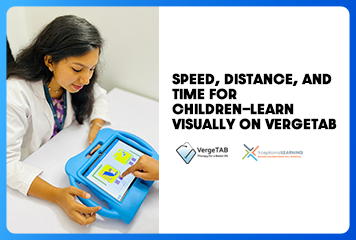
Struggling to Teach Speed, Distance, and Time? How VergeTAB Makes These Concepts Easy to Understand
21 Jan 2026

Speed, distance, and time are ideas children encounter every day, often without realising it. From walking to school, running in the playground, or riding a bicycle, children experience these concepts constantly. Yet, for many children—especially those with developmental delays, learning difficulties, or neurodivergent profiles such as ADHD, autism, or speech and language delays—traditional teaching methods can make maths feel abstract, confusing, or overwhelming. Worksheets, charts, and formulas rarely reflect the real-life relevance of these ideas.
Long before children are introduced to equations like Speed = Distance ÷ Time, they interact with these movement-based concepts naturally—watching how long it takes to walk somewhere, noticing the difference between a short route and a long one, or observing how quickly someone moves compared to themselves. Learning becomes meaningful when children can see, touch, and interact with these ideas.
Without visual and structured practice, children may memorize formulas without truly understanding how these concepts work in real-life situations. This is where VergeTAB, used together with the XceptionalLEARNING platform, is implemented in schools and therapy centers to provide distraction-free, goal-based digital activities that help children visually explore and understand speed, distance, and time through guided learning.
Talk to our team on WhatsApp
Why Visual and Interactive Learning Matters
Children with special educational needs often benefit from seeing concepts in action rather than memorising formulas. Visual and interactive learning helps them:
- Understand relationships: Watching how distance and speed affect travel time
- Learn at their own pace: Pause, repeat, or experiment with simulations
- Reduce anxiety: Playful interactions feel less intimidating than worksheets
- Connect learning to life: Concepts become part of everyday experiences
With VergeTAB, children can drag and move animated characters, adjust their speed, and watch paths of different lengths—all within a safe, focused learning environment.
Chat with our team on WhatsApp for guidance
Distance: Understanding How Far Things Are
Distance is about how far one point is from another. Children often grasp this naturally through movement and observation.
Visual Learning on VergeTAB
- Dragging Characters Along Paths: Children move a character from point A to point B. They can test multiple routes—straight or curved—and visually notice which one is longer.
- Comparing Two Routes: Two paths of different lengths appear on screen. Children follow characters along each path and observe which one takes more steps or time.
- Interactive Maps and Mazes: Characters move through mazes or virtual playgrounds, building an intuitive sense of distance across different contexts.
Hands-On Reinforcement
After experimenting digitally, children can walk the routes physically—one path across the playground and another longer route around the garden. This bridges digital understanding with real-world experience.
Parent / Educator Tip:
Ask, “Which path is shorter?” or “Which one will take longer to walk?” Focus on observation, not exact measurement.
Speed: Seeing How Fast Things Move
Speed is about how quickly something travels from one point to another. Seeing movement visually helps children understand this idea intuitively.
Visual Learning on VergeTAB
- Animated Characters: Two characters move along the same path at different speeds. Children clearly see who reaches the finish first.
- Adjustable Speed Controls: Children increase or decrease speed and immediately see how it changes travel time.
- Trail Visualisation: Characters leave trails behind, making the difference between fast and slow movement easy to see.
Hands-On Reinforcement
Children can walk, run, or push toy cars along the same path and compare the time taken, connecting real movement with what they observed digitally.
Parent / Educator Tip:
Encourage prediction: “If one child moves faster than another, who will reach first?” This supports critical thinking alongside visual learning.
Time: Seeing How Long It Takes
Time can feel abstract, but visual and interactive learning makes it more concrete. Children observe the passage of time without relying on numbers initially.
Visual Learning on VergeTAB
- Digital Timers: When characters move along paths, timers show how long each journey takes.
- Multiple Scenarios: Different speeds and path lengths allow children to compare durations visually.
- Slow Motion & Fast Motion: Children adjust animation speed to explore how time and speed interact.
Hands-On Reinforcement
Children time themselves walking or running the same distances physically. Matching real-life timing with digital simulations helps make time meaningful.
Parent / Educator Tip:
Ask, “Which journey took longer?” Encourage estimation before timing to strengthen reasoning skills.
Integrating Distance, Time, and Speed
Once children understand each idea separately, VergeTAB allows them to combine these concepts through playful exploration:
- Scenario-Based Learning: “One child walks slowly along a short path, while another moves faster along a longer path. Who reaches first?”
- Prediction & Observation: Children predict outcomes, test them on screen, and discuss results.
- Bridging to Formulas: After visual understanding is established, formulas like Speed = Distance ÷ Time feel less intimidating.
Hands-On Application
Children can race on a playground, compare walking versus running speeds, and estimate which route takes longer. Digital simulations support safe, repeated experimentation.
In real therapy and classroom environments, speed, distance, and time concepts are practiced using VergeTAB in a controlled, distraction-free setup designed specifically for special education and therapy use. Schools and clinics use VergeTAB along with XceptionalLEARNING to ensure structured skill development and measurable progress.
See how VergeTAB works in real sessions
Adapting for Different Abilities
Not all children learn the same way. VergeTAB’s blank tablet environment allows for flexible adaptation:
- Simpler Paths or Characters: For children who need reduced complexity, shorter paths and fewer characters help focus on one idea at a time.
- Step-by-Step Animation: Children can pause or repeat actions, ensuring understanding before moving on.
- Colour and Visual Cues: Highlighted paths, contrasting characters, or animated trails make it easier for children with visual processing differences.
Parent/Educator Tip:
Adjust scenarios to the child’s pace. Encourage repetition and exploration, rather than rushing to complete a set task.
Combining Digital and Real-Life Learning
Visual learning on VergeTAB is powerful, but real-life reinforcement ensures long-term understanding:
- Walk and time routes physically
- Use toy cars or balls to simulate movement
- Compare longer vs. shorter paths outdoors
- Discuss the effect of faster vs. slower movement
This hybrid approach helps children truly understand these ideas, not just observe them on a screen.
Benefits Beyond Maths
Learning these concepts visually supports more than academic skills:
- Practical life skills: Estimating time, planning routes, managing routines
- Decision-making: Choosing faster paths or pacing oneself
- Independence and confidence: Navigating environments effectively
- Problem-solving: Predicting outcomes based on movement and time
For children with special educational needs, these functional skills are often more valuable than formulas alone.
Drawbacks and Considerations
No approach is perfect. Consider the following:
- Tech dependence: Requires VergeTAB and XceptionalLEARNING
- Screen time: Digital sessions should be balanced with physical activity
- Limited offline practice: Real-world reinforcement is still essential
- Attention span: Some children may need adult guidance
When used thoughtfully and balanced with real-life activities, the benefits—engagement, concrete understanding, and exploration—often outweigh these limitations.
Tips for Parents and Educators
- Let children experiment freely before introducing numbers
- Use predict–observe–discuss strategies
- Combine digital learning with daily real-life practice
- Celebrate exploration, not just correct answers
- Encourage drawing paths or recording timings for kinesthetic learning
The VergeTAB Advantage
VergeTAB is not just a tablet—it is a distraction-free digital therapy tablet, designed exclusively for XceptionalLEARNING:
- Visual-first learning: Concepts are seen, not just told
- Interactive exploration: Actively engage by choosing paths, movements, and speed.
- Flexible progression: Learning adapts to individual pace
- Practical connections: Concepts link directly to daily routines
- IEP-aligned outcomes: Builds independence, reasoning, and functional skills
Children gain confidence, independence, and a deep understanding of these movement-based concepts, making learning meaningful and memorable.
Bringing It All Together
Children don’t need to memorize equations to understand these movement-based concepts. By watching, experimenting, and interacting, they naturally internalize the relationships between them. VergeTAB transforms learning into a visual, interactive experience, building confidence and independence while preparing children for everyday situations and practical problem-solving.
Take the Next Step
Support your child’s learning journey with a visual and interactive approach. VergeTAB, powered by XceptionalLEARNING, enables hybrid learning across school, therapy, and home.
Contact us today to see how VergeTAB, an Digital Therapy Device for Special Education, makes learning visual and interactive—clearly demonstrating how digital therapy works for confident, independent learning.