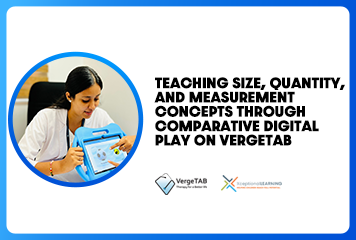
Confused About Big, Small, More, and Less? How VergeTAB Helps Children Understand Size, Quantity, and Measurement
06 Aug 2025

In classrooms and therapy sessions, educators and therapists often notice that children struggle to understand basic concepts like big and small, more and less, and simple measurement. These foundational ideas are essential for early math learning, comparison skills, and everyday understanding.
Traditional worksheets or verbal teaching methods may not give children enough visual and interactive practice to truly grasp these concepts in a meaningful and lasting way.
VergeTAB, used together with the XceptionalLEARNING platform, is implemented in schools and therapy clinics to deliver distraction-free, goal-based digital activities specifically designed to help children understand size, quantity, and measurement through guided visual learning.
Talk to our team on WhatsApp
What Is Comparative Digital Play?
Comparative digital play involves interactive digital activities where children compare items based on measurable attributes such as:
- Size (small vs. large)
- Quantity (more vs. fewer)
- Height, weight, or length
These activities often feature:
- Drag-and-drop sorting
- Animated stacking or filling
- Real-time feedback with sound and visuals
VergeTAB’s exclusive content on the XceptionalLEARNING platform engages learners through touch, motion, sound, and visual feedback, helping them understand deeply abstract concepts in a concrete, engaging way.
Chat with our team on WhatsApp for guidance
Real Applications Using VergeTAB: Activity-Based Learning
Let’s explore how different structured activities on VergeTAB teach key concepts through digital play.
1. Size Sorting Challenge
Objective: Sort and categorize items by size.
How it Works:
- Children drag objects (e.g., apples, blocks) into labeled small, medium, or large baskets.
Skills Developed:
- Visual discrimination
- Categorization
- Vocabulary (small, medium, large)
- Decision-making
Use Case: Perfect for occupational therapy and special education sessions to build foundational sorting skills.
2. Fill the Container!
Objective: Understand volume and estimation.
How it Works:
- Children fill digital containers (like buckets or jars) using objects like balls or cubes.
- Overflow or under-fill feedback helps them adjust and try again.
Skills Developed:
- Quantity estimation
- Cause and effect
- Volume awareness
Use Case: Helpful for learners with impulsivity or autism spectrum conditions in cognitive rehab sessions.
3. Measure It Right
Objective: Teach basic length and unit comparison.
How it Works:
- Children measure two objects (e.g., pencil vs. crayon) using a digital “measuring stick” made of blocks or clips.
Skills Developed:
- Measurement using non-standard units
- Length comparison
- Early numeracy
Use Case: Ideal for early intervention, where children aren’t yet familiar with standard measurement units.
4. Match the Quantity
Objective: Compare group sizes and create equal sets.
How it Works:
- Two groups of items appear on the screen.
- Children determine which has more, less, or if both are equal and adjust accordingly.
Skills Developed:
- Counting
- Visual quantity comparison
- Problem-solving
Use Case: Great for speech therapy sessions involving descriptive phrases like “more than” and “equal to.”
5. Tallest Tower Contest
Objective: Explore height and structure.
How it Works:
- Children use digital blocks to build towers.
- They are prompted to build taller or shorter than visual targets (e.g., “Make it taller than the giraffe”).
Skills Developed:
- Concept of height
- Strategic planning
- Comparative vocabulary (taller, shorter)
Use Case: Used in occupational therapy for motor planning and spatial awareness. “Children don’t just memorize concepts—they experience them.”
6. Compare and Pick
Goal: Quick identification of size or weight.
How it Works: Tap the bigger, heavier, or longer object among two or more (e.g., spoon vs. watermelon).
Skills:
- Visual comparison
- Descriptive vocabulary
- Object recognition
Best For: Speech therapy and cognitive sessions.
7. Equal or Not?
Goal: Understand numerical equality.
How it Works: Adjust two groups to make them equal in quantity. Use expressive language during play.
Skills:
- Basic maths logic
- Expressive language
- Equality concepts
Ideal For: Early cognitive and language development in children with developmental delays
8. Measuring Fun with Units
Goal: Introduce measurements using playful tools.
How it Works: Measure familiar objects using animated worms or cubes instead of rulers.
Skills:
- Unit-based measurement
- Visual tracking
- Counting
Perfect For: Young learners or those new to measurement ideas.
9. Pattern Parade
Objective: Recognize and complete visual patterns.
How it Works: Children observe a sequence of shapes, colors, or objects (e.g., red-blue-red-blue-?) and drag the correct item to complete the pattern.
Skills Developed:
- Pattern recognition
- Predictive thinking
- Attention to detail
- Early math readiness
Use Case: Excellent for cognitive rehabilitation and foundational math instruction, especially in children with learning disabilities or ADHD.
10. Sort & Stack for Size Sense
Goal: Teach size and sequencing through sorting and stacking.
How It Works: Children sort items by size and stack them in order from smallest to largest using drag-and-drop.
Skills Built:
- Size recognition
- Ordering
- Categorization
- Visual-motor skills
Best For: Special education sessions to support early maths, fine motor control, and IEP-based language goals.
In real therapy and classroom environments, these skills are practiced using VergeTAB in a controlled, distraction-free setup designed specifically for special education and therapy use. Schools and clinics use VergeTAB along with XceptionalLEARNING to ensure structured skill development and measurable progress.
See how VergeTAB works in real sessions
Why Comparative Digital Play Works
Here’s what makes VergeTAB-based learning effective:
- Multisensory Experience: Combines visual, auditory, and tactile input to reinforce retention.
- Drag-and-Drop Interaction: Boosts both engagement and fine motor skills.
- Instant Feedback: Encourages trial-and-error learning and builds confidence.
- Self-Paced & Adaptive: Supports individualized learning at each child’s level.
- Controlled Environment: Runs only therapy content via XceptionalLEARNING—no distractions.
- Therapist-Crafted Modules: Every activity aligns with developmental milestones and IEP goals.
From Digital to Daily Life: Real-World Connections
Learning through VergeTAB doesn’t stay on-screen. Children begin to apply these concepts at home and in school:
- Choosing the right-sized shoe
- Pouring without spilling
- Dividing snacks evenly
- Picking the smaller or bigger bag
- Following commands like “Stand in the shorter line”
Tips for Therapists and Educators
- Use real objects post-session: Encourage the same comparisons using classroom tools or everyday items.
- Pair with speech goals: Ask children to narrate what they’re doing—“This cup is fuller than the other.”
- Repeat frequently: Consistent practice leads to mastery.
- Customize sessions: Use VergeTAB’s dashboard to select tasks based on each learner’s pace.
- Track progress weekly: Share growth in concept understanding with families.
Conclusion: From Digital Play to Practical Understanding
Teaching children about size, quantity, and measurement doesn’t need complex explanations—it needs meaningful, hands-on interaction. If your school or clinic is looking for a practical way to help children understand size, quantity, and measurement using a dedicated therapy device, VergeTAB provides a safe, guided, and distraction-free digital environment built specifically for special education and therapy.
Request a VergeTAB Demo
Talk to our team on WhatsApp for institutional enquiries