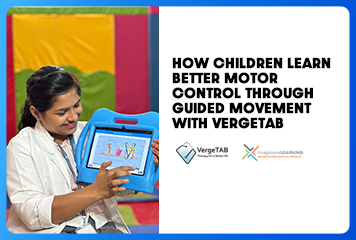
How Children Learn Better Motor Control Through Guided Movement with VergeTAB
24 Feb 2026

Movement is more than action—it is intelligence in motion.
A child steps onto a playground, pauses mid-step, and subtly shifts their balance before climbing a slide. Fingers hover over a pencil, then adjust instinctively to grip it just right. No one told them how to move—it’s their nervous system learning silently.
For children struggling with coordination, movement planning, pacing, or fatigue—whether in classrooms, playgrounds, or therapy—these subtle adjustments reveal the most advanced learning happening inside them.
Adaptive motor control shapes how effort is calibrated, outcomes are anticipated, pace is regulated, and movement becomes efficient across environments. This guide explores how children learn to move with awareness, intention, and adaptability—and how VergeTAB, a digital therapy tablet powered exclusively by the XceptionalLEARNING platform, supports this process through structured digital therapy.
Want to understand how adaptive motor control shapes movement, coordination, and independence—and how structured digital therapy through the XceptionalLEARNING platform can support measurable progress? Connect with our team on WhatsApp for personalized guidance and solutions.
When Movement Learns Before the Mind
The body often understands before the mind can explain.
A pause in the fingers. A quieter step. A subtle shift in balance—each guided by the brain’s ability to predict, adjust, and conserve effort. These moments often pass unnoticed, yet they reflect the most advanced learning within a child: movement guided by awareness rather than instruction.
This is adaptive motor control—not about strength, not about speed, but the nervous system’s ability to sense, plan, correct, and adapt automatically.
VergeTAB, a purpose-built therapeutic tablet that works exclusively with the XceptionalLEARNING platform, transforms these invisible motor processes into structured, trainable experiences. Through carefully designed digital therapy activities, children refine movement from within.
When movement becomes intelligent, independence follows naturally.
Curious how adaptive motor control is strengthened through structured digital therapy?
See how VergeTAB works in real sessions.
Understanding Adaptive Motor Control
More Than Just Motor Skills
Adaptive motor control is a child’s ability to plan, regulate, predict, adjust, and optimize movement in real time. Unlike basic motor milestones, it’s not about completing a task—it’s about how they perform it, when they adjust, and why strategies change mid-action.
Children with strong adaptive motor control can:
- Modify movement without external prompting
- Detect potential errors before they occur
- Adjust speed and effort intuitively
- Conserve energy while maintaining coordination
- Transfer skills across environments
These abilities emerge through structured experiences that challenge the nervous system while allowing self-discovery—the core principle behind VergeTAB’s integration with the XceptionalLEARNING platform.
Motor Calibration: Learning Self-Correction
Motor calibration is often mistaken for accuracy or force control. In reality, it is the brain’s ability to continuously adjust movement based on sensory feedback—visual, tactile, vestibular, and internal signals working together.
Calibration answers constant questions:
- Was that movement too much or too little?
- Should I adjust grip, posture, or speed?
- Did the outcome match my expectations?
Children who struggle with calibration may overshoot targets, press too hard, or rely heavily on adult correction—not due to lack of effort, but because their sensory feedback integration needs support.
On VergeTAB, interactive tapping challenges respond in real time to the child’s force, encouraging self-correction. A child tracing a spiral pattern learns to refine pressure naturally, while another practices tapping letters accurately, building the nervous system’s internal guidance.
Movement Efficiency: Smooth Over Fast
Efficient movement is economical, not fast.
Children with reduced movement efficiency expend excessive energy on simple tasks. Their bodies recruit unnecessary muscles, causing fatigue, frustration, and reduced endurance—even during familiar activities.
Efficiency depends on:
- Smooth coordination across joints
- Minimal unnecessary muscle activation
- Balanced force distribution
- Seamless transitions between actions
Rhythm-based stepping games on VergeTAB guide children to synchronize movements across joints. A child virtually walking along a balance beam or tracing a zig-zag path learns to conserve energy while maintaining accuracy, promoting smooth, efficient motion without explicit instruction.
Developing Somatic Awareness
Somatic awareness is more than proprioception—it’s the internal understanding of how the body feels during movement.
Children with limited somatic awareness may move constantly yet struggle to sense when something feels “off.” This can lead to compensatory patterns, excessive tension, or inefficient posture.
Somatic awareness develops through:
- Slow, intentional movement
- Reduced reliance on visual cues
- Tasks emphasizing sensation over outcome
Through slow-motion digital simulations on VergeTAB, children notice subtle shifts in balance or posture. A child adjusting virtual stacking blocks or tracing shapes on the screen learns to sense effort and alignment, supporting self-regulated, sustainable movement.
Motor Prediction: Anticipating Before Acting
Before a child moves, the brain runs a silent simulation—motor prediction—anticipating outcomes before action.
It supports:
- Adjusting grip before lifting
- Preparing posture before transitions
- Modifying direction mid-movement
When prediction is underdeveloped, movement becomes reactive rather than proactive. Children rely on trial-and-error, appearing hesitant or unsure.
Progressive task variation on VergeTAB strengthens prediction by subtly changing task demands. The brain learns to anticipate rather than guess, leading to smoother, confident movement over time. For example, a child predicting which virtual block to catch next builds proactive coordination skills.
Error Anticipation: Catching Mistakes Early
Error anticipation is the ability to sense when a movement is about to fail and adjust mid-action.
Children lacking this skill often:
- Recognize errors only after failure
- Become frustrated quickly
- Depend heavily on external feedback.
Near-miss maze challenges on VergeTAB allow children to feel deviations and self-correct. A child navigating a virtual obstacle course or balancing on a simulated beam learns internal monitoring and adaptive correction naturally.
Task Pacing Regulation: Controlling Speed Internally
Task pacing regulation is a child’s ability to control movement speed without reminders.
Poor pacing affects:
- Task completion
- Endurance
- Emotional regulation
Timed stacking or sorting challenges on VergeTAB encourage self-regulated speed. Children practice moving at an optimal pace, sustaining engagement without external prompts.
Fatigue Recognition: Listening to the Body
Fatigue is information.
Children who struggle to recognize fatigue may push beyond their limits, leading to drops in movement quality, attention, or emotional regulation.
VergeTAB sessions help children connect internal sensations with performance changes, building awareness, autonomy, and long-term endurance.
Context-Based Motor Adaptation: Real-World Transfer
Adaptive motor control must transfer beyond therapy spaces. Context-based motor adaptation allows children to adjust movement strategies across classrooms, homes, playgrounds, and daily routines.
Through varied digital contexts on the XceptionalLEARNING platform, VergeTAB prepares the nervous system for real-world transitions. Skills become flexible, adaptable, and functional—not fixed or task-bound.
Children can practice everyday tasks digitally—climbing virtual stairs, reaching for classroom objects, or navigating a playground path—helping them generalize these movements instinctively.
VergeTAB and XceptionalLEARNING: A Unified System
VergeTAB is not a general-use tablet. It is a blank, purpose-built therapeutic device designed to work exclusively with the XceptionalLEARNING platform.
This closed ecosystem ensures:
- Zero distractions
- Structured progression
- Consistent therapeutic intent
Together, they transform adaptive motor control from an abstract concept into a measurable, trainable experience—supporting therapists, educators, and families alike.
Why Adaptive Motor Control Shapes Independence
Adaptive motor control is not about perfection—it’s about resilience.
Children with strong adaptive motor systems can:
- Navigate unfamiliar challenges
- Recover from errors
- Regulate effort and fatigue
- Move confidently across changing environments
VergeTAB, operating exclusively with the XceptionalLEARNING platform, supports this journey by building movement intelligence—quietly, consistently, and meaningfully.
When children learn to listen to their bodies, anticipate outcomes, and adapt with confidence, movement stops being a struggle—and becomes a strength.
Take the Next Step
Discover how digital therapy works through structured, therapist-guided activities and interactive learning experiences that help children build adaptive motor control, coordination, and functional skills. Digital Therapy Solutions for Special Education empower personalized learning and measurable progress in areas such as communication, behaviour, and motor development. Learn how the role of parents in therapy enhances outcomes by supporting consistent practice and reinforcement at home. Connect with our team on WhatsApp for personalized guidance on demos, suitability, setup, training, pricing, and tailored solutions designed to meet your child’s or clinical practice’s needs through the XceptionalLEARNING ecosystem.