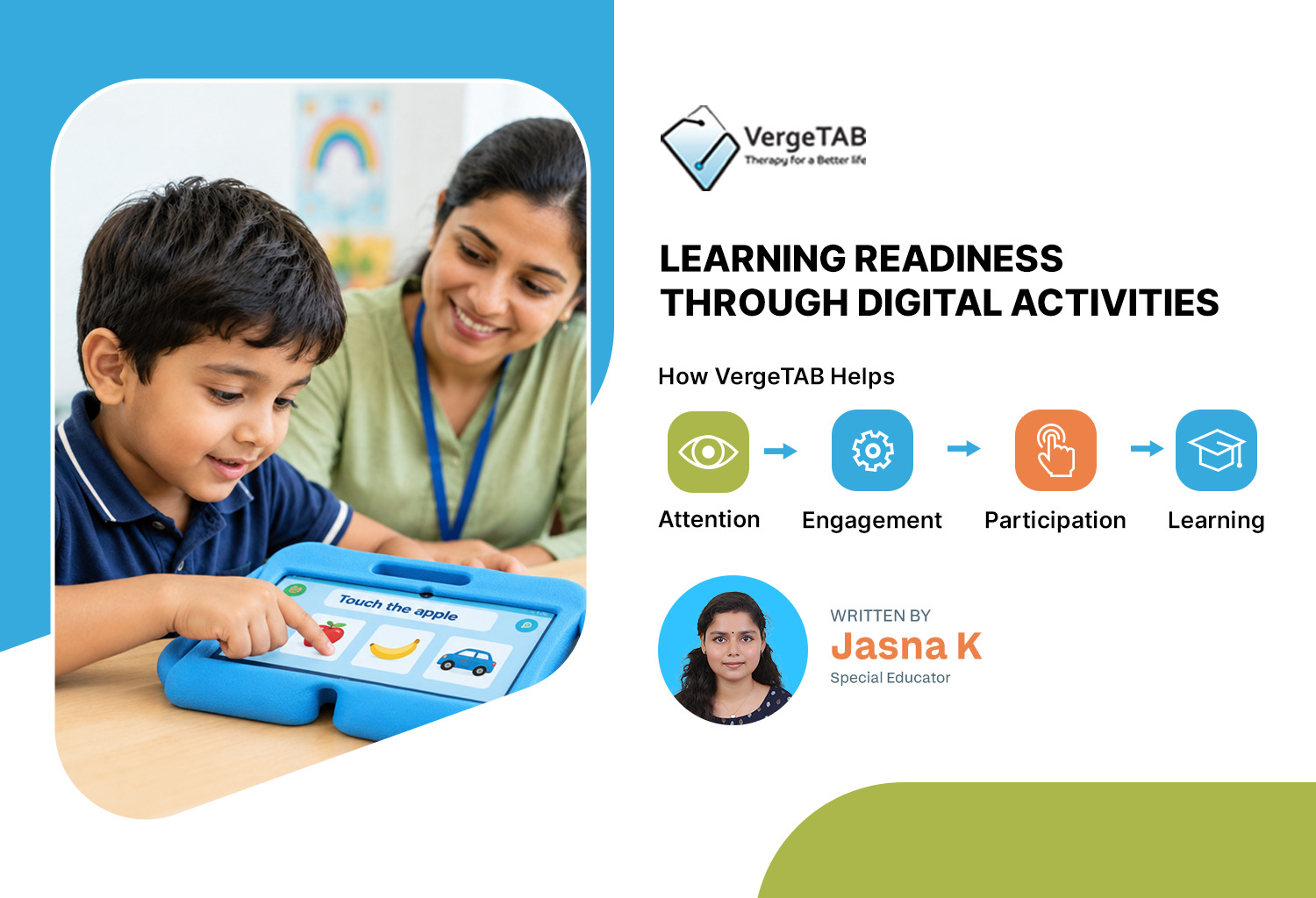
Learning Readiness Through Digital Activities: How VergeTAB Helps
06 Oct 2026

Written By: Jasna K
Special Educator
A child may be sitting in front of a learning activity, but that does not necessarily mean they are ready to learn.
For some children, the challenge comes even before the lesson begins. They may find it difficult to sustain attention, respond to instructions, or complete a simple task. In these moments, expecting the child to start learning straight away may not be the answer.
Perhaps we need to begin with a different question:
What does this child need in order to become ready to learn?
This post is written for parents, special educators, speech-language pathologists, occupational therapists, and others who support children with developmental or learning needs, and who are exploring how digital activities can fit into a child’s programme.
Learning Begins Before the Lesson
Before a child can engage with academic concepts, they may first need opportunities to develop and practise foundational skills such as attention, instruction-following, visual recognition, and task participation.
These skills do not develop in the same way for every child. For one child, sitting with an activity for a few minutes may be a meaningful first step. For another, completing a task with less support than before may be the real milestone.
Progress does not always look like a major achievement. Sometimes it is a child staying with an activity a little longer, or responding to an instruction for the first time. These small moments are often the beginning of a much larger learning journey.
From Screen Interest to Meaningful Participation
Many children are naturally drawn to screens, colours, cartoons, and animations. For parents and educators, this can be a worry, especially when a child becomes intensely focused on screen-based entertainment.
But what if the very thing that captures a child’s attention could also become a pathway towards learning?
The goal is not more screen time. It is about understanding how a child’s interest in digital content can be carefully and purposefully channelled. A child may first open an activity because of its pictures or movement. With guidance and structure, that curiosity may gradually turn into responding to simple instructions, identifying familiar objects, making choices, and completing short tasks.
Over time, the journey may move from:
Interest → Attention → Engagement → Participation → Learning
Every child’s journey is different. Progress may be gradual, and the support each child needs will vary.
Where VergeTAB Fits In
VergeTAB is a locked digital learning device powered by the XceptionalLEARNING (XL) Platform, providing children with access to purposeful, interactive digital activities. Rather than offering open access to digital entertainment, it is designed to keep the child’s digital experience focused on structured learning activities. Through the XL Platform, activities can be selected according to each child’s age, abilities, needs, and learning goals.
The idea is simple: technology should serve the learner.
For one child, an activity may focus on sustaining attention. For another, it may encourage identification, matching, or following instructions. With consistent and appropriate use, the device can gradually become associated with structured learning, not only entertainment.
Supporting the Foundations of Learning
Digital activities can give children opportunities to practise several skills that contribute to learning readiness.
Sustaining attention and engagement. Interactive activities can provide opportunities for children to sustain attention during a task. A child who once moved away after a few seconds may gradually stay long enough to finish a short matching task.
Following instructions. Structured activities give children a chance to listen, understand, and respond. The example below is a composite, not a real child.
Imagine a child who at first taps anywhere on the screen. With a structured activity that asks, “Touch the apple,” and appropriate professional guidance, the child may gradually begin to pause, look, and choose the apple. As the child’s skills develop, the professional can introduce more complex instructions when appropriate.
Visual recognition and cognitive skills. Matching, identifying, sorting, sequencing, and remembering activities encourage children to observe and process information in different ways. A child may first identify familiar objects, then move on to sorting them into categories or recognising patterns.
Hand-eye coordination. Touch-based activities, such as selecting an object or dragging and matching pictures, help children connect what they see with how they respond.
Task participation and completion. Every completed activity, however simple, lets a child experience a task from beginning to end. For a child still developing learning readiness, that can provide an experience of participation and achievement, while encouraging further engagement.
The Difference Lies in Purpose
Screen time alone does not automatically create learning. The value lies in how, why, and for whom the technology is used.
That is why screen-based learning should never be one-size-fits-all. The type of activity, level of difficulty, duration of use, and support provided should all be chosen for the individual child. Some children do best with short, simple activities. Others are ready for longer or more complex tasks.
Digital activities are also only one part of a child’s learning. Meaningful learning happens through people, play, communication, movement, and everyday experiences. Technology is most valuable when it complements these, not when it replaces them.
The screen is only the medium. Learning is the purpose.
A Structured and Controlled Learning Environment
This is also what makes VergeTAB different from an ordinary tablet.
VergeTAB is designed as a dedicated digital learning environment, not a general-purpose device. Features, applications, and services that are not relevant to the child’s learning can be restricted or locked, which helps reduce distractions and keeps the experience focused.
The learning experience is also managed by the professional supporting the child, whether a special educator, speech-language pathologist, occupational therapist, or another relevant professional. Through their XL Platform account, they can:
- Choose which activities are available to the child
- Schedule when activities are available
- Set how often activities are repeated
- Hide, remove, or replace activities that are no longer working
This flexibility matters because every child responds differently, and an activity that suits one stage may not suit the next. When something is not working, the professional can review and adjust the programme so it stays relevant to the child’s current needs.
The environment is structured. The activities are purposeful. The learning experience is individualised.
Every Small Step Counts
Learning does not always begin with reading a word or completing a worksheet. Sometimes it begins when a child looks at an activity, responds for the first time, follows a simple instruction, or completes something they could not complete before.
These small steps are not separate from learning. They are part of learning.
Because sometimes, before a child is ready to learn something new, the first step is simply helping them become ready to learn.
See How VergeTAB Supports Structured Digital Learning
Explore how VergeTAB, powered by the XceptionalLEARNING Platform, provides a structured digital environment for purposeful activities guided by a child’s individual needs and learning goals.