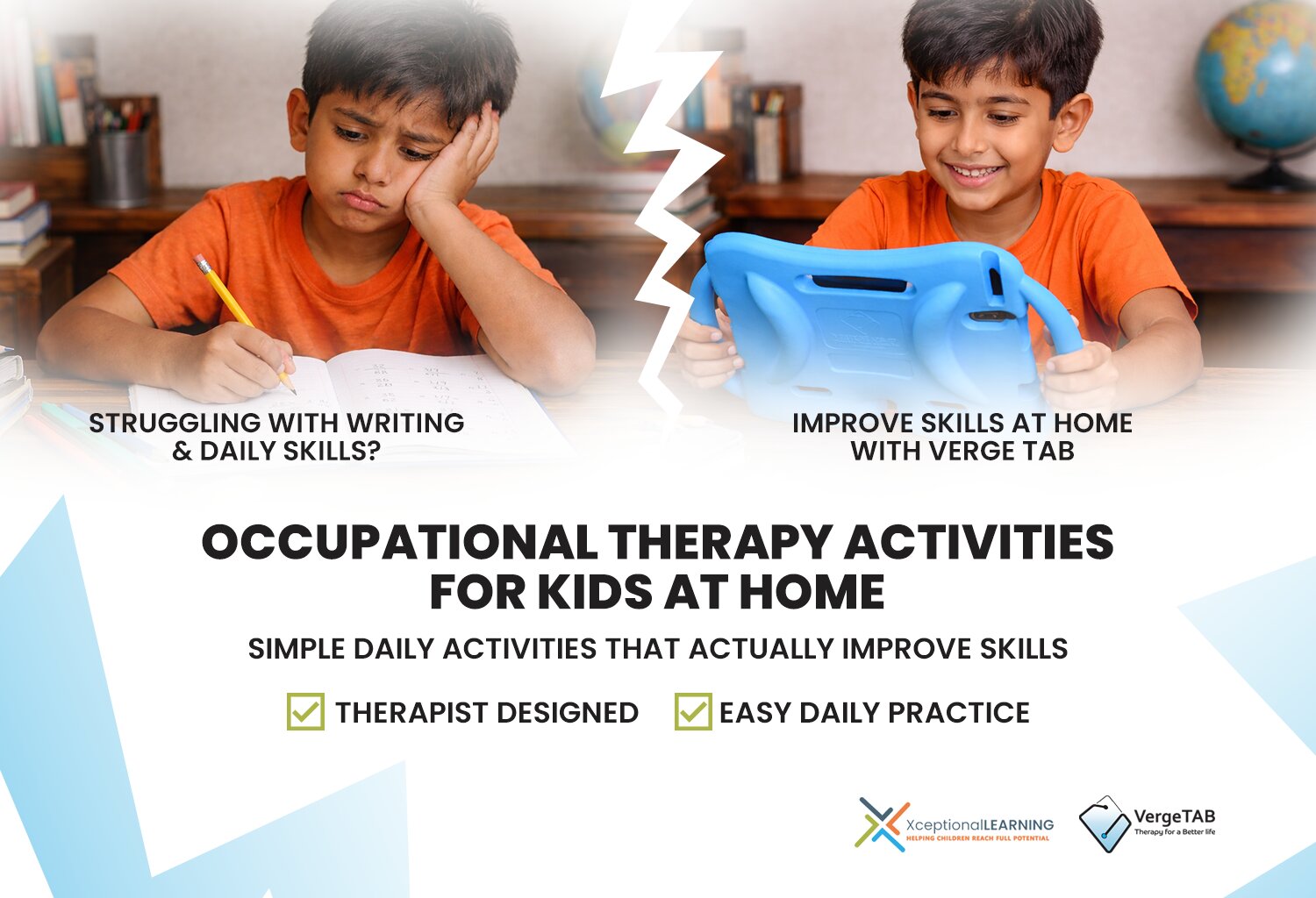
Occupational Therapy Activities for Kids at Home Using VergeTAB to Improve Daily Skills
28 Apr 2026

Fun and Effective Occupational Therapy Activities at Home Using VergeTAB to Build Daily Living Skills in Kids
Is Your Child Struggling with Simple Daily Tasks?
Is your child finding it difficult to hold a pencil, button a shirt, or stay focused during simple activities?
Many parents feel worried and unsure about what to do next. The good news is—with the right guidance and consistent practice, children can improve step by step.
This guide will help you understand simple occupational therapy activities you can do at home—and how to make them work.
Quick Summary
- Occupational therapy (OT) supports children in developing daily life skills like writing, coordination, and focus, promoting independence and participation in everyday activities
- Simple activities at home can enhance fine motor, sensory integration, hand–eye coordination, attention, and daily living skills in children.
- Consistency and structured practice are key to faster progress.
- VergeTAB helps parents follow therapist-designed activities easily at home
- Combining therapy + digital tools improves results and engagement
What Are Occupational Therapy Activities at Home?
Occupational therapy (OT) activities at home are simple, structured, and meaningful tasks that support children’s participation in everyday routines and promote independence.
These activities help children develop:
- Fine motor skills (hand and finger control)
- Gross motor skills, coordination, and balance
- Sensory processing and integration
- Visual–motor integration and hand–eye coordination
- Attention, focus, and self-regulation
- Cognitive and problem-solving skills
- Activities of daily living (ADLs) such as dressing, writing, feeding, and grooming
These activities are especially helpful for:
- Early childhood groups (toddlers and preschoolers), where foundational skills develop.
- Children with developmental conditions such as Autism Spectrum Disorder, Attention-Deficit/Hyperactivity Disorder, and other developmental delays
Why Most Home Activities Don’t Work
Many parents try activities, but don’t see real improvement.
Here’s why:
- No structured plan
- Inconsistent practice
- No progress tracking
Without the right approach, even good activities may not give results.
Every delay in building these skills can affect your child’s independence and confidence.
The earlier you start structured practice, the better the outcome.
Feeling stuck with what to do at home?
Get expert guidance and a clear plan for your child.
Signs Your Child May Need Support
You may notice:
- Difficulty holding a pencil
- Trouble using hands properly
- Avoiding drawing or writing
- Poor coordination
- Struggling with daily tasks like buttoning
This can feel stressful – these signs may indicate the need for occupational therapy support, and early intervention is key to improving functional outcomes.
Simple Occupational Therapy Activities You Can Do at Home
These activities are simple, effective, and require minimal setup—perfect for daily practice at home.
1. Bead Stringing (Beginner)
Age: 2–4 years
Time: 10 minutes
Goal:
Improve fine motor control, bilateral coordination, and finger strength
Steps:
- Provide large beads and a thick thread
- Demonstrate the activity slowly
- Encourage the child to attempt independently
Result:
Improved grasp and hand coordination over time
2. Drawing and Colouring (Beginner → Intermediate)
Age: 3–6 years
Goal:
Develop pencil grasp, visual–motor integration, and hand control
Steps:
- Begin with thick crayons or markers
- Practice simple lines and shapes
- Progress to patterns and pre-writing strokes
Result:
Enhanced pre-writing and handwriting readiness
3. Playdough Strength Activity
Age: 2–6 years
Goal:
Improve hand strength and fine motor skills
Steps:
- Squeeze, roll, pinch, and flatten dough
- Create simple shapes or objects
Result:
Increased hand strength for functional tasks like writing
4. Puzzle Play
Age: 3–6 years
Goal:
Improve visual perception, problem-solving, and hand–eye coordination
Activity:
Start with 4-piece puzzles and gradually increase complexity
Result:
Better cognitive and visual–motor skills
5. Spoon Transfer Game
Age: 2–5 years
Goal:
Develop hand stability, coordination, and attention
Steps:
- Transfer rice, beans, or small objects between bowls using a spoon
Result:
Improved control needed for self-feeding
6. Buttoning and Zipping Practice
Age: 4–6 years
Goal:
Promote independence in activities of daily living (ADLs)
Activity:
Practice buttoning and zipping using real clothing or dressing boards
Result:
Increased independence in self-care tasks
7. Sorting and Matching
Age: 3–6 years
Goal:
Enhance cognitive skills, visual perception, and attention
Activity:
Sort objects by colour, shape, or size and match similar items
Result:
Improved thinking and organizational skills
How Much Time Should You Practice?
The best approach:
- 15–20 minutes daily
- 5–6 days a week
Consistency is more important than doing too much at once.
Quick Improvement Timeline
With regular practice:
- 2–3 weeks: Better hand control
- 4–6 weeks: Improved coordination
- 2–3 months: Noticeable independence
How VergeTAB Helps: A Structured Therapy System for Real Results
Many parents feel confused:
- “What should I do today?”
- “Am I doing this correctly?”
- “Why is my child not improving?”
This is where most home therapy fails—not because of effort, but lack of structure.
What Makes VergeTAB Different?
VergeTAB is more than just a device—it is a structured therapy system powered by the XceptionalLEARNING platform, designed by experts to support children’s development at home.
1. Step-by-Step Guidance
- Clear instructions for every activity
- No guessing or confusion
- Easy for parents to follow
2. Daily Structured Practice
- Simple 15–20 minute routines
- Helps build consistency
- Ensures steady improvement
3. Supports Real Hands-On Activities
VergeTAB does not replace physical activities—it guides them:
- Tracing lines and shapes
- Bead stringing
- Drawing practice
- Buttoning skills
Just like having a therapist at home
4. Keeps Children Engaged
- Interactive learning
- Active participation
- Reduced passive screen time
5. Tracks Progress Clearly
- Monitor improvements
- Stay motivated
- Understand what’s working
Without vs With Structured Therapy
| Without Structure | With VergeTAB |
|---|---|
| Confusion | Clear guidance |
| Random activities | Step-by-step plan |
| Irregular practice | Daily routine |
| No progress tracking | Visible improvement |
See How Structured Therapy Improves Real Skills
This video shows how guided activities improve coordination, focus, and independence in real-life situations.
Want the Same Results for Your Child?
Simple Tips for Parents
- Practice daily
- Sit with your child
- Be patient
- Encourage effort
- Celebrate small wins
Frequently Asked Questions
Conclusion
Occupational therapy activities at home can make a powerful difference in your child’s development. With simple daily practice, children can improve their hand skills, focus, and independence.
But real progress comes from:
- Doing the right activities
- Following a structured approach
- Practicing consistently
The difference between slow progress and real improvement is consistency—and having the right system.
VergeTAB, powered by the XceptionalLEARNING, helps parents follow a clear plan, practice daily, and track real improvement—making therapy at home more effective and stress-free.
Take the Next Step for Your Child
Don’t wait—give your child the right support today with therapist-designed activities, daily structured routines, and clear progress tracking for real, visible improvement
Help your child grow with confidence—starting today.