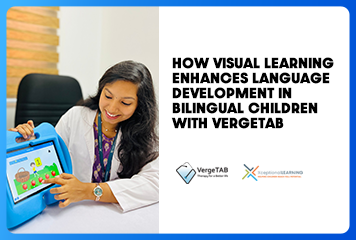
Why Visual Learning Works Better for Bilingual Language Development with VergeTAB
10 Feb 2026

A therapist once described a moment that stayed with her:
“He understood everything I said—but he couldn’t answer.
The moment I stopped asking questions and showed him the task visually, he smiled and completed it perfectly.”
This experience is common with bilingual children.
They are not confused.
They are not inattentive.
They are processing more than one language at the same time.
That is why visual learning, delivered through VergeTAB with the XceptionalLEARNING Platform, plays such an important role in bilingual language development.
VergeTAB is a dedicated therapy tablet that works exclusively with the XceptionalLEARNING Platform. It is intentionally blank, distraction-free, and designed for structured visual learning—exactly what bilingual children need to understand before they speak.
Who This Blog Is For
This guide is written for:
- Parents raising bilingual children are worried about delayed or limited speech
- Therapists working with multilingual learners in clinical or school settings
- Schools aiming to create inclusive, language-neutral learning environments
If a child understands more than they can express, this article is for you.
If this feels familiar, you can chat directly with our team on WhatsApp for guidance on using VergeTAB with bilingual children.
Why Bilingual Children Often Struggle With Verbal-Only Teaching
Before responding to a spoken instruction, a bilingual child may need to:
- Identify which language is being used
- Understand the meaning
- Suppress the other language
- Retrieve the correct word
- Organize a response
- Form a sentence
All of this happens before speech.
To an adult, this pause can look like:
- Confusion
- Non-compliance
- Lack of attention
In reality, the child is doing complex mental work.
When learning depends only on verbal instructions, much of a bilingual child’s understanding remains hidden.
Why Visuals Reduce Language Stress in Bilingual Children
When a bilingual child hears spoken language, the brain often activates both languages at once. The child must then choose which language to respond while suppressing the other.
Visual input works differently.
Images do not belong to one language or another.
A picture of a toothbrush does not demand English first—or Malayalam, Hindi, or Arabic.
It simply communicates meaning.
When VergeTAB presents learning visually:
- Meaning is processed directly
- Language competition reduces
- Cognitive load decreases
- Pressure to respond verbally disappears
This is why many bilingual children appear calmer, more focused, and more engaged during visual-based activities.
How VergeTAB Makes Learning Visual—Not Verbal-First
VergeTAB does not rely on spoken instructions to begin learning.
On the XceptionalLEARNING Platform, children interact through:
- Matching
- Sorting
- Sequencing
- Categorizing
- Drag-and-drop actions
A child can show understanding without speaking.
Language is introduced only after comprehension is clear—not before.
For bilingual learners, this order makes a meaningful difference.
Why VergeTAB Being a Blank Tablet Actually Matters
Parents often ask:
“Why not use a regular tablet with learning apps?”
For bilingual children, this distinction is critical.
Regular Tablets Often:
- Demand constant decision-making
- Introduce distracting visuals and notifications
- Change layouts unpredictably
Each of these increases cognitive load.
VergeTAB, Because It Works Only with XceptionalLEARNING:
- Uses a consistent visual language every session
- Keeps layouts predictable
- Removes non-therapy distractions
This predictability allows bilingual children to use their mental energy for learning, not navigation.
Case Snapshot: How Visual Learning Supported a Bilingual Child
Child: 5-year-old bilingual learner
Concern: Minimal verbal responses during therapy
Using VergeTAB:
- The child was shown a visual sequencing task (daily routine)
- No verbal instruction was given initially
- The child completed the sequence accurately.
Only after understanding was clear did the therapist add verbal labels—first in English, later in the home language.
Outcome:
Understanding became visible before speech.
Over time, verbal responses began emerging naturally and confidently.
What a 15-Minute VergeTAB Session Looks Like
Minute 1–2: Familiar Start
- Child opens VergeTAB
- Same clean, predictable interface
Minute 3–7: Visual Task Engagement
- Matching, sequencing, or categorizing
- No pressure to speak
Minutes 8–10: Language Layering
- The therapist introduces verbal labels
- Can switch languages without changing visuals
Minutes 11–15: Closure
- Clear visual completion cue
- Child experiences success, not correction
One Concept, Two Languages—Without Confusion
The visuals stay the same.
Only the language labels change.
For example:
- An image of eating
- Labelled in English at school
- Labelled in the home language during therapy
This helps children understand that languages are different ways to express the same idea, not competing systems.
Skills Strengthened Through VergeTAB-Based Visual Learning
Visual-first learning supports more than language alone:
- Receptive language – understanding without overload
- Expressive language – words emerge after meaning
- Vocabulary retrieval – faster access using visual anchors
- Narrative sequencing – organizing thoughts visually
- Working memory – holding and manipulating information
- Cognitive flexibility – switching languages smoothly
- Executive functioning – planning, initiation, completion
Traditional Language Teaching vs VergeTAB Visual Learning
| Traditional Methods | VergeTAB Visual Learning |
|---|---|
| Verbal instructions first | Visual understanding first |
| Immediate speech expected | Response through action |
| Correction-focused | Confidence-focused |
| Language-dependent | Language-neutral |
When a Child Is Quiet—but Learning Is Strong
Some bilingual children speak very little in structured settings.
With VergeTAB, these children can still:
- Follow multi-step tasks
- Identify emotions accurately
- Show consistent understanding
Silence no longer hides learning.
What Parents Usually Notice First
Parents often expect speech changes immediately.
What they usually notice first is:
- Improved attention
- Reduced frustration
- Fewer emotional outbursts
- Better instruction-following
These are signs that understanding is growing, even before speech increases.
Why Speech Takes Time—and Why That’s Okay
For bilingual children, silence often means processing.
Visual learning through VergeTAB allows children to:
- Build strong internal language maps
- Organize concepts clearly
- Learn without pressure
When speech appears, it is often more confident and meaningful.
Consistency Across Home, School, and Therapy
Because VergeTAB is purpose-built, children experience:
- The same interaction style
- The same visual structure
- The same expectations
Even when adults speak different languages, the learning environment remains stable.
Beyond Language: Long-Term Learning Benefits
The skills developed through VergeTAB also support:
- Reading comprehension
- Writing organization
- Maths problem-solving
- Classroom independence
For bilingual learners, this means confidence that extends far beyond speech.
Observable Changes Seen Over Time
Professionals commonly observe:
- Faster task initiation
- Reduced frustration
- Improved attention
- Better classroom participation
- Increased spontaneous communication
Final Thoughts
Bilingual children don’t need more talking.
They need clarity, structure, and time to process.
By combining visual-first learning with a distraction-free device, VergeTAB with the XceptionalLEARNING Platform supports bilingual language development in a way that is natural, respectful, and effective.
Discover how VergeTAB, a purpose-built digital therapy tablet, supports bilingual learners across therapy, school, and home through structured visual learning on the XceptionalLEARNING Platform. See how VergeTAB works in real sessions and understand how children learn through action before speech.
Want to See VergeTAB in Action?
Whether you are looking for an institutional setup or a single purchase for home use, our team can guide you.
Talk to our team on WhatsApp for institutional enquiries and purchase support.