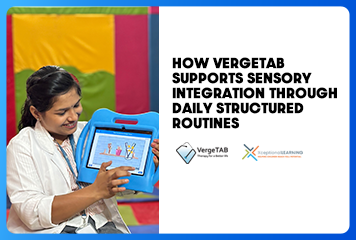
How VergeTAB Supports Sensory Integration Through Daily Structured Routines
04 Feb 2026

Supporting Tactile, Vestibular, and Proprioceptive Processing Through Integrated Sensory Routines
Every child builds their learning foundation through touch, movement, and body awareness. Research shows that strong sensory processing skills support participation, focus, and performance in classroom tasks. Difficulties in tactile, vestibular, or proprioceptive areas often show up as handwriting struggles, poor posture, attention issues, or emotional overload.
A child who avoids textures, loses balance, or presses too hard while writing may be experiencing sensory-processing challenges. VergeTAB, powered by XceptionalLEARNING, bridges this gap with structured touch, tilt, and movement-based activities that strengthen these systems in a child-friendly, measurable way. To understand how these sensory routines can be practically implemented using VergeTAB in your therapy room, classroom, or home setting, you can connect with our team on WhatsApp at +91 89212 87775 for a quick discussion and guided demo.
Why Sensory Skills Matter
Daily-Life Impact
Strong sensory processing helps children:
- Focus for longer
- Follow instructions
- Coordinate handwriting and dressing
- Maintain emotional regulation
Common Challenges
Weak skills may show up as:
- Avoiding textures
- Difficulty balancing or sitting still
- Using too much/too little pressure
- Trouble following multistep tasks
- Getting overwhelmed easily
What VergeTAB Adds
Its guided activities strengthen sensory pathways, supporting independence, confidence, and smoother daily participation.
Overview of the Core Sensory Systems
- Tactile (Touch): Perceiving textures, pressure, vibration, and temperature. Crucial for handwriting, self-care, and exploring the environment.
- Vestibular (Balance & Spatial Awareness): Governs posture, head control, and equilibrium. Strong vestibular skills improve attention, coordination, and movement confidence.
- Proprioceptive (Body Awareness): Provides feedback about joint and muscle position, helping children move with control and force modulation. Supports motor planning and daily tasks.
How VergeTAB Supports Each Sensory System
1. Tactile Development Through Interactive Touch
How VergeTAB Supports Tactile Input
Touch-based tasks improve precision, texture recognition, and finger control.
Examples of Tactile Tasks
- Tracing
- Dot-to-dot paths
- Texture-simulation animations
Featured Activities
1. Pressure-Responsive Trace
VergeTAB responds visually to the amount of pressure applied as children trace shapes or lines, providing immediate feedback for light, moderate, or firm touch.
- Therapy goal: Develop awareness of pressure control and tactile-proprioceptive integration
- Activity focus: Adjusting finger force based on real-time on-screen cues
- Benefits: Improves handwriting readiness, finger strength, and graded motor control
2. Guided Sensory Trace
Children follow a guided pathway that provides varying tactile feedback through visual and movement-based cues, encouraging controlled and adaptive finger movements.
- Therapy goal: Improve tactile tolerance and graded motor responses
- Activity focus: Maintaining consistent pressure and smooth movement while tracing
- Benefits: Enhances sensory regulation, fine motor control, and finger coordination
3. Tactile Sorting Challenge
Children drag and drop objects with different simulated textures into categories, such as soft, rough, or bumpy.
- Therapy goal: Enhance categorization, tactile discrimination, and decision-making.
- The child’s role: Objects appear on-screen; children must sort them correctly.
- Benefits: Supports cognitive skills, attention, and practical touch perception.
2. Vestibular Engagement Through Movement-Based Play
Visual–Vestibular Integration in Action
Moving visuals promote balance, spatial awareness, and controlled eye-head coordination.
Examples
- Follow-the-ball
- Direction tracking
- Slow/fast-moving objects
Featured Activities
1. Tilt-and-Follow Light Trail
Children tilt VergeTAB to keep a glowing trail centred on the screen, integrating visual and vestibular input.
- Therapy goal: Strengthens head-eye coordination and visual-vestibular integration.
- What happens: Children tilt VergeTAB to centre the glowing trail.
- Benefits: Boosts balance, spatial awareness, and visual-motor focus.
2. Step–Pause–Balance Game
VergeTAB provides visual cues for stepping, pausing, and balancing, encouraging children to respond quickly and accurately.
- Therapy goal: Develop postural control, coordination, and attention to movement cues.
- What the child follows: Children follow on-screen prompts while standing or moving.
- Benefits: Builds postural control and movement timing.
3. Vestibular Freeze Patterns
Children follow movement prompts or music until VergeTAB signals them to freeze in specific poses.
- Therapy goal: Trains balance, impulse control, and body awareness.
- How the task flows: The child moves with animated cues, then freezes in a precise posture.
- Benefits: Improves attention, self-regulation, and gross motor coordination.
3. Proprioceptive Activation Through Force and Precision Tasks
Strengthening Proprioceptive Control
Tasks help children practice pressure regulation, movement speed, and alignment.
Examples
- Hold & press tasks
- Force-graded sliders
- Slow vs. fast drag actions
Featured Activities
1. Push–Pull Strength Meter
Interactive sliders on VergeTAB simulate resistance. Children press, drag, or hold to match light, medium, or strong targets.
- Therapy goal: Develop graded force control and muscle awareness.
- What children adjust: Children adjust pressure to meet the on-screen meter.
- Benefits: Supports handwriting, object manipulation, and controlled movement.
2. Big vs. Small Movements
Animations demonstrate large vs. tiny movements for children to replicate physically.
- Therapy goal: Improves motor planning, precision, and understanding of movement scaling.
- What children imitate: Children mimic movement sizes shown on-screen.
- Benefits: Strengthens coordination, body awareness, and movement adaptability.
3. Controlled Push-Release Game
Children press, drag, or hold objects on-screen to match a required speed or pressure.
- Therapy goal: Trains fine motor control, timing, and force modulation.
- How children interact: Objects respond dynamically, giving real-time feedback.
- Benefits: Improves hand-eye coordination, finger strength, and graded motor control.
Why Sensory Routines Matter in Daily Life
Real-Life Skills Supported
- Dressing
- Eating
- Writing
- Sitting upright
- Emotional control
Quick Example
A child who “crashes” into chairs may be seeking proprioceptive input, not misbehaving.
How VergeTAB Helps
- Touch tasks strengthen hand skills
- Tilt challenges support balance
- Force tasks build body awareness
Integrating VergeTAB Into Daily Routines at Home & School
Simple Ways to Add Digital Sensory Breaks
- Short 10–15 minute sessions between classes
- Warm-up routines before handwriting or reading
- Movement tasks for children needing sensory regulation
- Evening calming sessions at home
Why This Works
Consistent sensory input strengthens motor planning, attention, and emotional regulation. Because VergeTAB adapts to each child’s pace, it creates a predictable routine that children feel safe and motivated to follow.
Support Through the XceptionalLEARNING Platform
- Level-based progression
- Easy customization
- Child-friendly visual feedback
- Activity logs that show what works best
Goal Setting & Progress Tracking With VergeTAB
Measurable Improvements Made Simple
With digital insights and session data, parents and therapists can track how sensory skills evolve week by week.
Examples of Achievable Goals
- Increase tracing accuracy
- Improve balance during tilt activities
- Extend sustained attention during tasks
- Increase correct pressure control
Why Progress Tracking Matters
Seeing improvements boosts confidence for both children and caregivers, while adaptive difficulty ensures each child is challenged appropriately—never overwhelmed.
Conclusion
VergeTAB strengthens sensory foundations through structured touch, tilt, and movement activities that enhance tactile, vestibular, and proprioceptive processing. As a Digital Therapy Tablet and Digital Therapy Device for Special Education, it demonstrates how digital therapy works by turning sensory routines into interactive, measurable learning experiences that build focus, balance, body awareness, and emotional regulation.
With the active role of parents in therapy, these guided activities can be continued at home, creating consistency between school, clinic, and daily routines. If you’re looking to buy a digital therapy tablet that supports real therapy goals in an engaging way, contact us today to learn how VergeTAB can support your school, clinic, or child.
See VergeTAB in Action
VergeTAB supports therapists with interactive activities that can be adapted across developmental, cognitive, motor and behavioural goals.